Thursday, September 07, 2006

Distracted by Disney

The Sherman Brothers and Walt Disney sing
about a great, big, beautiful Tomorrow.
Dang! It's late again! I've been distracted all night with the same subject I was obsessing about last night: Disney, specifically Disneyland, more specifically Tomorrowland. I ended up heavily revising a Wikipedia entry about my favorite non-Mary Poppins song by the Sherman Brothers: "There's a Great Big Beautiful Tomorrow." This song, written for the General Electric pavilion at the 1964 New York World's Fair, has the following lyrics:

There's a great, big, beautiful tomorrow
Shining at the end of every day.
There's a great, big, beautiful tomorrow
And tomorrow's just a dream away!

Man has a dream, and that's the start.
He follows his dream, with mind and heart,
And when it becomes a reality,
It's a dream come true, for you and me!


--There's a Great Big Beautiful Tomorrow
by Robert M. Sherman and Richard B. Sherman

Concept art for the contemporary/world of tomorrow
scene in the Carousel of Progress show

As you probably know if you read my Round Robin entry from last night, the most important part of the G.E. pavilion at the World's Fair, the Carousel of Progress, was relocated to Disneyland once the fair was over. It opened at Disneyland in 1967, and was moved to Walt Disney World in 1973, where it remains today.

Carousel Theater, now home of Innoventions, 2005

Another audio-animatronic show, America Sings, took over the Carousel Theater at Disneyland. I don't think I ever saw it. Once it was gone, the building remained closed until Innoventions opened as part of the rededicated "New" Tomorrowland in 1998. John and I were there. Frankly though, Innoventions is mostly a snoozer, with lots of computer games and other non-cutting edge technology.

The one thing I like about Innoventions involves this audio-animatronic character, Tom Morrow, voiced by Nathan Lane in sort of a Charles Nelson Reilly impression. He hosts introductory segments on innovations in sports, transportation, the home, and I forget what else. The cool part is that he sings There's a Great Big Beautiful Tomorrow, with new lyrics by the Sherman Brothers.

It's kind of a sad commentary on the 1998-present version of Tomorrowland that my favorite parts of it are little homages to the Tomorrowland of yesteryear. Here, for example, is a nice display in the window of Star Traders for the 50th Anniversary of Disneyland.


And this is a screen capture of something I found just tonight on the Walt Disney Treasures Tomorrow Land DVD set. Walt and the Shermans made a little film for G.E. before the World's Fair, introducing the song and other preliminary work for the pavilion. When Walt dismisses the Shermans, they go out singing and dancing, with the G.E. logo stuck to the backs of their conservative business suits. Walt hangs around for another three minutes to show off concept art and a scale model of the Carousel Theater. When he finally turns his back to the camera at the end, he too is wearing the GE emblem.

I have to say that I've always been fond of G.E., partly because of our kitchen appliances in Manlius, partly because Joel's dad worked for them and my mom wrote a parody song (Come Back, G.E.) about their employees being transferred to other cities. But mostly, I've always been fond of the company because of the Carousel of Progress and the Sherman Brothers song - and for the sequel show at Epcot, Horizons, which had the slogan, "If we can dream it, we can do it."

Hey, it's something to aspire to!


Technorati Tags:

Wednesday, September 06, 2006

Round Robin: The Way the Future Was

This week's Round Robin Photo Challenge, "Nostalgia," comes from Dorn, author of the blogs Through the Eyes of the Beholder and Dust Bunny Club of North America. As you may know, large parts of my home, Casa Blocher, a.k.a. The Museum of the Weird, are filled with fondly remembered items from the past, ranging from a particular end table from 1960 to vintage Barbies, toys and games. Most of the furniture is midcentury modern or recreations thereof, which is to say furniture that would have been in style circa 1960.

But over the years I've shown you a lot of that stuff, and right now most of it is either in boxes, behind boxes, or under boxes. So I asked John for advice, and he mentioned Disneyland. Well, okay, I've showed you Disneyland before, too, but let's try for a different angle on the subject.


When I was a kid, I used to watch Walt Disney introduce his own program on Walt Disney's Wonderful World of Color. Disneyland was often featured on the show, and I longed to visit the place. But I lived in Manlius, NY, thousands of miles from Disneyland. It was clear that I wasn't going to get there any time soon.


So I made do with watching TV, and displaying one of my most prized possessions on my bedroom wall: a plain map of Disneyland on brown paper, which my parents brought me after they went to California (without me or Steve!) in 1968. John and I have a much older and nicer map of Disneyland (which is horribly difficult to photograph!) than that 1968 guide map I had, but I'll never forget that little brown map.


Was I jealous of my parents for going to Disneyland without me? You betcha! But I loved picking out on the map the one Disneyland ride I'd actually been on. You see, before it got to Disneyland, the G.E. Carousel of Progress was at the New York World's Fair (1964-1965). I was there, and I loved it. So I guess you could say that even at the ripe old age of eleven, I was nostalgic for a Disney attraction I first saw when I was seven years old. But mostly I was looking to the future. Someday, somehow, I was going to get to Disneyland!


Once my Mom moved to Florida in 1976, I got to go to Walt Disney World quite a few times: with Mom, alone, and later with John. Because of this, I'm not quite certain whether I finally got to Disneyland the one summer that my mom lived in San Bernardino. I kind of think not. If that's true, then I didn't get there until John and I had our vagabond year in 1986, in which we spent months traveling the U.S. and Canada. That first night at Disneyland, we saw Chubby Checker perform there, of all people, a nostalgia act if there ever was one. I should probably scan a photo from that trip for you, but they didn't come out well (cheap camera, probably not well developed, either) - and besides, John probably took most of those photos. The one above is from 1998, and could have been taken by either of us.


John loves Disneyland as much as I do, possibly more. He comes at it from a true nostalgic perspective. He was actually there circa 1960, so he has memories to relive when we walk down Main Street USA or go on the monorail. My memories are from TV, from Florida, and from that brown map. John's are the real thing. He's very interested in collecting memorabilia from that era of Disneyland, with pictures of attractions that in some cases have been gone for decades - especially old Tomorrowland attractions. For example, he has several postcards from the Monsanto House of the Future (also called the plastics Home of the Future). It used to stand near where Ariel's Grotto is now, at the entrance to Tomorrowland. I wish I could have seen it! This is stuff I love, too: vintage visions of the way our parents' generation thought the future would look. Even the Carousel of Progress (and its Walt Disney World "sequel," Horizons) tapped into that, happily prdicting that "There's a Great Big Beautiful Tomorrow."


John also collects View-Master reels of early Disneyland. The top left one is a related subject, the New York World's Fair, which had four Disney attractions.


Of course, John and I have made more memories of Disneyland together since 1986. Every time we've gone there, we've had a camera of one sort or another, even if it was a disposable one. So I can show you a ride that hasn't operated since the night we last rode it in 1998: Submarine Voyage. It's coming back sometime in the next year or two with a Finding Nemo theme, but it will never again be what it was.

Karen

Now go see what everyone else is posting on this topic. Better yet, join in yourself!


Linking List

Dorn
Through The Eyes Of The Beholder - POSTED!
http://journals.aol.com/dornbrau/ThroughtheEyesoftheBeholder/

Karen
Outpost Mâvarin- POSTED!
http://outmavarin.blogspot.com

Chris
It's All About Me...I Think! - POSTED!
http://itsallaboutmeithink.blogspot.com/

Carly
Ellipsis...Suddenly Carly- POSTED!
http://ellipsissuddenlycarly.blogspot.com/

TJ
Every Picture Tells a Story
http://tjexpressions.blogspot.com/

Nancy
Nancy Luvs Pix - POSTED!
http://journals.aol.com/nhd106/Nancyluvspix/

Julie
Julie's Web Journal - POSTED!
http://www.barrettmanor.com/julie/journal.aspx

boliyou
Percolation - POSTED!
http://boliyou.blogspot.com/

AscenderRisesAbove
AscenderRisesAbove Studio Updates - POSTED!
http://ascenderrisesabove.blogspot.com/

Suzanne R
New Suzanne R's Life- POSTED!
http://newsuzannerslife.blogspot.com/

Steven
(sometimes)photoblog - POSTED!
http://sepintx.blogspot.com/

Gina
Gina's Space- POSTED!
http://journals.aol.com/rbrown6172/Ginasspace

Valorie
Retrospect USA - POSTED!
http://journals.aol.com/redbird914/RetrospectUSA/

Marie
Photographs and Memories Too - POSTED!
http://journals.aol.co.uk/mariebm56/PhotographsMemoriestoo/

Janet
Fond of photography POSTED!
http://fondofphotography.blogspot.com

Becky
Where Life Takes You... - POSTED!
http://ryanagi.blogspot.com

Linda
Blah Blah Blog - POSTED!
http://blahblahblog.wordpress.com/

Tess
First Digital Photos - POSTED!
http://journals.aol.com/tc01hm/FirstDigitalPhotos/

Technorati Tags: , , , ,

Tuesday, September 05, 2006

Storms, Sunsets and Silhouettes

Your Monday Photo Shoot: Capture something in silhouette. Faces, bodies, trees, buildings -- whatever is attractively shadowed is up for consideration.

The Tucson mountains in silhouette,
as seen from Golf Links and Wilmot.

Aw, heck, John. It feels as if I serve up silhouettes practically every night as it is. Many of my sunset shots have backlit trees, mountains, houses, fences, power poles, or some combination thereof.

That same row of trees turns up in most of my Safeway sunsets.


This tree no longer blocks my sunsets.

There's one particular tree near my house that's in so many shots that I'm a little embarrassed when it appears yet again. Actually, there are a few trees like that. Here's one tree you won't be seeing in newer shots. It's the one that fell on someone's roof, a week after this photo was taken.

That familiar, blobby tree in silhouette.

But what the heck. Van Gogh painted a lot of cypress trees. Is it so bad that I photograph certain trees in silhouette over and over, because they happen to be in my sunset shots?

I thought I'd have a little fun with this one.


This isn't technically a silhouette picture, but it's from tonight and I like it. To the naked eye, the mountains seemed to stand in front of each other in flat layers, like a bad Viewmaster shot.


Here's another shot from back in August, which I played with a bit. It's the tree next door. Don't let it fall on my roof!

Tomorrow: more storm pictures.

Karen

Technorati Tags: , , , , ,

Monday, September 04, 2006

Progress! and Fiddling with the Sunset

I had three goals - no, four! Four goals! - for this weekend.
  1. Sleep! This was my one-word answer to my boss's question about my plans for the weekend.
  2. Catch up on email. At one point last week I was up to 80 unread emails on the one screen name I check every day.
  3. Clean around the house.
  4. Get some work done on Mages.
So, how have I done so far?


  1. Friday night/Saturday morning and afternoon I got about nine hours of sleep. Saturday night/Sunday morning I went to bed at 5 AM and got up four hours later for church. After church I went to bed for six hours. Now it's almost 4 AM again, but I can sleep in. So no points for getting on a reasonable sleep schedule, but I'm doing pretty well on the actual getting of sleep.
  2. Most of my unread email was FeedBlitz alerts, going back to August 8th or earlier. I got through them all. I didn't comment on every blog I read, let alone every entry, but I read through everything except some of the memes. The only blogs and journals I'm still behind on (aside from blogs I don't have on alert) are the ones on my LJ friends list.
  3. I've done almost no cleaning so far, but I have big plans for Monday.
  4. I'm still on Chapter Three of Mages of Mâvarin, but I have made some progress on it, especially while waiting for blogs to load on my dialup connection.

Fiddling With the Sunset

Among the many old postings I read today was one from Julie that I'd somehow previously missed, called "A picture discussion." She wrote about the levels of photo editing that might be used in journalism (not journaling, journalism), ranging from cropping and color correction to more severe and deceitful photo manipulation. It got me thinking about how much I typically do to my pictures, especially sunset photos. Usually I mention when I've boosted color saturation, autocorrected lightened or darkened, but not always. To be honest, I sometimes lose track, especially when I'm editing a handful of similar photos at the same time. For example, here are four versions of tonight's sunset:


This one I boosted the saturation on, but only a little. The original looks very similar. The camera doesn't really capture the colors quite as strongly as my eyes do, so I don't feel too guilty about doing this, as long as it's not too extreme. Or, if it is extreme, I try to cop to it.


This one I pushed the saturation on by "50" (percent?) or so, and then applied an "oil painting" effect. I was trying to do kind of an homage to Maryanne's colorful paintings.


This is the more-or-less unadulterated version of the same shot, other than being cropped to get rid of the cars in the driveway and a tree on the left. I let the flash go off on this, and then switched to sunset mode on the camera.


I think this was Sunset mode, Effect 2. It's cropped, saturated a bit and probably autocorrected, not in that order.

Aww, heck. I don't know exactly what I did to each photo. But you get the general idea.

Karen

Technorati Tags: , , ,

Sunday, September 03, 2006

Wikipedia and Other Neuroses

As obsessive as I've been lately about Wikipedia, it's good to know that there are people who are even more extreme about it than I am - within their particular areas of interest, at least.

Snoopy: not a "real" beagle?

Take, for example, the person who claimed a few weeks ago that Snoopy was originally depicted as brown and white instead of black and white. Here's what this person added to the Wikipedia article on Snoopy:

The original Snoopy books although printed in black and white fetaured colour front covers and show Snoopy as a brown beagle. After the comics went into colour, Snoopy was left Black and White - an oddity as these are not colours that Beagles come in.

Interesting theory, right? Problem is, it's demonstrably false. One editor who keeps a close watch on the article deleted this reference, with a note in the edit summary, "That sounds like baloney to me." When someone else put it back in, "Chowbok" took the trouble to refute the story on the article's Talk page:

I don't believe this is true. See the first three Peanuts books here. The first one's cover was black and white, the second one was color but did not feature Snoopy, and the third one was color and showed Snoopy as white. Please do not re-add this without supporting evidence.

and

See also this painting Schulz made in 1951. The strip was only a few months old, and Snoopy is white with a black spot.

Someone else chimed in with a further bit of info:

Also, Snoopy was based on Schulz's dog Spike, who was mostly white with a few black spots, so it would make sense if Snoopy were colored white right from the start. See this image.

If Snoopy was never brown, why did anyone think otherwise? I think the key is in this phrase: "these are not colours that Beagles come in." Everybody knows that beagles are brown. If Snoopy isn't brown, either he's not a beagle, or someone screwed up somewhere. Or so the theory presumably goes.

That was the end of it for a while, but then, a few days ago, someone changed the initial description of Snoopy from

Snoopy is the name of Charlie Brown's pet beagle in the long-running comic strip Peanuts, by Charles M. Schulz.

to

Snoopy is the name of Charlie Brown's pet beagle-mix in the long-running comic strip Peanuts, by Charles M. Schulz.

Chowbok and everyone else let this edit stand for five days, although other changes were made to the article in that time. Finally someone took it out, stating, "There is no evidence that Snoopy is not a purebred beagle." This is true, as far as internal evidence goes. Snoopy is consistently called a "beagle" for most of the strip's run, and it is never implied that he is of mixed breed. Indeed, one would expect that a dog from a breeder, the Daisy Hill Puppy Farm, would be an AKC purebred dog. But this runs afoul of what people know about beagles in the real world. They don't look like Snoopy. They are brown and black and white, not white with black ears and spots. It seems likely that this edit, like the brown Snoopy edit, comes from a dog fancier who wants to set the record straight on the characteristics of real-world beagles.

I mentioned all this to John tonight. Although John is as much as dog person as I am, he couldn't imagine being so obsessive about dog breeds as to make these sorts of edits to a Wikipedia article. When I pointed out that Snoopy doesn't look much like a real beagle, John pointed out that Charlie Brown doesn't look like a real human, either.

Also, I have it one good authority that real beagles don't battle the Red Baron from atop their dog houses.


Similarly, on August 22nd, someone from an anonymous IP (as opposed to a registered user of Wikipedia) edited the paragraph about the Madeleine L'Engle character Mrs Who to say the following:

Mrs Who

Mrs Who is described as being a plump woman with giant spectacles. She is often seen quoting in different languages such as Latin, Spanish, German, Seneca, and a variety of others. She also quotes William Shakespeare repeatedly. Mrs Whatsit explains that Mrs Who finds it "difficult to verbalize" in her own words.

Do you see the problem with that? Mrs Who quotes in Latin, Spanish, French, Italian, German, and even Greek, but she doesn't quote in the language of the Senecas, an Iroquois tribe from western New York. Mrs Who quotes an historical figure, Seneca the Younger, in Latin, and then translates. Perhaps the person who put this in, twice, should be forgiven for making this mistake. His or her other edits show a level of illiteracy I associate with kids. But anyone who actually looks at that page in the book should be able to see that the quote is not written in a Native American language or dialect.

"Ab honesto virum bonum nihil deterret. Seneca. Nothing deters a good man from doing what is honorable."

So when I took out the Seneca reference, I explained why. Maybe it will do some good.

While I was at it, I took a look at the article on the Senecas. It was a horrible mess. Right in the body of the article itself, which had a section header "Contact with Colonial Minded Oppressors" and was heavily peppered with "citation needed" tags, were remarks like this:

[I find this next section offensive and abusive. As a Seneca, I do not feel that this is "one of the most significant features of the Seneca Nation!" Please read the rest of this with caution as in my opinion it is written by an individual that is anti-Seneca. Thank you.]

What follows is a fairly neutral account of a wrangle between the Seneca Nation and New York State Attoney General over legal issues surrounding the sale of cigarettes.

Now, I'm not in a position to fuss with that article (an admission for which I'm sure John is grateful), since all I know about the Senecas I learned in seventh grade social studies over 35 years ago. But it looks an awful lot to me like the work of people who have a strong interest in one particular point of view, who see anything outside the party line as offensive and an attack. On the other hand, for all I know there may be serious factual errors in the article, and selling cigarettes probably should not be called "one of the most significant features" of the Seneca Nation. I hope someone can mediate a resolution and get the article under control, but fortunately it's not my problem.

I don't even have to worry about a similar wrangle in the Tucson article, about whether the O'Odham origins of the name Tucson should be mentioned in the first sentence (or paragraph) of the article. The discussion of this on the talk page goes on and on. Fortunately for me, however, the question was apparently settled back in 2004.

An Old Tucson "sheriff" and tour guide

I did take a look at another Tucson-related page today, the one on Old Tucson Studios. It seems odd to me that the article doesn't mention even the possibility that the fire that nearly destroyed the place in 1995 was due to arson. (The Tucson article states this as a fact.) I suspect that this has more to do with avoiding the possibility of a lawsuit than any real doubt that the fire was probably set. However, I'm fairly certain that no one was ever charged with a crime in connection with the incident. I didn't fuss with it, but I did add links to the articles on a bunch of the movies that have been made there.

With all the Tucson-related articles, I've been considering the possiblility of uploading a few of my photos to Wikipedia. However, I'm not sure of the rights situation. For example, I had permission to take this picture of an Old Tucson cast member. Does that mean that it's fair use to post it? I'm not sure. I'm not too worried about using it on my blog, but a high profile posting on Wikipedia is another story.

This cloud must have been at least 20 miles across.

One more thing I want to bring up here in this horribly long post before I get to bed, I hope before 5 AM (it's 4:44 now). I got some good cloud pictures on Friday, but it didn't rain until today. Now it's hot and muggy again. Friday the high was 100 degrees. Nope, summer's not over yet!

The huge cloud overwhelms the Tucson Mountains
at sunset, as seen from 22nd St.


Karen

P.S. I did write an installment of The Jace Letters tonight.


Technorati Tags: , ,

Friday, September 01, 2006

Fairness to George, Part Two

A caveat before we get too far into this entry and I say something that might offend somebody somewhere. (Yeah, that about covers it.) To an extent I'm going to be speaking from ignorance - and that's kind of the point of the entry.
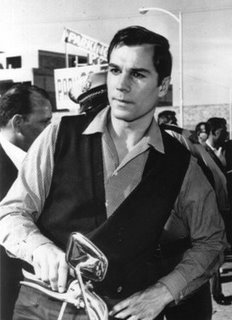
Back in July I promised to write more about George Maharis, the Route 66 star whose departure from the show remains somewhat controversial, some 43 years later. My original entry gives the background about our research for a Route 66 book (which I never wrote), the interviews we did, what I think really happened in 1963 and why I didn't write about it back in 1986. The short version: Maharis insists that he left the show for his health after being hospitalized twice with hepatitis. Executive producer Herbert B Leonard insisted it was a ploy to break his contract and go make movies, and furthermore brought up Maharis's homosexuality and alleged indiscretions, apparently to show that the actor couldn't be trusted. I shied away from the whole issue, and didn't even ask Maharis's co-star, Martin Milner, for his opinion until later.

Personally, I think George Maharis was legitimately concerned that his health was suffering, due to the punishing working conditions he was expected to put up with when he returned to work. He was very angry about it, and did not handle the situation with tact or discretion. The producers were ticked off: he was badmouthing the show and costing them money, just another star behaving badly. I doubt that they ever seriously considered the possibility that George was telling the truth, and that 15 hour days and shooting for hours in winter-cold water really was too much to ask of a guy with hepatitis. Actors who gripe in public are typically assumed to be spoiled and greedy, and Leonard didn't trust Maharis anyway after learning that the handsome young star was not the All-American heterosexual hearthrob the producer thought he'd hired. Aside from offering more money, which they assumed was the real issue behind the histrionics, the producers made no attempt to address Maharis's concerns, so he left the show. It's a tragedy in the classical sense, with hubris and a fatal flaw leading to the star's downfall. Maharis never regained the popularity he had for the first year and a half of his Route 66 tenure.

So George Maharis left Route 66 under a cloud, and with a bad boy image that did not yet have a sexuality component to it. Back in 1963, nobody was talking about which stars were gay, much less attaching a mystique to them as tragic heroes. But Maharis was reportedly arrested in 1967 and 1974 for "lewd conduct" involving men, and in 1973 he posed for Playgirl Magazine. As the LGBT subculture became less underground, these incidents gave the actor a cachet that presumably made him a more interesting and sympathetic figure for some people. He was no longer merely an actor who behaved badly and was struck down. Now he was a tragic, misunderstood artist, a bad boy who came into conflict with straight culture and suffered because of it.

Here we are, then, with multiple versions of the George Maharis story, and multiple perceptions of who he was and is, depending on who is telling the story. Frankly, none of these renditions, including mine, do the man justice. He's not merely an actor who misbehaved, nor the victim of circumstance, nor a gay icon. Well, okay, yeah, he's all of the above, but none of those descriptions provide a complete or accurate picture of him.

So when I first saw the George Maharis article on Wikipedia, I was less than pleased. From an old version of the article:

...the show's appeal declined when Maharis departed after his third year on the series, reportedly due to conflicts between him and Milner over acting styles. Glenn Corbett stepped in as Milner's new sidekick on the road, but a mere year later, in September 1964, Route 66 was cancelled.
For Maharis, a string of film failures followed, including "Quick Before It Melts" (1964), "Sylvia" (1965), "A Covenant with Death" (1967), "The Happening" (1967) and "The Desperados" (1969). To complicate matters, Maharis was arrested....

The two arrests were recounted in detail, but there was no mention of his Emmy nomination, his involvement in the unsuccessful-but-respected film The Satan Bug, the 1970 TV series he starred in, The Most Deadly Game, or his Las Vegas dinner theater gigs in the 1980s. No, the Wikipedia version was, he came from a large family, appeared in early dramas, starred in Route 66 alongside Martin Milner and a bunch of important guest stars, had a brief recording career, left Route 66 for no good reason, made some bad movies, was arrested a couple of times, sang in nightclubs, and does some impressionist painting.

Phooey on that. That narrative may be the one the first people who wrote the article wanted to tell, but it's not very accurate, and it wasn't very fair. So I added more of his tv, movie and Las Vegas credits plus his Emmy nomination, details on his recording career, and a photo that wasn't out of Playgirl. I also brought up the hepatitis, and both sides' claims about why he left the show. Better.

Then one day, as part of a general effort to bring Wikipedia biographies up to a required standard, the following notice appeared on the article's Talk page:

This article must adhere to the biographies of living persons policy as it directly concerns one or more living people. Unsourced or poorly sourced, and especially potentially libellous, material must be removed immediately.

That's when I deleted the references to the two arrests from the article.

Do I think those arrests ever happened? Oh, probably. But the only evidence I found online was an eBay listing for an obscure magazine, which had an article about one of the arrests. That's not exactly an unimpeachable source. To meet the Wikipedia standard, it needs to be better than that.

And frankly, I'm in no hurry to find a reliable source and put that stuff back in the article. The man is a (retired) actor, a singer and a painter. His profession should be his claim to fame, not a few incidents for which he was fined a few bucks. There was a time when George Maharis was a very successful actor in a very good tv show. That should be what's celebrated about him, not what happened in a men's room in 1974.

It's funny how the Internet works sometimes. Earlier this evening, I Googled "Mavarin map," hoping to find the entry in which I posted the map of Mâvarin that turned up recently in one of my old printouts. I wanted to use it in a pirate map generator. Instead I found a Route 66 blog, which did a whole entry about my earlier "Fairness to George" post, called Why did George Maharis leave “Route 66″? (Oddly, Google refused to turn up my entry itself.) After a semi-accurate recap of what I wrote about Maharis, Ron concludes:

I find it a little ironic that a socially progressive show like “Route 66,” which dealt with race and labor issues, didn’t take the high road with one of its co-stars. Then again, this was before the Stonewall uprising that sparked the gay-rights movement.

Yup. I agree. I hesitate to say outright that Herbert B. Leonard was homophobic, and that this was a contributing factor to the misunderstadings surrounding Maharis's departure from Route 66. But based on what we were told in those 1986 interviews, it's a little hard to draw any other conclusion. It really is rather sad. Here was a rising young actor in the role of his life, and it all came crashing down for reasons that had very little to do with the reported ones. Yes, Maharis and Milner had very different personalities and acting styles,but that wasn't the problem. Yes, Maharis probably did get the idea that he was largely carrying the show, and deserved better treatment. But if that's what he thought, there was plenty of justification for it. Maharis was so successful on the show that St. Louis Dispatch TV Magazine called Milner ""The 'Other Star' of Route 66". And Maharis certainly deserved to be treated with as much consideration for his medical situation as possible. Unfortuately, that didn't happen.

Blocher promises to write more about this subject, as she closes her post with “To be continued.” So stay tuned.
 
Done.

Karen

Update: Fairness to George, Part Three

Summer and Monsoon/Some 17 Syllable/Farewells to Them Both

Weekend Assignment #127: Write a haiku saying farewell to summer. A haiku, as many of you know, is a poem of three lines, with five syllables in the first line, seven in the second and five again in the third. Simple and fun, and anyone can do 'em. You can do more than one if you want. As a bonus, technically speaking haiku are supposed to feature seasonal imagery, so we've got that going for us this time around.

Extra Credit: A picture of a fun summer activity you're saying goodbye to for another year.

Aha! Time for more of my perversion of haiku brevity: epic haiku!

Haiku for the Monsoon

Here I sit, sticky
In the Arizona heat,
Well after midnight.


The monsoon hangs on:
Moisture in the cotton clouds,
No relief in rain.

Labor Day, we'll see
Another hot, humid day;
Summer lingers here.


Farewell to summer?
Shall I mourn tomorrow's high -
"Only" ninety-three?


Drawings of storm-clouds,
I will celebrate if you
Fulfill your promise!


Give me cooling rain!
Water my tree in peril,
Half brown, half new green.

Let the pattern change
As worries of drought recede:
Dry air: monsoon fades.


When the sky stays clear,
We'll smile: one hundred degrees
Should come to an end.

Hail, summer monsoon!
I liked the sights you showed me.
Depart now in peace.


My summer fun was taking all the sunset and monsoon pictures.

Karen


Technorati Tags: , , , , ,