Showing posts with label Frank Funk. Show all posts

Sunday, June 16, 2019

Son of Jersey, Scholar of Syracuse


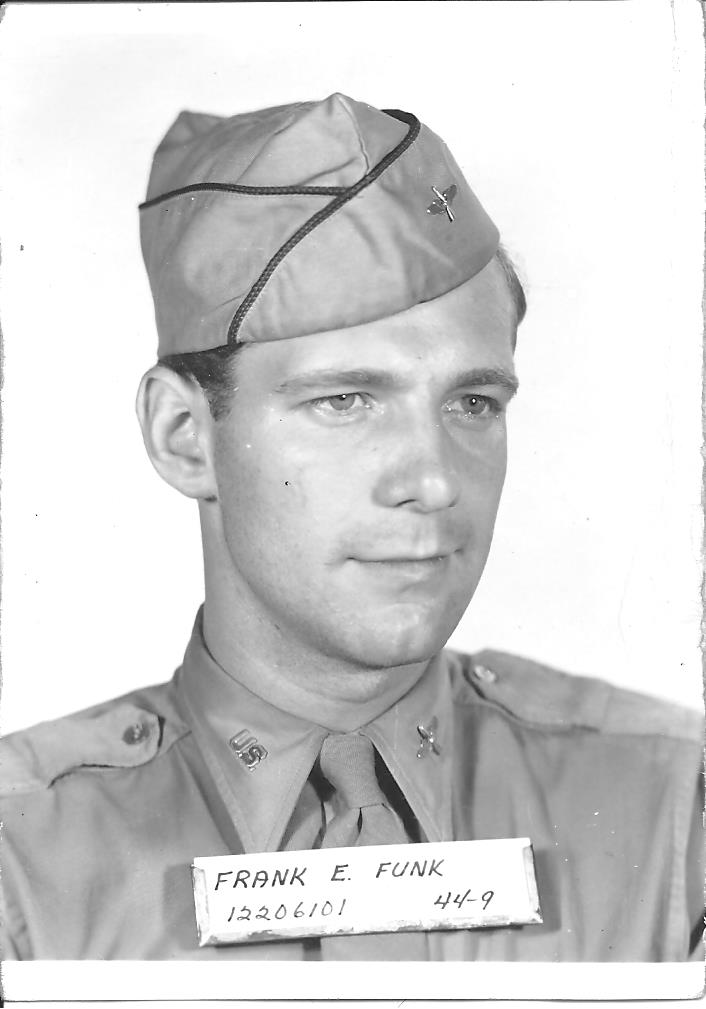
My dad, Frank E Funk, was born in Jersey City and raised in New Jersey, the only son in a family with four daughters. A high school graduate, he initially did't go to college, in part because he knew that war was coming:
I'd gotten out of high school in 1940, and you could tell the war was coming. You know, the march into Poland and all kinds of things. And Britain was in it early and so on. So I was saving money to go to college. Nobody else in my family had gone to college. I have four sisters.
So I didn't go to college. I went to work for a valves company and did all kinds of other things. Eventually, after Pearl Harbor, all young men wanted to get into the service, and most of us wanted to be a hot pilot. I went to get a physical and was rejected because of a deviated septum. I went and got it operated on and went back the same day. And I remember the doctor looked at me and pulled the cotton out and said, "I can't even see, but I can tell you've had an operation done on your nose. Accepted." And then you went to basic training, Atlantic City, then to a classification center in Nashville, where you had all kinds of tests. Then you'd go to the bulletin board, and if your name was on it in the right way, you'd go to an officer's school. If it wasn't you'd go to a gunnery school and be a noncom, or an enlisted man, a gunner. I evidently made it to navigation school at Monroe, Louisiana, and the government spent about $87,000 on each of us and taught us to navigate by the stars, celestial navigation, and then they sent us to Europe. And my sextant to do the star sighting was in a polished wooden box at the corner of my muddy tent in Italy. But if they needed to, they could have sent me the Pacific, you see. So that's the way it was.
He first came to Syracuse, NY in March 1943 as part of his training as a navigator for the Army Air Force. He didn't actually get to Europe until 1944, where he flew seven missions before bailing out of a (probably) sabotaged plane and ending up in Stalag Luft 1. When the prison camp was liberated, he was evacuated to France, where he met General Eisenhower:
Yeah, we were in Marseilles, on a chow line, ready to be shipped out. And usually, by boat, which gave them a chance to fatten us up on the way over to the States. Anyway, the story goes like this. We noticed this commotion, and here comes Ike Eisenhower and a whole retinue of people with him. And he stopped and it sounds like I'm making this up, but I swear, I'm not. He stopped the guy next to me and he said, 
"Where are you from, son?"  
And the guy said, "Kansas, sir."  
"Oh, the hell you are. You know, I'm from Kansas too," and they both laughed. And he says, "Got a question to ask you," says Ike. "Would you rather go home quickly, or in style?"  
And this kid, without missing a beat, said, "Both, sir." And he laughed and moved on. And that's a wonderful memory of a world renowned figure and humanizing. And he was that way with the troops, and it was genuine. You know, it wasn't phony. "Oh, the hell you are. I'm from Kansas." You know, it was like-- it made him very human and special.

Eventually, Frank made it back to the States, and went to college on the G.I. Bill:

When I first got in the service, as so many men were going in soon after Pearl Harbor that the classification center was jammed. So what they did was to send you to a campus in a college training detachment, and I went to Syracuse University. And so, I wanted to go, I knew it, and it was a beautiful city, and I wanted to go back to it, and I did. And eventually, you know, got my undergraduate degree there, on the GI bill. Went to Lehigh University in Bethlehem, Pennsylvania as an instructor, working on a master's. Finished my master's, went to Purdue University to get my doctorate in 1955.

He returned to Syracuse University in 1956, this time as Assistant (later Associate) Professor of Speech. I was born the following year. What I remember of his professorial days was my Mom driving me down to the University on the day JFK was shot, and leaving me sitting in a classroom at the Hall of Languages, drawing headstones.

In 1965, Frank became Assistant Dean at S.U.'s University College. About five years after that, he succeeded Cliff Winters as dean of U.C. He finished his 32-year career at Syracuse as Dean of University College and Director of Continuing Education.

In 1988 he retired and moved to Wilmington NC, where he quickly got involved in the community there, at the local NPR station, the Wilmington Railroad Museum and at First Presbyterian Church. He spent the last few years of his life in memory care here in Tucson.

This funny medieval-style outfit is from a Commencement in the 1970s. Is that Melvin Eggers next to him? Eggers was Chancellor at Syracuse for most of my Dad’s time there.

On this Father’s Day, I’m thinking of my dad, and wondering why I don’t have the same painful reaction to that holiday as I have to Mother’s Day. Perhaps it’s because my dad had a long, good life, my mom, not so much. In any case, this year I've been thinking about all these connections between Dad and Syracuse, NY, and with Syracuse University in particular. Although I moved away from Syracuse in 1979, the choices my Dad made all those years ago still echo through my own life.

Happy Father’s Day to all who celebrate it, whether or not your father is still around.

Karen

Wednesday, August 16, 2017

Frank Funk Vs. the Nazis

 A picture someone posted of Allies storming the beaches of Normandy tonight reminded me of my own dad's World War II experiences. He didn't talk about it much, but he spent time in a German POW camp, and saw the actual, historical Nazis close up.


(Any typos or mispelling are from the quoted source.)

Frank Funk: As a World War II combat vet, I decided I would go [to a class on World War II]. And what was interesting to me is that while I had experiences during World War II, but I had a narrow view of a war, because of my own experiences., flying out of Italy in a B17 bomber as a navigator. But Wilbur's course gave me more of a global sense of that total war, including the Pacific as well as European war and all that.

I flew out of Foggia, which is north of Naples, as I say, in a B17 bomber. After three missions, I think, our plane went down in Czechoslovakia. We were captured by the old guard and taken to prison.
They took us to an interrogation camp where they tried to squeeze what they can out of you. It was an interesting experience, because they understand, if you get isolated and nobody talks to you, then you can play the good cop, bad cop. Bad cop suggests you might leave feet first. And good cop says, "For you, da var is over. Ve is flyers together. Ve understand these things, und have a zigaretten." And I said, "No thank you." 

So an interrogation camp, and then to an officers' camp. See, under the Geneva Convention, officers were not supposed to have to work, whereas enlisted me had to be in work camps. And so I was in Stalag Luft I north, about 60 miles from Sweden, north of Berlin, for seven months I think, seven or eight month. We eventually were liberated by the Russians, believe it or not, and they were very unhappy with us, because our high command had decided that the would keep us locked in, because if they let us scurry around the countryside, people would get in trouble, easily. We were half starved, and if you overate, you could actually die from acute gastritis and stuff. 

Anyway, I'm coming up to my favorite World War II story. So we were finally, after drinking vodka with the Russian high command and radioing frantically to France, we were flown out from a nearby airport to Marseilles in France. So here we are, ex Krieg Gefangeners, was the German name. Krieg for war, war prisoners, on a chow line, watching German POWs go through the line with their trays piled high with food, and we'd eaten sawdust bread and scooped maggots of the top of stew and so on. So that was not a very good thing for us to see, but we had tried to understand. And there was a commotion at the end of the chow line. You could tell from retinue that somebody important was coming along. By gum, it was Ike Eisenhower.

Yeah, we were in Marseilles, on a chow line, ready to be shipped out. And usually, by boat, which gave them a chance to fatten us up on the way over to the States. Anyway, the story goes like this. We noticed this commotion, and here comes Ike Eisenhower and a whole retinue of people with him. And he stopped and it sounds like I'm making this up, but I swear, I'm not. He stopped the guy next to me and he said, "Where are you from, son?" 
And the guy said, "Kansas, sir." 

"Oh, the hell you are. You know, I'm from Kansas too," and they both laughed. And he says, "Got a question to ask you," says Ike. "Would you rather go home quickly, or in style?" 

And this kid, without missing a beat, said, "Both, sir." And he laughed and moved on. And that's a wonderful memory of a world renowned figure and humanizing. And he was that way with the troops, and it was genuine. You know, it wasn't phony. "Oh, the hell you are. I'm from Kansas." You know, it was like-- it made him very human and special. That's my World War II story.

We had a quick home visit and then went to a convalescent hospital in St. Petersburg, Florida. And they had ex prisoners of war go there. They thought that we might have post traumatic stress syndrome. And so they gave us what is called truth serum, to have us talk about horrible things that happened and so on. Well I read recently, that don't assume that everybody has automatically post traumatic syndrome. I don't think I had a lot of it. I saw a guy get shot through the window, because we weren't supposed to be near the windows during an air raid. And somebody was drawing his picture and wanted him near the window for light. I saw a guy get shot because he went after a ball, and he thought the guard had nodded to say, yes you can get it, and the guard didn't. So, you know, and we were starving and all kinds of things. And we were shot at, as we went over targets and saw planes go down and so on. But anyway, then we talked earlier. We came back and got the GI Bill. I'd gotten out of high school in 1940, and you could tell the war was coming. You know, the march into Poland and all kinds of things. And Britain was in it early and so on. So I was saving money to go to college. Nobody else in my family had gone to college. I have four sisters.

So I didn't go to college. I went to work for a valves company and did all kinds of other things. Eventually, after Pearl Harbor, all young men wanted to get into the service, and most of us wanted to be a hot pilot [makes engine noise]. I went to get a physical and was rejected because of a deviated septum. I went and got it operated on and went back the same day. And I remember the doctor looked at me and pulled the cotton out and said, "I can't even see, but I can tell you've had an operation done on your nose. Accepted." And then you went to basic training, Atlantic City, then to a classification center in Nashville, where you had all kinds of tests. Then you'd go to the bulletin board, and if your name was on it in the right way, you'd go to an officer's school. If it wasn't you'd go to a gunnery school and be a noncom, or an enlisted man, a gunner. I evidently made it to navigation school at Monroe, Louisiana, and the government spent about $87,000 on each of us and taught us to navigate by the stars, celestial navigation, and then they sent us to Europe. And my sextant to do the star sighting was in a polished wooden box at the corner of my muddy tent in Italy. But if they needed to, they could have sent me the Pacific, you see. So that's the way it was.

After the war, I used-- yeah, I went back to Syracuse. Oh, I forgot. When I first got in the service, as so many men were going in soon after Pearl Harbor that the classification center was jammed. So what they did was to send you to a campus in a college training detachment, and I went to Syracuse University. And so, I wanted to go, I knew it, and it was a beautiful city, and I wanted to go back to it, and I did. And eventually, you know, got my undergraduate degree there, on the GI bill. Went to Lehigh University in Bethlehem, Pennsylvania as an instructor, working on a master's. Finished my master's, went to Purdue University to get my doctorate in 1955.

End quote.

Yes, it was a different time, but the same Nazi regime that imprisoned my dad also killed millions of Jews, gays and others for the crime of merely existing. The Nazis of yesteryear are now being emulated by twenty-somethings and others who carried Nazi flags, torches and guns in Charlottesville last weekend. Anyone who marched and chanted with such people, some carrying Confederate battle flags, some not, is allying himself or herself with evil. Anyone who equates the counter-protesters (many of them clergy, many of them trying to help and protect others, very few of them violent in any way) with armed and violent neo-Nazis and their allies as "equally to blame" for what happened in Charlottesville is giving aid and comfort to the forces of hatred and oppression.

Karen

Tuesday, August 25, 2015

The Many Obituaries of Dr. Frank E. Funk

If you follow me on Facebook or attend my church, you probably already know that my dad, Dr. Frank E. Funk, died early Friday morning last week. The memorial service in Tucson is this Thursday at 12:30, and the funeral and interment of his ashes will be at First Presbyterian in Wilmington, NC, probably the following Tuesday. even though my dad planned ahead, prepaid his funeral arrangements and had things all organized, there is still a lot to do.

The final arrangements for my dad are an interstate web of communications. My stepsisters are in Vermont and in Phoenix. The cities where people would care that my dad died are Syracuse, Wilmington and (a little bit) Tucson. Tucson obituary ad rates are exorbitant. Even with everything remotely interesting about his life omitted, the Tucson ad will be over $500. The Wilmington one will be much longer, covering his military service, professional career and Wilmington volunteerism. I just sent a  very long, Syracuse-centric version to Syracuse University, where he worked for 32 years, much of it as Dean of University College. And of course, there's always the Internet: my Facebook page, the page of a group dedicated to the 463rd Bomb Group for which my dad was a WW II navigator, this blog, Find-a-Grave and probably my website.

I've lost track of how many versions of the obit my stepsisters and I have labored over these past few days. There were cuts to the Tucson one, to the point at which - oops! - I temporarily left out mention of my stepmother! There was a cut to the Wilmington one to deliberately omit my own mother, who was out of the picture by the time he and Ruth moved there. There were additions to the Wilmington one to mention more of his volunteer and board member work in Wilmington, and to omit all mention of my time with him after he moved to Tucson. And there was a weird hybrid version that I put on Ancestry.com last night, filling in details around the ages of family members at the time of his birth and other genealogical details.

Sometime in the next few days, I'll put together the definitive, kitchen sink tribute to Dad. Watch this space.

Karen

Saturday, May 31, 2014

Round Robin: Age Is Relative

For the Round Robin Challenge: Really Old, I asked to see photos of people, places or things at least 60 years old, and preferably at least a century old. I think I had some idea of photographic historic buildings or old ruins, that sort of thing. But it's been a busy couple of weeks for me, and who am I kidding? When I think of great age these days, I think of my Dad. He turned 91 years old this past February. He probably won't make it to the century mark, but who knows?


My Dad has dementia, and week by week he loses a little more of who he was.  May 10th was National Train Day, and I took him down to the Historic Depot, where an N-scale model railroad layout had been set up in the vintage Amtrak waiting room. This should have been a neat thing for him, because a) he used to be an avid model railroader, working in N-scale, b) he used to be president of the Wilmington Railroad Museum, and c) even in the past month or two he has shown interest in tiny scale models of things. But on that day, he declined to go up to the model train setup and take a look.


 I thought it was because he was tired (and he was), but we were there at least an hour, and he never did agree to get up and look at the trains.


He's also losing his ability to remember some fairly basic concepts we take for granted. On Train Day we also stopped at the Kon Tiki for lunch. He doesn't focus on the menu well enough any more to really choose his own food, and even before this he tended to make bad food decisions, solely on the basis of lowest price. ("No, Dad, that's the wine list. Look at this page where the sandwiches are.") So on that particular Saturday I ordered him a chicken sandwich(?) and a dinner salad. At first he was eating croutons and cucumber slices with his fingers, not having put the salad dressing on it. Thinking he might not want the Italian dressing I'd ordered for his salad, I gave him my leftover thousand island dressing. He promptly spread this on a slice of banana bread and ate it. More recently, I showed him how to crack open a peanut, and more recently still, he didn't understand how to consume a root beer float. He kept stirring and stirring it with both the straw and the spoon, and ultimately ate and drank very little of it.


Some things are still in his head, though, including what a red light means, and the idea that he should sit in the driver's seat. Last Saturday I drove him up to the top of Mount Lemmon - not to Marshall Gulch past the village of Summerhaven, but taking the right fork past Ski Valley and continuing until we reached a road block a few miles later. I don't think I'd been that far up the mountain in 20 years, if ever. We parked in a little lot up there, and Dad chose to get out, only to return to the car after about two minutes - it was too chilly up there for him, and the air was too thin. I was taking pictures and not paying close attention, and when I reached the car, there he was on the driver's side. I told him his was NOT going to drive down the mountain, and fortunately he acquiesced. It's a good thing that I am careful nowadays not to leave the car running or the keys in the car when he's with me and I'm not actively driving.


I found something else last weekend that is also very old. In our library was a food storage bag containing stuff of Dad's that I'd never seen before, presumably out of one of his boxes of keepsakes that we packed up in December 2012. Along with his Bachelor's and Master's diplomas, a very old kid's book, his childhood autograph book (signed by family and classmates) and two pocket New Testaments, I found a pocket memo notebook. In it I found a list of family birthdays, several lists of addresses, and a two-page timeline of Dad's service in World War II. Apparently in 1943 he wrote down when he was sworn in (Dec. 15, 1942), began active duty (Feb. 23, 1943, two days after his 20th birthday), and the four places he was assigned to Stateside in 1943 (Atlantic City, Syracuse, Nashville and finally Monroe LA for flight school). His handwriting is different on the next page, where he recorded that he entered advanced navigation school at Selman Field, LA on Feb. 27, 1944 ("approx," he says), graduated July 3, 1944 as a Navigator-Flight Officer, experienced a Delay en Route, and finally reported to Lincoln Army Air Base, Lincoln NB, July 14, 1944.

He never got around to recording in this memo book when he got to Foggia, Italy, his seven missions, his capture and imprisonment at Stalag Luft One, his liberation in mid-May 1945, his return, hospitalization and discharge. I know from his Library of Congress Veteran's History Project page that he was with the 772nd Squadron, 463rd Bomb Group, but it's not something he ever talked about in my presence except on one memorable (for me!) day in January 2011. He also did a long interview and a living history recording around 2010, so there are some records of what my Dad did all those years ago. Which is good, because he mostly doesn't remember being a veteran at all.


As old as Dad is, he's not the oldest person I've known. My friend Margaret is two weeks older and in much better shape cognitively, and years ago my other friend Eva made it to age 104. But even that great age is pretty ephemeral compared with the mountains I love to drive on, or this planet we keep endangering.


But human life has meaning, and each individual life has meaning, even after 91 years, when brain function falters and much of who the person was has been lost. He's still my Dad, and he still is glad to see me each day. And I still love him.

Karen

You know what? I bet Carly's entry this week is much more cheerful than mine....

Linking List
as of May 31st, 2014, 2:53 AM MST

Karen - Posted!
Outpost Mâvarin
http://outmavarin.blogspot.com

Carly - Posted!
Ellipsis
http://ellipsissuddenlycarly.blogspot.com

Sunday, September 22, 2013

A Prisoner of Conscience


Today I drove my Dad up Mount Lemmon. There was an Octoberfest at Ski Valley at the top, but when Dad saw the $5 parking fee he declined to attend at all. So we made a brief detour to Marshall Gulch beyond Summerhaven, and then drove back down.


On the way down, we turned in at the Gordon Hirabayashi Recreation Area, but the gate was closed perhaps a hundred yards in. There was a fire in the area in July, and apparently it is not yet safe for visitors to return. The prison camp ruins are still accessible, but we didn't stop for that. I have previously taken pictures, though.


As we turned toward Tucson, I tried to tell my dad about Gordon Hirabayashi, a college student who committed civil disobedience in response to racist policies (curfews, interment camps and a required loyalty oath) applied to Japanese Americans during World War II. From what I've read, he actually asked to have his sentence for breaking curfew extended so that he could serve his sentence at the Federal Honor Camp on Mount Lemmon, where conscientious objectors, deserters, and illegal immigrants were put to work building Mount Lemmon Highway. The government refused to pay Hirabayashi's way to Tucson, so he hitchhiked here and showed up at the camp. Even then, they didn;t have the proper paperwork to incarcerate him. They sent him back down the mountain, where he took in dinner and a movie before returning when they were ready for him. Hirabayashi later argued his case before the Supreme Court and lost. It wasn't until the Reagan era that the government finally admitted wrongdoing in the wartime anti-Japanese hysteria and apologized. Hirabayashi became a sociology professor, and attended the renaming of the prison camp ruins in his honor in 1999. He died in early 2012.


Great story, but my dad wasn't listening, partly because he has a cold and his ears are stopped up, so he was extra-deaf today. But after I dropped him off at his place and drove away, I was pleased to hear Gordon's story retold on the local radio show Arizona Spotlight late this afternoon. They were supposed to post something about it online, but they haven't yet done so.


Karen

Saturday, September 14, 2013

Just a short note tonight

I think I've gone as far as I can at the moment with this business of writing about my Dad, at least on a day-to-day basis. I've pretty much said what I wanted to say, and complaining about the situation every night doesn't help. There aren't that many things that happen to my Dad on a given day, nor things he does and says that are substantially different from what he did or said the night before.

Tonight he has a cold. Also, the bump on his hand is actively hurting now, not just being annoying. But that's the sum total of news.

I'm going to try to keep up on the blogging, but it's best that I find other things to write about besides this one depressing area of my life.

Karen

Thursday, September 12, 2013

progris riport


Tonight when I went to see my Dad, he was napping in his lift chair, which he's never learned to operate other than just sitting in it. (Not that he needs the lift function, but I'm sure he's unaware that there is an electric motor or a remote control.) The room was dark, and for a moment I didn't think he was even in the room.

I turned on the light, and he was glad to see me. He told me about things he wanted to get done: a manicure, ear hairs trimmed, nose hairs trimmed, a shave that isn't really needed at the moment, and trimming of his already neat hair. He's constantly frustrated that he can't find scissors, razors and clippers sitting around - except when they are, because someone forgot to lock something up. When he does find a razor or scissors he always ends up mildly injuring himself, but he doesn't understand or remember that. Neither does he understand when I explain that having these tools accessible is against the rules, that he's not allowed to shave himself. I tell him that the caregivers do have the tools and it's their job to shave him and trim his nails. He only has to ask. Dad's response is basically to shrug and indicate that he has no idea what I'm talking about.

Dad also did a little inventory of the things on his little table, pointing out to me a water bottle, half full and with the cap on; his glasses case, in which he keeps both his glasses and a small black comb; and a white handkerchief. He had pulled the handkerchief from his pocket along with the pocket lining, which was poking out of his pants, completely inside out. He seemed to think he needed to remove the lining before the pocket would be truly empty. I told him it was okay to push it back in, and did so for him.

I also tried, two or three times, to explain that the nurse practitioner had not frozen the wart or lesion off his hand yet because she wanted me to sign off my permission for this minor surgery, which I did tonight. All he did was push against the bump and explain that was the best he could do with it.

This is a man who was a PhD, a college dean. Now he doesn't know how a pocket works.

As I pulled out of the facility's parking lot, it occurred to me that I'm living in a rewrite of "Flowers for Algernon" by Daniel Keyes. In case you're unfamiliar with the story, let me explain. It's a science fiction tale of a mentally challenged man who receives an experimental treatment, as does a rat called Algernon. Over the course of a series of progress reports, Charly becomes more intelligent, to the point where, as a genius, he takes over the research into his own case. The rat dies, the research fails, and Charly ends up back where he started intellectually.

My dad's case isn't science fiction. There is no experimental treatment on offer. Over the past few years he has slid further and further, from near-genius level intellect to an utter inability to understand anything beyond the most concrete facts. But I know that somewhere out these in the world, researchers are working on understanding how Alzheimer's does its damage, how other forms of dementia arise, and what can be done about it. None of that is going to help my Dad. At the risk of being selfish, though, I hope to God they find some answers in time to keep me from losing the ability to understand what a pocket lining is.

Karen

Wednesday, September 11, 2013

No Entry

There will be no entry here tonight, other than this notice that there's no entry. I've been uo way too late, way too many nights in a row, to tackle a significant bit of writing at 1 AM tonight.

But yes, I saw Dad, and no, nobody's taken that wart thing off his hand, yet, but the nurse I like and trust is going to try again to bet it taken care of. Dad again described a series of occurances, vaguely but at some length, which I eventually figured out were tv shows he had watched. He does that - he gets invested in a tv show even if he doesn't understand what's going on, trying to help the people on the show accomplish whatever it is they are doing.

At the vet's office two weeks ago
 
The dogs had a busy day - hanging out at St. Michael's and visiting the park behind it twice, with two trips to PetSmart later in the day. The afternoon trip was a private lesson for Cayenne, with Kito tagging along. The evening one was a class for Kito in a group session. Kito was so frightened of going to PetSmart without Cayenne that he refused to get in and out of the car, and peed on the seat cover. But the "lie down" command that he completely failed to do in class was one he accomplished easily once he was safe at home with Cayenne.

Tonight I also worked on the 60th Anniversary issue of The Messenger - not the 60th of the publication, but of the church the publishes it. More on that later.

Karen

Tuesday, September 10, 2013

Welcome Home, Computer!

I got my computer back tonight, after work, after visiting Dad, but before picking up chicken wings for dinner at 8 PM. So far it seems to be fine. I've spent the evening setting it up, answering some email, updating the church's music page, and tweaking the photos in entries made over the weekend using my iPhone. Smartphones are wonderful things to have, but they are still extremely clunky to use for conventional blogging.

Monday has come and come, a day when a visiting nurse practitioner was supposed to freeze off a growth (a wart?) on my Dad's hand. It's still there. I've repeatedly requested that somebody do something about it, but I suspect that the visiting medical people mostly ignore the notes from the facility's nursing staff, let alone secondhand requests from family members of residents. But I'll keep trying. Also, where are the other seven pairs or so of my dad's pants? Thursday is his laundry day, and half his laundry doesn't seem to have made it back to him room yet. It's hard to check on all this stuff when I don't get there until after 7 PM, when everyone is gone for the night except for the evening caregivers.

Other things I want to discuss with someone there when I can include Wil's suggestion about posting Ruth's obituary, and what and how he is doing with scheduled activities. I have tried to get him involved with drawing things and he isn't interested. I took him into a hobby shop with train stuff and he wasn't interested. A few days ago he apparently was involved in some sort of craft project, but I was completely unable to deduce what it was he was trying to do or make, and what went wrong. Whatever it was, I don't think he finished it. But I'd still like to find something he can do besides watching tv without comprehension, looking over newspapers, going to meals, going out with me and obsessing about his facial hair. That's his world right now.


Karen

Monday, September 09, 2013

Travels With Frank: The Small Stuff

I didn't get my computer back today. In fact, I haven't heard a word from Staples since I prepaid for the servicing. I hope they didn't forget that I came in and paid, and that the computer isn't impossible to clear of malware. I should have called today, but forgot until after Staples' closing time.


So let me just post a few photos with a brief explanation. My dad is very interested in visual detail, something he's still capable of as words and concepts and memories of past and present increasingly elude him. Before the strokes and Ruth's death, he used to build extremely detailed Model railroading layouts in N-scale, the smallest of the commonly available sizes for such things. I'm told that he used to paint even the faces of tiny people inside the N-scale school buses and the like!


So today, when I realized that the Gadsden-Pacific Toy Train Operating Museum reopened today after bring closed all summer, I took him down there for a very enjoyable 45 minutes or so. I just wish there was a way to get him involved in working on such things again, instead of just looking at them. But I suppose that's asking far too much if him at this point.


Karen


Sunday, September 08, 2013

Travels With Frank #7: Wandering the Desert

Saturday is my day to take my Dad out for "lunch and adventures." I had an idea today that I might try again to take Dad down to Bisbee, Arizona, but it was raining and the check engine light is on on the Prius, so...no. We started out east on I-10, but I pulled off at the exit for Vail and Colossal Cave. We drove down to Colossal Cave at the very end of Old Spanish Trail. At the entrance I asked whether there is anything to do there on a rainy afternoon with a man of limited mobility. Not really, was the answer, because "it's mostly all stairs in there." In the cave, I presume. Stairs. Go figure.

So I drove up Old Spanish Trail, and we took the loop road in Saguaro National Park East. Dad kept asking how long the loop was. It's only 8 miles, but with a speed limit of 15 mph on a one way road with steep hills and hairpin turns, it takes a while. Dad was bored. He's not very interested in nature. He'd rather have lots of signs to read, and traffic to keep an eye on. "How much did this cost?" He asked, with the implication that it wasn't worth it. But it was free today. The first time we went there, I got a lifetime Golden Age pass for a pittance. It gets us into National Parks, Forests and Monuments for the rest of Dad's life.

Saguaro National Park East.

After that we stopped by St. Matthew's Church briefly, where I work on Thursday afternoons, and then went on to Amber Restaurant on Tanque Verde. Tucson apparently doesn't have a German restaurant but it has two Polish ones. Amber's pierogies, red cabbage, sauerkraut and sausage are all quite good.

Ice cream at Amber Restaurant.

To finish up the afternoon we followed Tanque Verde until it turned into Redington Rd, and that until it became the rough dirt road of Redington Pass. On the way back I drove around the parking lot of Agua Caliente Park. Again, Dad wasn't interested, except in the people in the parking lot. He thought I should ask a woman in the parking lot, but I don't know what the question would have been.


Oh, and Dad asked again today about his wife. Once I realized that he really did mean Ruth, my stepmother, I told him again that she died of cancer last year. I said that Ruth told me before she died that she always thought she'd be there to  care for Dad, which is true. Then I said Ruth passed on that responsibility to Jan and me, which is something she didn't actually say out loud to me. But it's true anyway. Dad smiled and laughed, and asked no more questions.

Redington Pass.

Twists and turns.

Karen

Saturday, September 07, 2013

Round Robin: Odd Behavior

For the "Round Robin Challenge: That's Odd!, I was counting on having, at the very least, access to my computer, with its thousands of recent and archived photo files. But my computer went into the shop yesterday, badly infected with some pretty devastating malware. So the only photos I have for tonight are whatever I can photograph tonight with my iPhone, whatever happens to be on my iPhone already, and whatever is already online. The latter category would smount to reruns, so let's stick with the first two options. As it happens, there's something I can show you that fits the topic two different ways, and illustrates something I wanted to write about anyway.

  
Above you see an odd number of newspapers: three to be exact. My Dad had them in the seat compartment of his walker tonight. After mentioning them several times - not by name; he seldom finds the right noun - he pulled them out and showed them to me. When I offered to take them and recycle them, something I do a couple of times a week, he gave them to me.

He then showed me how he had them in date order, with the dates circled in ink. He had put each one together with a rubber band around it. When he tried to show me that the Thursday paper had a calendar section, that newspaper's rubber band broke. Dad fretted and apologized. 

"It doesn't matter," I told him.

At this stage in his life, my Dad has no idea what I do with the newspapers, what recycling is, that the order and condition of the papers don't matter, that the rubber bands don't matter. He probably thinks, if he has any theory at all, that I take them home, read them, and file them carefully away in date order. This is despite the fact that he often sees newspapers floating around in my car.

I do think it qualifies as odd behavior, the care he takes over these newspapers, circling the dates and keeping them neatly arranged in perfect order, only to relinquish them to me. But the need to be methodical and organized has been part of my Dad's behavior for decades. When I was a kid, my Dad had a numbered list for each family member's Christmas presents - with the corresponding number - K-5 or S-11 or whatever - written on the bottom of the gift's meticulous wrapping. One year when we left on vacation, my Dad checked off three lists - stuff to pack, and the order in which to load them in the car; things to be done to keep the house safe, such as stopping the mail and turning off the thermostat - and I forget what the third list was!

Anyway, that's my main odd photo for the night, showing an odd number of oddly marked used newspapers, oddly obsessed over by an old man. But I can show you two other oddities, if you like. I photographed them 15 months ago - for an identical Round Robin topic, it turns out!


Now let's see what other oddities people have found!

Linking List
As of Saturday, September 7th, 12:17 am MST

Karen
Outpost Mâvarin
http://outmavarin.blogspot.com
http://www.facebook.com/mavarin

Carly
Ellipsis
http://ellipsissuddenlycarly.blogspot.com

Karen

Friday, September 06, 2013

Travels With Frank #6: Inanimosity

This morning I got a call from a friend at St. Michael's, who is working with me on preparations for the church's 60th anniversary celebration later this month. We compared notes on how busy we are and how much sleep we're not getting. When I mentioned that Dad appeared not to know who I was last night, she told me not to worry. "That's just sundowning. Your dad is fine." Apparently, being more confused and memory-impaired at bedtime is a known phenomenon for dementia patients. What a relief!

So I carried on with the day, taking my computer and two external hard drives to Staples to get rid of the ransomware and adware. It's going to take 72 hours and $150 to get it done, but the work is guaranteed. John is unhappy. He's sure I must have been careless somewhere along the line. I really don't think so. The only things I can think of are opening apparently real but lesser-known genealogy sites, and a suspicious ad I tried to decline, not open, on a major site that should have been safe. And Norton 360 was running the whole time.

I dropped off the computer and went to work at St. Michael's, where my financial software stopped communicating with the server at one point and I had to reboot. Then I struggled to print some fliers, which looked exactly the same whether set for color or grayscale printing. (It turned out all four ink cartridges were on empty.)

As I prepared to leave for my third job, the Staples tech called, apologetically, to say he forgot to collect the fee in advance, without which they weren't allowed to start work. I went back over and took care of it, so the clock could start running on the 72 hours. Years ago, before iPads and iPhones, giving up my computer for three days would have been a major inconvenience. As it is, I'm writing this blog entry on my phone, which is less than ideal but doable. The thing I really need a computer for, scanning material from the church archives, I would (and will) do on my computer at church in any case. The matter of the computer being missing from my office at home seems strangely unimportant.

But what is it with me and computers today? At St. Matthew's this afternoon, I was about a minute from finishing the data entry on the weekly deposit when QuickBooks crashed with an "unrecoverable error." Really? Et tu, third recalcitrant computer of the day? Years ago, John coined a word, "Inanimosity," to describe the apparently hostile behavior of inanimate objects. That's what I experienced today.

And so did my Dad, as far as I can tell. Tonight he seemed to have no trouble knowing who I was (I got there by 6 PM) and launched into an attempted description of his day. He seems to have almost accidentally joined in on a group activity, some kind of craft project. At first he thought he had what he needed to start putting things together, but later on he felt he needed more of some things but there wasn't any more, or nobody gave him any more, and he decided he wasn't really part of the group activity after all. At least, that is my best guess about what he thinks happened today. It's hard to tell when most of his nouns and adjectives are the wrong ones, descriptions are vague and the gap between reality and his understanding of it is likely to be substantial.


But I do know that months ago he was in a painting activity, and the instructor completely ignored him for most of the class and worked extensively with others instead. Dad didn't know how to proceed to another part of the painting, and as far as I know he hasn't done any drawing or painting since. And this is a man who painted his wife's portrait, and used to build and paint detailed railroad layouts in the tiny N-scale, right down to the faces of the tiny people.

K.

Thursday, September 05, 2013

Travels With Frank #5: Is He Kidding?

I had to work late tonight. I was supposed to be off work at 6 PM. Then there would be a half-hour drive across town to see Dad, and then I would have to go buy dinner, and then I would be able to go home and eat dinner. But my boss was still adding to my workload when 6 PM came. I ended up leaving work at 7:30  PM. So I didn't reach Dad's room until after 8 PM. He was in bed. That's the second time in two weeks that work obligations kept me from visiting before he went to bed.

He told me, as best he could given his aphasia, that the caregivers had made him take his clothes off, and given him a shower, and one of the male caregivers a shave. "Then a woman came in. And she wasn't you."

"No, it wasn't me,"

"So I don't know who you are."

*gulp*

"You know who I am. I'm your daughter, Karen."

"Yes, I know who you are."

I tried to pass it off as him teasing me, but I really have no idea. Did he momentarily not recognize me, or did he merely get tangled in his thoughts and words, meaning to say that he didn't know who the female caregiver a few minutes earlier was? I don't know.

This entry is being posted especially late. Wanna know why? I spent a good chunk of the evening trying to remove adware from my computer, the kind that turns words into badly formatted links to advertising. None of the pages I looked at provided an answer that worked, deleting cache and cookies didn't help, and Norton found nothing wrong when I did a scan. I did a registry cleanup, restarted Chrome and gave up. 

But when I started writing this entry, my computer started acting up. Blogger kept telling me that the page wasn't saving or publishing (I wasn't trying to publish yet) and the Internet connection troubleshooter wouldn't launch, but kept flickering as an empty dialog box. I rebooted, and there it was, the very thing I was worried about: a "ransomware" screen, absurdly claiming that the FBI had locked my computer for the crime of looking at child pornography, and to pay $300 to get my computer running again. I first had this screen a week ago, and managed to remove it once (so it seemed) but it's a nasty, persistent Trojan. It takes over the whole startup, and it's gotten even more aggressive so that the clean up methods I looked up on my iPhone browser no longer work.  I can't reach Safe Mode, and F8 does nothing except show me a list of options that don't include F8 or Safe Mode. System Recovery failed to complete, and before it started refusing to go there at all I got to Safe mode briefly, only for it to shut itself down a few seconds later. There is absolutely nothing I can do at this point except take it to Staples, and hope my most recent backup isn't likewise infected.

It's been a bad day.

Karen

Wednesday, September 04, 2013

Travels With Frank #4: Rainy Days and Tuesdays

Alamo Wash where it crosses Calle Betergeuse, 9/3/13

Today was a work day, a week, day, and a particularly busy one. On the rare occasions when I  take my Dad out on weekdays, it's almost always a Tuesday or a Thursday, because I get off work earlier on those days, and don't have to drive across town. Usually I don't take him out on a weeknight, though. I didn't do it today. I try to discourage him from even thinking he might go out on a weeknight, so that he's not disappointment. It's right on his whiteboard, standing note #3.

Dad's whiteboard was a really good idea that John had, based on Jan having used a cork bulletin board in Dad's rehab room in Wilmington. It was a little valentine I made, a picture of some of his old N-scale layout reassembled at the Wilmington Railroad Museum and, hanging off the bottom, a floral still life he painted. But the rest of the board is full on my all caps, handwritten notes. I apologize in advance for the all caps below:

MONDAY THROUGH FRIDAY

1. FRANK EATS DINNER DOWN THE HALL BY 5 PM. THEN FRANK CAN RETURN TO HIS ROOM.

2. KAREN WILL VISIT FRANK SOMETIME AFTER FRANK'S DINNER.

3. FRANK IS NOT GOING OUT EXCEPT ON WEEKENDS, AS LISTED BELOW.

__________________________________________________________

TODAY IS _______DAY!

_________________________________________________________

SATURDAY - KAREN WILL PICK FRANK UP ABOUT NOON [time varies as needed] FOR LUNCH AND ADVENTURES. AFTERWARD FRANK EATS DINNER DOWN THE HALL AT 5 PM. KAREN DOES NOT VISIT FRANK AFTER DINNER.

___________________________________________________________

SUNDAY - KAREN WILL PICK FRANK UP AT 9:50 AM FOR CHURCH AT ST. MICHAEL'S, FOLLOWED BY COFFEE HOUR AND LUNCH. AFTERWARD FRANK EATS DINNER DOWN THE HALL AT 5 PM. KAREN DOES NOT VISIT FRANK AFTER FRANK'S DINNER.

This set of messages has evolved over the past seven months, as I worked out and implemented a routine, and adjusted the wording to make the meaning as clear as possible and as easy to remember as possible.

It's a lot harder than you might think.

I used to try to list, day by day, what time I was likely to arrive, but he would obsess over the exact time. Once I came in and he did not want to look away from the clock on the cable box. He had apparently been watching it for an hour, noticing each change of minute. Goodness knows what he thought would happen if he stopped watching it!

The sentence about returning to the room was added after he took to hanging around the dining area after dinner, waiting for something else to happen. He had no idea what that something might be, but was disappointed that nothing happened, other than my eventual arrival. I've had to explain to him many times that he should not wait for me to arrive before eating dinner. (They close the kitchen at 6 PM). I'm almost never there at 5 PM, but because that's the only time given for weekdays, he half expects me at that time. The concept of "after" is only vaguely understood, if it's even remembered.

One Sunday night, just a few hours after I returned him to the Cascades, I got a call that he was agitated, trying to push his way out the locked door to walk to my house, despite having no idea how to get there by foot. That's when I added the part about not visiting after dinner.

And so on. It's a continual challenge.

Karen

Tuesday, September 03, 2013

Travels With Frank #3: An Origin Story, Part Two

It being Labor Day, I actually had the day off for a change - sort of. I didn't have to go to any of my three jobs,, but I did do some web work for St. Michael's, I helped a friend clean house in preparation for an inspection, and I took my Dad to Saguaro National Park again.

There was a lecture about mountain lions (a.k.a pumas, a.k.a. cougars, among other names) at the Red Hills Visitor Center at Saguaro National Park West. I didn't really expect Dad to enjoy it, but it was good an excuse as any to choose that particular drive for this afternoon, over Gates Pass, past the Arizona-Sonora Desert Museum and on into the western unit of the National Park, the other half of which lies on the absolute opposite side of the city of Tucson. The underground room where the lecture was held was a bit warm, we were late, only two other people were in attendance and Dad was bored. But I learned a lot. And he got the part that he likes, a fairly long and dramatic drive, with lots of signs to read.

What makes the drive dramatic, apart from the mountains and desert in general, is the drive over Gates Pass. I have yet to really capture in pictures how steep and narrow and twisted and scary it is, but here is today's attempt to do so:

 Going down!

 The white speck on the middle left of the photo is a car.

 There's a car speck in this shot also.

A long way down!

Anyway, so we did the drive, and learned how to scare away a mountain lion in the unlikely circumstance that it isn't already running away from you - at least, I did. When we got back up Gates Pass afterward we came across a young women posing against the dramatic scenery in a rather spectacular dress:


So that was today. But last night in my entry, I left off my "origin story" at the point when my stepsister Jan and I chose to move Dad from Wilmington, where he had been in the hospital and then in a rehab facility, to the memory care unit of Cascades of Tucson. By the time Dad was well enough to travel and the Cascades people were satisfied that we was well enough to live there, it was early February. Meanwhile, in December, the five of us - Jan, Amy, my brother Steve and me, plus John as a non-heir helping out - gathered at Dad and Ruth's now uninhabited home, divided up the possessions and met with the lawyer. The idea was to empty out the place and sell it, so that the money could be applied to Dad's care. But eight months later it still hasn't sold. There hasn't been so much as a nibble in months. But Jan and Amy packed up their mom's stuff amidst many tears, Steve chose things that either he could use or that meant something to him by way of family history, and I went for things from my childhood, or that I could use to furnish Dad's new home or remind him of his past. And we got Dad's 2005 Prius, just as John's car had become undriveable.

Jan told Dad he was going to Tucson and sort of told him that he was moving there, but he didn't really understand. Amy and his caregiver Bunny flew with him. Bunny would stay in town several days to help ease him into his new life. My stepsister Amy, a doctor, met with the nurses at the Cascades, looked things over and asked the right questions, and flew home to Detroit the next day.

By February 21st, Dad's 90th birthday, the novelty of Tucson had warn off and Dad expected at any given moment that I would drive him home. He had no idea that that was never going to happen, nor that it was more than a few minutes' drive away.When I told him, he was quite unhappy, saying that the place he was, or his situation, was "not much good at all."

But he got something like 40 cards for his 90th birthday, which I later had to hang on his walls with strings. He still hasn't let me take those down. And we took him out to an Italian restaurant that night, and he got his own salad from the salad bar.

The next day he was in the hospital, and nearly died. In all the moving about, with all the different doctors and nurses in all the different facilities, he had ended up with excessive heart medicine, resulting in dangerously low blood pressure.  I was by his side, watching the monitors giving off their alarming readings as he ranted semi-deliriously about an upcoming board meeting at the Wilmington Railroad Museum, where he had been the board president. The meeting was probably years ago.

Again we thought he would die. He didn't. Actually, since he left the hospital this time, he's shown no sign of further heart trouble. I'm sure the chronic underlying problems are still there, but I see no evidence of it, and I see him every day.

His cognitive function is another story.

Karen


Monday, September 02, 2013

Travels With Frank #2: An Origin Story


Those of you who were blogging at AOLJournals in the old days may remember a blogger named Mary, who used to write about her Italian-American father. He lived in some kind of assisted living facility, and she would spent significant time visiting him. She also got to know and spend time with other residents, who weren't so lucky as to have relatives who turned up frequently to see them. Mary's posts were loving and strong and honest, not hiding at all from the difficulties of the situation. I really admired her for that, and was glad I wasn't going through the same thing.

Now I am.
Dad gets a haircut, 8/10/2013. He's obsessed these days with being clean-shaven.

I don't promise I can write about all this as steadily or as wisely as Mary did. I'm not sure exactly what my situation and my dad's calls for, here and now, but I know I need to say more than I've been saying. Recently I asked whether I should be blogging about my dad's dementia, and I got two votes for, two against. The first two comments were the nays. The concern was that I would violate my dad's privacy and dignity, putting him on display like a cute cat video. I can see that as a potential problem, but I don't think what I plan to do here will rise (or sink) to that level. I may make a few YouTube videos at some point, but if I do it won't be to have my Dad perform for the camera.

I also have more than a few things to say about parts of my life that don't involve my Dad.

Building on last night's intro, I'd like to use this entry to explain further the dynamics of the situation, and to respond to Bea's and Wil's comments to the previous post.

First: here's a quick look at the family tree.

My parents, Frank E Funk and Ruth Anne Johnson Funk, were divorced in 1976. My mom moved to Florida and lived in the Space Coast area for something like 17 years before moving here to Tucson. She had mild dementia in later years, compounded by mental health issues. Her last days, in late 2002, were a bit of a horror show, and I'm convinced that her extreme vagueness at the end was more psychiatric than memory-related.

Dad married Ruth Christy (formerly Ruth Christy Sisley) in 1977, and they moved to North Carolina around the beginning of 1989. Ruth had two daughters from her previous marriage, Jan and Amy, both around my age. They're both terrific people, but we never spent significant time together. They were very close to their mom, of course, and grew to love my dad as well. Financially and geographically, they were able to visit Dad and Ruth much more often than I was. I was a bit jealous of that!

Ruth was always wonderful to me, and she and Dad had a terrific marriage. Being younger than my Dad, Ruth always assumed she would be around to care for him at the end of his life, and they made their financial arrangements accordingly. But she was diagnosed with cancer in the spring of 2012 and died very soon after. I was on the phone with her four days before my dad found her body in the kitchen, and tried unsuccessfully to wake her up. Nowadays he doesn't always remember that she died at all. He wonders why he's not home in Wilmington with her, and whether she knows where he is.


Dad, Steve and me, December 2012.


My own brother, Steve, lives in the Cleveland area. His health is poor and his finances aren't much better. My dad used to worry about Steve a lot, when he was still capable of worrying about such things. One good thing about this dementia is that it seems to have blunted his emotional response to painful situations. Dad doesn't seem to feel Ruth's death as keenly as he otherwise would, although I'm sure he misses her. I'm not sure how much he remembers Steve at all, let alone Steve's heart issues and financial problems. As Jan says, Dad has trouble remembering who someone is unless they are right in front of him.

In 2011 or so, Jan had moved to Wilmington, NC to spend more time with her mom. My Dad had a few strokes and fibrillation early that year, leading to significant memory loss after his being remarkably active and functional well into his old age. When Ruth died, Amy and I flew out to Wilmington and strategized before and after the funeral. The plan was to keep Dad in his home as long as he could be safe and comfortable there. Jan was next on the list as successor power of attorney, so she set about settling the estate, making sure bills were paid and hiring caregivers, led by a wonderful woman called Bunny. But by November Dad was in the hospital with heart problems, kidney problems and a UTI. If he survived, he needed to move into a facility that could do more for him than Bunny and Co. could. And Jan and her husband wanted to move back to Vermont. The logical thing was for Dad to come here. Jan and I researched assisted living facilities in Tucson with memory care, which could also keep an eye on him medically. We settled on Cascades of Tucson. I'll pick up the story from there tomorrow night.

Regarding questions about the Mâvarin books: yes, Wil and Bea, I do intend to publish them as e-books. I was well on my way through a final edit on Heirs of Mâvarin when I got sidetracked by other concerns, mostly Dad. Part of the purpose of this return to blogging is to get me back into the discipline of writing in general, so that I can get the books done as well. One thing I still need to complete the project is a good cover illustration. I approached a former next door neighbor from 40 years ago who has illustrated children's books, and asked whether she would be interested in a commission, but I haven't heard back. Maybe she doesn't want to tell me I can't afford her services, or assumes I'm not serious and prepared to pay for them. But looking at the e-books I download, I can see that a professional quality cover image is a must. Any leads, anyone?

Karen

Sunday, September 01, 2013

Travels With Frank #1 - Tombstone

Okay, this is where I try to start blogging on a regular basis again. For several years I've mostly just used Facebook and someimes Tumbler, and generally only blogged here for the Round Robin Photo Challenges. But I'm going through a time in my life that is both stressful and interesting. I need an outlet, and the discipline of writing on a regular basis again, and a place to keep a log of what's going on in my life that I can crib from if I ever write that threatened autobiography. In short, I need a blog. How fortunate that I already have one! (Actually, I have a number of them. But this is the one that still gets some use!)

So.

My dad in February, before the beard came off.

If you follow me on Facebook, or even if you just read my Round Robin entries, you probably know that my Dad, Dr. Frank E. Funk, moved to Tucson in February 2013. It was not his idea, and he didn't quite realize he was coming to Tucson to stay. My stepmother, Dr. Ruth Christy Funk, had died on June 1st, 2012, and in the months that followed it became clear that his ability to live safely in his own Wilmington, NC condo was greatly diminished. Dad has dementia, and unskilled, round the clock care at home was getting to be both expensive and insufficient to his needs. So, after a stint in the hospital during which we thought we were going to lose him, we closed up his house and he came here.

By here, of course, I mean Tucson, not my house. He lives just a few miles away, in a memory care unit at Cascades of Tucson. The people there are friendly, caring and competent, and the location is extremely convenient for me, being close to both St. Michael's and my home. It means I can make up for all the years that I hardly ever saw him because we lived 1500 miles from each other. Now I see him daily, even if it's just for 15 minutes on my way home from work. And on Saturdays, we go out together for "lunch and adventures."


 Today, for example, I decided to drive him to Bisbee, Arizona, there to see the historic town and a giant open pit mine. But Tombstone was on the way, and we got there just as shots were ringing out from the gunfight reenactment, and the town was having a big Labor Day Weekend Rendezvous of Gunfighters. Needless to say, we never made it to Bisbee.


Now, the fact is, Dad didn't actually enjoy visiting Tombstone today. I asked him whether that was fun, and he simply said "No." It was too long a walk for him, and I don't think he really grasped the history of the place, much less cared about it. But he had ice cream at the oldest continuously-operated restaurant in Tombstone, and rode on a stagecoach for a narrated tour of the town, and got to do some people-watching.


The part he really likes is the long drives. He enjoys seeing the mountains, watching the clouds build up, keeping an eye on my driving and, mostly, reading the road signs, business sign and licence plates. The drive from Tucson down to Tombstone is a fairly spectacular one, with mountains and desert and several historic towns along the way. There was also a big, dramatic storm on the return drive that we watched but didn't need to drive through. So that part of the day was a success.

Karen