Showing posts with label Harlan Ellison. Show all posts

Tuesday, July 27, 2010

Weekend Assignment #328: Writing to Writers (Mostly)

Fan Mail? Yes, I've written fan mail. So glad you asked!

Weekend Assignment #328: Fan Letters

How about a lighter topic this week? Let's talk about FAN LETTERS. I have never personally written one, because the one time I attempted to, it came off, well, sounding kinda weird! LOL. Apparently I have NO talent for them at all! Nope. Nope. Nope. But how about you? Have you ever written a successful FAN LETTER? If so, tell us about your experience. Did you hear back from the celebrity? Was it a positive experience? Tell us all about it.

Extra Credit: Write a one paragraph FAN LETTER to your favorite celebrity.

I suppose most people who write fan letters address them to actors, but that hasn't been my pattern:
  • I wrote to the Laugh-In tv series as a whole circa 1969 when I was 12 years old, and got a few photos and a contract in return (for joke submissions to a spin-off game show, Letters to Laugh-In). I think I asked for autographs from "everyone involved." "Everyone," based on the response, was pretty much just Gary Owens. I've long since lost that photo, and doubt it was really autographed. But I still have the contract!
  • When Wayne Rogers announced he was leaving M*A*S*H on the grounds that his character Trapper John was not being given equal prominence with Alan Alda's Hawkeye, I wrote and tried to talk him out of this, citing several episodes that centered on Trapper. I don't think I ever heard back.
  • a package from Harlan, 2005.In 1975, as editor of a local Star Trek zine and, more importantly, because he was my favorite writer at the time, I wrote to Harlan Ellison, author of the Star Trek story "The City on the Edge of Forever" as well as a slew of highly-imaginative, award-winning short stories. He replied promptly, with a letter that I mislaid a few decades ago but which may yet turn up. I wrote to Harlan a second time, asking permission to publish his prior letter in 2-5YM. He gave permission, advised me on securing speaking engagements at Syracuse University and the folly of living in Los Angeles without a car, and closed with "I don't have time for correspondence. Please." I still have that letter. I've met him a number of times since those two pieces of mail, first when he spoke at Syracuse University (imagine that!) and we took him out to dinner, later when John and I met at the Clarion Writer's Workshop where Harlan was teaching, and most recently when he was given the SFWA Grand Master Award in Tempe, AZ a few years ago. He's a fascinating and maddening person, and my small acquaintance with him began with two fan letters from a recent high school graduate.
  • In July, 1986, after reading Ellis Weiner's excellent novelization of the flawed-but-fun film Howard the Duck, John and I wrote to praise the book and to ask whether he was Steve Gerber (creator of the Howard character) writing under a pseudonym. We got an appreciative and funny reply in return, which I still have in my autographs binder. Weiner now writes funny stuff on Huffington Post, among other venues.
  • About the same time as the Weiner letter, I wrote to artist and editor Dick Giordano, then in charge of DC Comics, objecting to the jettisoning of decades of story continuity in order to "reboot" the stories of Superman and other major characters. His form letter reply had a long, individualized postscript, defending the decision on the basis of sales, but doing so in a fairly gracious way. All these years later, I still think the short-term gain in sales was not worth what DC did to its characters in that era and since. I concede that it can be hard to keep the stories "fresh" after 50 years or longer, but I don't think in helps to press a reset button every few years and simply start over. How many origin stories does one character need?
  • Also in 1986, I wrote to writer Madeleine L'Engle because I was having theological and literary difficulty with her use of Noah and his family in her most recent book about the Murry family, Many Waters. As it happened, her husband had just died of cancer, but she added a postscript to a form letter about her bereavement, explaining briefly that there was nothing wrong with using the Ark "myth," as she called it, in a fantasy novel, and quoting Karl Barth: "I take the Bible much too seriously to take it literally." Heady stuff! 
  • 1986 was the year that John and I tried to write for a living rather than hold down conventional jobs, which perhaps explains why so many of the entries on this list are from that year. I also wrote to writer Damon Knight that summer, but that was more of a business letter. So was my letter to Martin Milner, requesting clarification on a few questions I had been reluctant to ask when we interviewed him that earlier in the year.


In the early 2000s I wrote to Madeleine L'Engle a few more times, offering her condolences on the death of her son and telling her about the website I maintained about her books. I also sent some photos to Harlan Ellison at his request in 2005 so he could make copies of them. But that's about it for snail mail to celebrities. My most recent contacts with writers I admired have been online. After the publication of the original and revised editions of The Writer's Tale by Russell T Davies and Benjamin Cook, I wrote to Ben Cook via Facebook and got a nice reply each time. And just in the past week or two I wrote to another Doctor Who Magazine journalist, Andrew Pixley, for a truly pleasant and informative swapping of ideas and anecdotes about the history of fan research about the show. Good stuff!

I always wanted to send a letter to Thurl Ravenscroft, the basso profundo behind the song You're a Mean One Mr. Grinch, the character Tony the Tiger, and, for more important to me, a long list of Disney shows and attractions. He died of cancer a few years ago, but I still have a cheap Tony costume I intended to get autographed. Which reminds me: I did get around to writing to Fess Parker in the early 2000s, and got an autograph back. He's dead now as well.

Another writer whose work I love is also on the short list of people who died before I got around to writing to them. Every time a Douglas Adams Hitchhiker's Guide book came out, I inevitably started writing a letter to him in my head, and occasionally onto a computer drive. But I never quite managed to say anything cogent enough, witty enough, or interesting enough to make it worth sending.
    Finally, I've never written a fan letter to any of the actors who played the Doctor on Doctor Who, unless you count a brief by-mail interview with Colin Baker. I've interviewed four of these actors, but no fan mail. Yet for years I've been writing a letter to David Tennant in my head, on the grounds that he was my favorite Doctor, the best actor of the lot, and by all accounts a nice man. The urgency to get this letter out of my head and over the the BBC has faded considerably this year, because his successor in the role, Matt Smith, is so outstanding as the Doctor that he threatens to take over the top spot in my affections. With that in mind, here is my fake but heartfelt letter to Matt Smith for the Extra Credit:


    Dear Mr. Smith:

    As an American who has been a Doctor Who fan since 1988 and interviewed four of your predecessors in the role, I never expected David Tennant to become "my Doctor," which he did over the course of his tenure. I expected even less for you to win me over completely in the first minutes of "The Eleventh Hour" this past spring. You had me from the moment you popped out of the crashed TARDIS and asked, "Can I have an apple?" Your Doctor is youthful and ancient, funny and sorrowful, brilliant and clueless, and always a joy to watch. How do you manage to look and act over 900 years old, when you yourself have not yet hit the tender age of 30? I just can't figure it out. What I do understand is that you are truly amazing in this role, which you were seemingly born to play. If forced to choose a favorite Doctor today I strongly suspect I'd choose yours, and your performance as well. May you have a long and happy tenancy in that ancient, brand new blue box!

    Karen

    Friday, August 07, 2009

    Weekend Assignment: #279: This Changes Everything!

    Following on from last night's entry:

    Weekend Assignment: #279: At one time or another, we've all had some kind of good news, expected or unexpected, that made a big difference in our lives, or at least gave us a sense that things were getting better. Tell us of such an incident.
    Extra Credit: Who was the first person you told about your good news?
    When I came up with this topic yesterday, it was going to be my excuse to tell you about Pepper not limping any more and the three job leads I had yesterday. But I wrote about all that last night, so I'm not going to do an extended rerun here. Suffice it to say that having three people call me on the same day to express interest in my resume is a major boost to my confidence, giving me real hope that I will soon be fully employed again.

    With that rather obvious observation out of the way, let's go back a little over three decades, to two bits of related news that had a greater impact on my life than I ever expected at the time.


    Karen at the Clarion SF Writer's Workshop, 1977Me at Clarion, July 1977.

    When I was in high school, my major extracurricular interests were Star Trek and the writings of Harlan Ellison. I also read and enjoyed lots of other fantasy and sf, but Harlan in particular was a big deal to me. He wrote the original version of my favorite Star Trek episode, "The City on the Edge of Forever," but that wasn't the main reason for my interest. I was hooked on his collections of award-winning short stories and edgy, personal and often political essays.

    I've written about my interactions with Harlan a few times over the years, but for the purpose of this entry, the thing to remember is this: he was my favorite writer, and a huge influence during my teens and early 20s. He was having a surge in popularity back then, fueled by several awards and a deal with Pyramid Books to republish many of his earlier works plus several new collections. Meanwhile, I was struggling to get a certain novel past page 2. (Yes, that novel, the one I'm still intermittently revising all these years later.)

    One book I bought about the time I graduated from high school was titled Clarion 3. It was an anthology of sf short stories by people associated with the Clarion Writers' Workshop, interspersed with essays about writing. The editor was Robin Scott Wilson, founder of the workshop. The last piece in the book was the essay "When Dreams Become Nightmares: Some Cautionary Notes on the Clarion Experience" by, you guessed it, Harlan Ellison. Harlan had taught at several Clarions, but wasn't going to do it anymore. That was unfortunate, I thought as I finished reading the essay in our back yard in Manlius. At that moment, I really, really wanted to go to Clarion and be taught by Harlan Ellison. Apparently, I'd already missed my chance.

    So: life-changing good news incident #1. My first two years at Syracuse University, I was majoring in Creative Writing and TV-Radio. (I switched to English Lit and Film my junior year.) My problem with Creative Writing was that I could never find the department head in his office, and consequently spent a lot of time hanging out at his closed office door. That's where I saw it: a little paper notice about the 1977 Clarion Writers' Workshop. Robin Scott Wilson would be teaching, as would Peter S. Beagle, writer of one of my favorite fantasy novels. These facts alone would have been enough for me to want to go, but there was more. Harlan was also teaching. I was stunned, almost shaking with excitement. It was like the Universe was saying to me, "Karen, the thing you wanted really badly but thought was impossible is possible after all. Now find a way to do it!"

    Fortunately, both my parents agreed to let me try, as long as I was willing to work a summer job until the workshop began. So I sent Chapter One of The Tengrim Sword (as it was called then) off to Michigan State, along with a self-addressed, stamped manila envelope. Weeks passed, and then that envelope arrived back at my dad's apartment. When I saw it, my heart sank. It was too heavy and bulky to contain just an acceptance letter.

    Then I opened it anyway - and a map of Michigan State fell out. Joy! Unbounded, whooping joy! And there you have it: life-changing good news incident #2! I was going to Clarion!

    I assume that my dad was the first person I told of my good news.

    a package from Harlan, 2005.I've written before about the Clarion workshop I attended, the people I met and worked with, the personal relationship stuff, and the not-entirely-positive effect the workshop had on my writing. (I put the novel away for years after that.) There were a lot of things about "the Clarion experience," as Harlan put it, that still influence me, all these years later, in my writing and in other ways. Harlan was part of that, but only a part.

    The biggest impact, by far, came from an unforeseen consequence of my six weeks in an East Lansing dorm in the hot summer of 1977. I started hanging out with one of my fellow Clarionites, this guy named John. Last name Blocher. 22 months later, I married him.

    How's that for a bit of good news that changes everything?

    So how about you? What bit of good news made all the difference for you? Please tell us about it in your blog, and include a link back here. Then leave a link to your entry in the comments below, so that next week I can direct people to your blog, thus:

    For Weekend Assignment: #278: Time to Blog, I asked you about your blogging habits, particularly your blogging schedule and frequency. Here are excerpts from the responses:

    Julie wrote...
    What it boils down to is the more I have to do, the less time I have to blog. That may be a good thing. Or not, depending on what I have to do. This is one of my busier times of the year, and some days I sit down at the computer, and the next thing I know, it's 3:30. Where has the day gone?

    Florinda wrote...
    "How often I blog" and "how often I post" are two different things, usually. I try to post here at least five times a week, and most of the time I have something up on one of the weekend days as well. But most of my posts are written ahead of time, and then I schedule them out daily; posting time is 5 AM Pacific time weekdays, and 6 AM on weekends.

    Mike wrote....
    Well, for me, there isn't a straight up answer. I certainly don't have a schedule. I pretty much blog when I can, or when I have something I want to say. I participate in Karen's Weekend Assignments, but I don't have a certain day that I do them. That's why I'm writing this at 10pm when I should be going to bed. That's dedication for you, people.

    Your turn! If you've ever considered participating in the Weekend Assignment (or used to participate but dropped out), please help us out with your thoughts on this topic, or else the next one. You've got until Thursday night to post your entry, and in a pinch I'll even take a late one. And if you haven't considered participating, why the heck not?

    Also please, if you have an idea for a future Weekend Assignment, email me at mavarin2 (at) gmail.com. Thanks!

    My Round Robin entry will follow in a few hours.

    Karen

    Sunday, October 14, 2007

    Wandering the Vortex

    After my weekly dose of adequate sleep, I spent this afternoon and evening wandering through a series of playgrounds, most of them electronic. In retrospect, my collected experiences of the day seem someone haphazard and disconnected, like the Doctor's travels with the randomiser enabled. But heck, I've had fun! My Magical Mystery Tour has taken in the following sights:
    • I've researched Harlan Ellison's connection with the 1950s paperback publisher Regency Books, only to discover that Harlan is more interested in spinning wild, "surreal" tales about his life than in setting out the facts. (He has claimed on dust jacket bios to be a "sightless Mennonite mendicant," a the vigilante hero of the barrio called "El Fiera de Batata ("The Wild Beast of the Sweet Potato"), and a retired school bus driver with a perfect driving record, among other fantasy personae.) Nearly as giggleworthy was a compilation of nonexistent story titles by Arland Hellisunk.
    • I've had yam bisque at Sweet Tomatoes, and could have sworn I tasted rutabaga in it. This led me to wonder whether I could sustain an entry (or part of one) called Turnip Anything? Good pun, anyway.
    • I've watched bits of the TV adaptation of A Wrinkle in Time, and discovered that I hardly dislike it at all any more. It is utterly unfaithful to the book, often corny or clumsy, and relies heavily on pointless, uncanonical scenes and unnecessary special effects; but there are some neat explorations in their version of this story and these characters.
    • I went looking for citations to add to the Murray Gold article on Wikipedia, and found a) a website on the history of the BBC Radiophonic Workshop, a bio of the Doctor Who composer on his management's website, and a somewhat embarrassing fan site, whose originator apparently considers Gold as cute as he is talented.
    • Back in the live world, specifically Safeway, I photographed Cliff's successful stacking of some of a customer's purchases. While there, I took a call from Eva, my 102-year-old friend. Hooray! She's well enough to go to church!
    • I've helped John fuss with some video files in an odd format his Mac doesn't like - or tried to. The Vaio doesn't like them, either.
    • I've put the First Doctor DVDs in chronological order. So far, I've watched the first four stories, including Marco Polo, which doesn't exist. Well, sort of. It's one of the missing serials, but I watched a reconstruction, consisting of the original soundtrack of the show and a series of colorized photos from it. Someone had also persuaded guest star Mark Eden to reprise his role as Polo, in a framing device of the aged Polo reminiscing about his literally unbelievable encounter with the Doctor and his friends decades before.
    • I've made a second attempt to read an older Doctor Who book called The Face of the Enemy by David A McIntee. The Doctor appears in about two pages of the book, which in theory features UNIT, Ian and Barbara as well as the Master. I'm curious to see how Ian and Barbara are portrayed, nearly a decade after their initial travels with the Doctor, but I'm having trouble getting deep enough into the book for them to appear at all. So far, it's mostly a police procedural!
    • I've discovered how much Tuffy likes meatloaf. She likes it a lot.
    And having done all these things, I'm going to bed now. Good night!

    Sunday, May 07, 2006

    Harlan Ellison Stories

    Okay, I've taken a long nap today, and compiled Harlan-related snippets from comments and IM. Here are a few of my Harlan Ellison stories.

    My first encounter with him, aside from his books, was by mail back in 1974 or so. I wrote a fan letter, and got a reply. I asked permission to print the contents of his letter in 2-5YM, the Star Trek fanzine I edited. He agreed.

    A couple of years later, on December 11th, 1976, Harlan had a speaking engagement at Syracuse University. When he first got to town, my friend Evelyn and I somehow arranged to take him out to a local German restaurant - Danzer's, I think. In attendance were Harlan, possibly his assigned go-fer (but I don't think so), Evelyn, me, and my then-boyfriend Bob. We chatted amiably about Star Trek and other subjects. That is, most of us did. Bob was throwing in zingers every few seconds, all of them directed at Harlan, for no reason other than attempted oneupmanship. I don't remember any of Bob's barbs, except for one. At one point Harlan did a Scottish burr as part of a Scotty impression. Bob made fun of it as a bad Irish brogue (which it wasn't).

    Harlan had had enough. "What do you do, sir, when you're not annoying me?"

    Bob said, unerepentently, "I play lawyer." Bob was indeed a lawyer.

    I did my best to defuse the situation at that point, but there wasn't a whole lot I could do to make Bob behave. In this particular incident, Bob was clearly the one who was being a jerk, not Harlan. At the Clarion Writer's Workshop in 1977, Harlan explained that he's often treated like an aging gunfighter. All the young guys want to try their hand at shooting him down. The resulting showdowns then get exaggerated in endless retellings. "If I'd done a twentieth of the things attributed to me, I'd be locked up and strapped down on a gurney, like Hannibal Lector," Harlan said last night.

    Nevertheless, he's not always the innocent victim of someone else's bad behavior. I had a great time seeing him Saturday, but he didn't exactly treat me with unwavering courtesy.

    I arrived about 3:20 PM, having driven around Tempe for twenty minutes trying to find my way to the hotel and its parking lot. The Google map and directions had dumped me onto a street that was completely closed due to construction. Finally I got to the front of the hotel, saved myself a lot of grief by using valet parking, and walked through to the building where the meeting rooms were. I immediately spotted Harlan, sitting at a table in the vestibule, chatting with a handful of people. He looked much older and a bit heavier and frailer than the Harlan of old, but in behavior he was unchanged in his essential Harlan-ness. Yes! This was exactly what I was there for, to hang out while Harlan sat around talking.

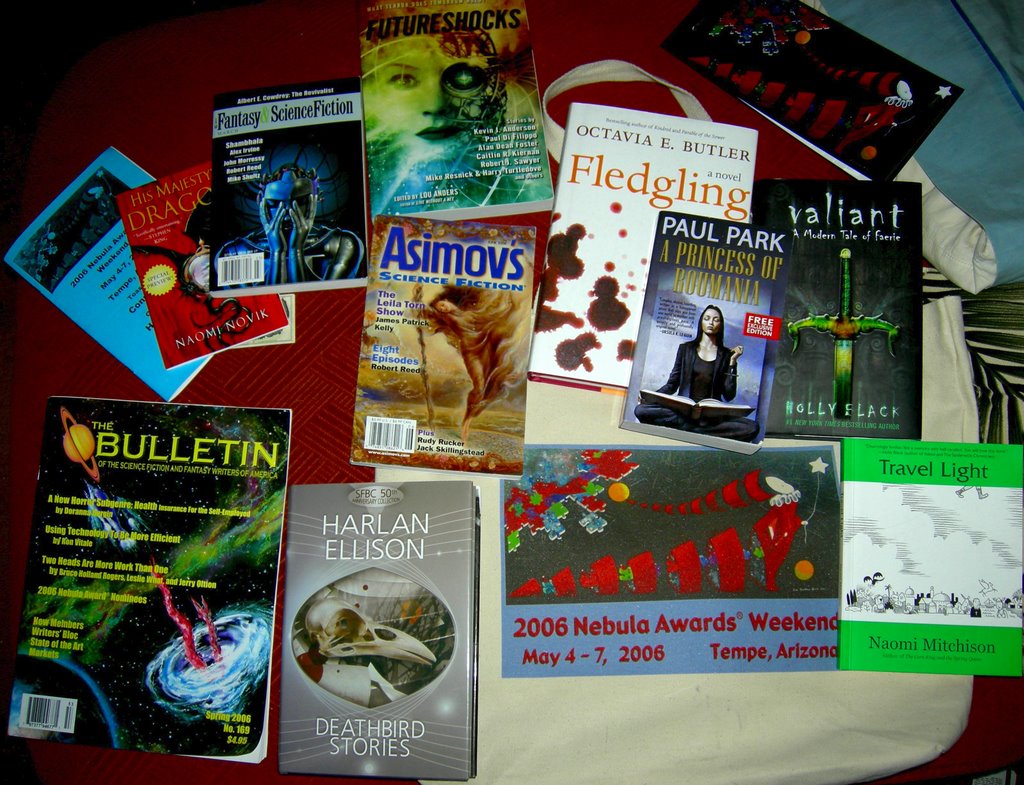
    But first I needed to pay for the privilege. I went over to the registration table at the other end of the vestibule, and paid my $50. In return I got a laminated badge with my full three-word name on it; plus a printed canvas bag full of books and magazines. Check out these goodies, easily worth the $50!


    That accomplished, I walked to Harlan's table and stood on the periphery, awaiting his attention, not interrupting. He continued chatting to his friends for a minute or two. Then he turned to me and said, "What?" As in, "Who are you, and what do you want?" "I see you there quivering," he added. (Yes, he has that effect on me.) "What do you want?"

    I had an answer all prepared. "Well, I haven't seen you in a couple of decades, and you're in my state," I began. I was going to add that "I thought I ought to make the drive up and say hello, and congratulations and things."

    I'm pretty sure I never made it through that second sentence. When he heard that he knew me from 20 years ago, his attitude changed instantly. "Let me see your name badge," he ordered.

    I leaned down, and he peered up. "Karen Funk Blocher!" he exclaimed. "If I were standing up I'd give you a hug, but as it is I'll just kiss your hand." He did so. "Didn't we exchange letters last year?"

    Yes, we did, I acknowledged, about those black and white photos I found from Clarion. I told him that the photos were taken by Mike Orgill.

    "I remember Mike Orgill," Harlan said.

    Returning to my prepared remarks, I told Harlan that my first novel is sitting in the slush pile at Tor, that the second one is a magnificent mess, and that I have bits and pieces of others in the works.

    "How long did it take you to write the first one?"

    "Thirty years," I said. I knew that oversimpified answer would sound bad to him. It made me seem like a dilletante, or someone who endlessly rewrites one thing rather than moving on. But I knew he wouldn't sit through a long, defensive explanation.

    "It had better be a very good book, to be worth all that time," was Harlan's comment.

    I should have said that it was that good, but I was still caught up in my script. Rather than respond to his implied question, I invoked the character in Camus who had been rewriting the first sentence of a novel for 20 years. "I didn't mean to make him my role model," I said.

    "There was only one Camus," Harlan said, which missed the point rather badly. Still, I thought that initial exchange went very well.

    Harlan does physical comedy shtick before his panel.

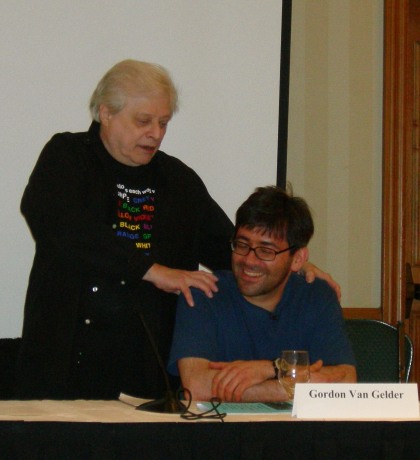
    I didn't do as well with him at the only panel discussion I attended. Harlan and the editor of F&SF (The Magazine of Fantasy and Science Fiction), Gordon Van Gelder, were discussing whether the science fiction and fantasy field was getting stale, with too many writers imitating what had come before, or writing bad, unnecessary, repetitive books such as the "sixteenth volume of a fantasy trilogy." (Ouch!) When they opened the floor to questions, hardly anyone was willing to ask anything.

    Harlan Ellison and Gordon Van Gelder

    I decided I was not afraid.

    Harlan had made an extreme claim, that no great books ever go unpublished. I brought up the fact that A Wrinkle in Time was rejected by about 23 publishers in 1960.

    Harlan: Did it get published?

    Karen: Yes, but--

    Harlan (again):
    Did it get published?

    Karen: Yes, but--

    Harlan: It got published. Shut up.

    Karen: But that's only the first half of the question! Nowadays she wouldn't have 23 different publishers to submit to.

    Harlan basically said that was nonsense. He didn't want to hear my point that most of the major publishers have merged, some don't take unagented work, and so on.

    Harlan: Go to the library. You remember the library, don't you?"

    Karen: Yeah, the place that doesn't buy books any more. [This is pretty much true in Tucson.]

    Harlan: Stop trying to argue with me. I'm smarter than you are, and I can make you cry in about 3 seconds. Go to the library, and ask for the LMP. Do you know what that is?

    Karen: I don't remember what that is.

    Harlan made fun of me a little more, and then said that LMP is a thick book called Literary Marketplace. He claimed that it lists a hundred pages of publishers, and called on editor Ginjer Buchanan (who was in the back row, sitting next to comic book writer and novelist Peter David) for confirmation. She agreed, but also said that the book is so expensive now that her publishing company no longer buys it.

    I let it go at that point. Afterward, though, I asked Ginjer (who knows me from Quantum Leap fandom) whether I was totally wrong. She said that the truth was somewhere in between. Some of the university and regional presses do publish genre fiction, she said, but yes, the majors are mostly all conglomerates now.

    So yes, theoretically one could get published by the Cactus Press, or the University of Baja Arizona Press. (I made up these publisher names.) But that doesn't sound to me like the best way to get the Mâvarin books into the world. (You knew it wasn't merely an academic question to me, didn't you? But let's not borrow trouble.) My research in Writer's Market has always indicated that the smaller presses usually have particular niches for what they put out: academic, or Christian, or books about a particular state or region, or GLBT issues, etc. Not many novels set in a fantasy world qualify under such guidelines. Mine certainly don't.

    I'm not mad at Harlan over this incident, because he's like that with pretty much everyone. He publically admits that he's petty, irritable and impatient, and that these are not good qualities. Knowing he knows he does things like this makes it easier to shrug it off. Even he knows it's not me, it's him.

    After the panel, people lined up for his autograph. I knew I'd missed the official autographing session, and hadn't brought anything to be signed. After all, I already have a couple of letters from him, and his autograph in at least a few books - even if I don't know precisely where most of those things are right now. But Susan Ellison, his wife of thirty years, was selling stuff by Harlan in the back of the room. I bought a cassette of Harlan reading "A Boy and His Dog" and "Repent Harlequin! Said the Ticktockman." I have the latter on LP, but no way to play it these days.

    So anyway, I got in line with my purchase. There was one person behind me. After a few minutes, the woman in front of me said she'd been told that the man she replaced in line was supposed to be the last person. I decided to take my chances, since there were only two extras. But a few minutes after that, Harlan noticed me there, still 50 feet away, in line where I ought not to be. "I'm sorry, Karen," he told me, "but the line is cut off with the person in front of you. I need time to get ready for tonight."

    "That's okay," I said, getting out of line. "It's not as if I don't have your autograph."

    After that I sat in the hotel bar drinking three glasses of badly-needed Diet Pepsi, and reading a not-so-good short story in my free copy of F&SF. Then I went to the pre-banquet reception. Harlan wasn't there, Ginjer was busy with Connie Willis and Peter David, and the only other person I knew, event chairman and longtime Who fan Lee Whiteside, wasn't there until the very end. I sat alone at a table, thinking, and checking in with John on my cell phone. Eventually I ended up in a long conversation with another aspiring writer.

    I didn't spend the extra $85 to attend the banquet, but after an hour they let the rest of us in to sit on rows of chairs in the back of the room. The lectern was in the middle of the room, and I was in the first row of seats. Even so it was much too far away to get good pictures of the proceedings. I did get about two minutes of digital video of Harlan talking, once his award came up at the end of the night.

    Connie Willis was very funny as toastmaster. Nearly all of the other presenters were similarly funny, or at least interesting. Joe Haldeman won for best novel, and Joss Whedon (not present) won for best script. A couple of women I'd never heard of won three awards between them for fantasy works that sounded like something I'd enjoy.

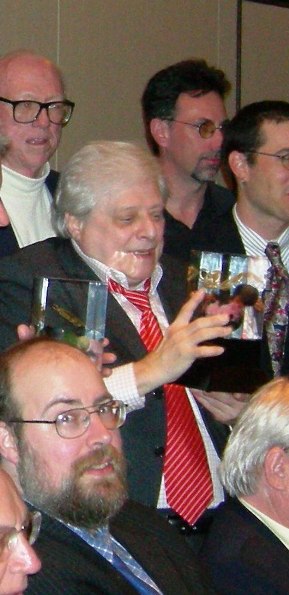
    Connie Willis pretended to end the presentation just before getting to Harlan's Grand Master award. Then she had a few remarks of her own about Harlan and his writing before turning over the microphone to two of Harlan's friends. Harlan's longtime literary agent was extremely amusing as he told exaggerated tales of Harlan's inconveniently timed phone calls, including one in which he purportedly threatened to "pull" a book because the publisher insisted on an unwanted hyphen in a particular obscene word. Neil Gaiman gave a second introduction, in which he pointed out that Harlan's writing was the reason for the award, not Harlan's public persona. Harlan's speech that followed was controversial, semi-gracious, and classic Harlan. He explained his ambivalence about the award and the organization that bestowed it, and his respect for others who had be so honored before him - Asimov, Clarke and the rest. He also told a story about Steve McQueen saving his life in the high desert. More than anything else, Harlan Ellison is a storyteller, on stage as much as on the page.


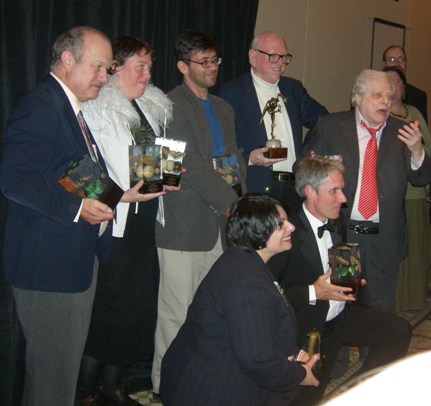
    Nebula winners, 2006. At least two people pictured here
    were "accepting the award for" someone not present.

    After that, Nebula nominees and winners posed for group photos. and I did my best to get a few decent shots. Harlan then asked Gordon Van Gelder to say a few words about him to a film crew that was making a documentary about Harlan. Van Gelder asked twice whether Harlan was joking before rising to the occasion.


    I would love to have stayed for the party, but I knew it was time to drive home. I waited for my moment when I wouldn't be interrupting, and called out to Harlan. "I have a two hour drive ahead of me, but I want to say aloha and congratulations before I go."

    Harlan seemed surprised by the term aloha, but didn't mention it. "Thank you, Karen. Don't drive off the road."

    I thought that was nice, his expression of concern that I get home safely. "I promise. I'll drop you a line when the novel sells. It is that good, really. And thirty years ago, I promised you a dedication."

    "I live for such moments," Harlan said.

    If I were as quick-witted as I'd sometimes like to be, I would have replied, "Then I'll do my best to make your life worth living." But instead I just said good night, and went to retrieve my car.

    Karen


    Technorati Tags: , , ,