Sunday, March 26, 2006

Deep Thoughts...and Theories of Nomenclature

"Great. Now I'm going to be stuck with serious thoughts all day.
- Cordelia Chase, "Beauty and the Beasts," Buffy the Vampire Slayer


As many people have pointed out before now, one of the cool and unique things about blogging is the way diversions, info, ideas, whole conversations spread from blog to blog, sometimes across a dozen or a hundred different venues, where hundreds of people read and comment on them. Some of these viral ideas - quizzes and other artificial memes, are designed to propagate in this way. Other stuff just happens to tap into what people are interested in and want to write about.

This has been another weekend of blog entries that inspire others to continue the conversation. First there was Pat's question about the origins of different screen names. Today she followed it up with an entry about place names and character names. Well, you know that's a topic that's pretty much guaranteed to get me blathering on about Mâvarin again. First, though, I'd like to offer my take on a couple of Carly's recent entries.

desert tortoise, Tucson, circa 1987Apparently a 250-year-old tortoise just died in India, one that belonged to a prominent Englishman at the beginning of that country's colonial era. (The critter shown here is not that Indian one, but a desert tortoise in our former back yard here in Tucson.) Carly tied this news in with a picture she took of some turtles recently, and the idea of being "comfortable in your shell," and the perspective that hundreds of years of life would bring.

That got me thinking about the way we look at the world now, we humans with our 60 to 90 years on the planet, assuming we aren't taken out early by murder, disease or accident. How often do we really think about what we'll be like - or what the planet will be like - decades from now? Most of the time, we're just trying to get through the week! Next week is a finite, comprehensible thing. We've got a pretty good idea what next week will be like. But 2016, 2026, 2036 - those years, and all the weeks in them, are abstractions to us. We may dutifully invest in an IRA if we can, buy insurance, or plan for the kid's eventual need for college tuition. But we don't really think about ourselves at age 80 until we're in our late 70s. We don't think about all the good and bad things that will be part of our lives by then - the latest gadgets, the medical advances, the depleted oil reserves, the changing planet itself. We can't really predict most of this stuff, so we don't. It's not real to us, anyway. The only perspective we can lay claim to is what we see looking back, when we compare today's world to the one we knew at the age of ten or twelve or twenty. Even that is filtered through imperfect memory, and limited by our ages. I can drive to downtown Tucson and onto a street that was built right over an 1865 graveyard, or learn more about a 2000 year old Hohokum pit house excavated near modern-day Church Ave. But I can't know what this place was truly like in 1865, let alone at the time of Christ. I wasn't here then.

Carly's next entry after the turtles and the tortoise was about predictions of the End Times, and how that relates to George W. Bush(!). She mentions "a reference to a recently published book that says, "members of the Bush administration have reached out to prophetic Christians, who see the war in Iraq and the rise of terrorism as signs of the apocalypse." A woman asked the President about this, and he said, "I haven't really thought of it that way." Carly goes on to ask for the thoughts of her readers about the Apolcalypse. Here are mine:

From what I've read and learned in several venues (college course, sermons, etc.), Revelations was written in a literary genre called apocalyptic literature. It is an allegory, mostly commenting in code on the destruction of the Temple in 70 AD. As my religion prof put it thirty years ago, "The author of Revelations was 'predicting' the recent past."

My beloved high school boyfriend Dan, a devoted reader of Hal Lindsay, was convinced the world would end in 1986. That year came and went, 20 years ago. Dan himself didn't make it to 1986, but the world goes on. Dan's world ended in 1978, and he presumably went on to the next one. The 1986 date was entirely irrelevent, it turns out, to his life and to ours, at least as far as the Apocalypse goes.

It turns out I suddenly find myself needing to know the plural of apocalypse.
--Riley Finn, "A New Man," BtVS


It seems to me that it's terribly presumptuous to predict a certain date or year, especially one we expect to see ourselves. We can't even be sure when our individual lives on Earth will end, much less predict what God (or the human race) will do and when. All we can do is take good care of the Earth and ourselves, and live as though the Earth needs to last for millenia yet - and as though we may die tomorrow. People have been predicting the Apocalypse since St. Paul's day. Does it really make sense to think that the world really is ending soon, this time for sure! - and that we therefore don't need to care about global warming, our disappearing rain forests or the health of our oceans? Shouldn't we be taking care of such things, just in case our children are going to be living here - and because God was expecting us to be good stewards and not trash the place?


Do we really want to assume these kids won't need
a healthy planet to live on, fifty years from now?

As for Republicans reaching out to evangelical Christians, there's certainly nothing new about that. I once heard an interview with a former NeoCon who claimed to have attended tactical meetings about using social issues - basically conservative Christian issues - to induce people to "vote against their own economic self-interest." (Warning: rant ahead.) Many people, regardless of political or religious affiliation, will vote their consciences instead of their pocketbooks. However, the things they vote for don't always fit well with rationality or compassion. Sometimes it has more to do with indoctrination - being taught that some other group of people is a threat and must be fought by all means possible.

Like Carly, I reject the idea that the only true Christians are the ones who fear and loathe Them: liberals, gays, undocumented border-crossers, Muslims, Jews, the ACLU, even members of other Christian sects. To hate anyone is a betrayal of what Jesus taught, IMO. And to teach others to fear the "Not We" (to borrow a Star Trek reference) is a way to manipulate them, and to promote war and intolerance and misunderstanding. This is what's been happening in the Middle East for a long time, never more so than now. And it's what happens here as well. Mind you, I do not mean to imply that the average Republican or evangelical Christian is a hater or a hypocrite. But there are certainly people on the fringes of both groups who equate all Muslims with terrorism, or believe that Mexicans who sneak across the Arizona border are mostly here to smuggle drugs and murder decent Americans, or at least steal their jobs; or have little concern for the wellbeing of anything or anyone beyond their own friends, families and bank accounts.

Okay, on to a lighter topic. Pat (DesLily) has posted a list of character and place names from the books she wrote (mostly for herself), and explained a bit about their derivations. A lot of them come from Southern California place names, or are truncations or variations of more familiar names. She asks,

As I look down the list of names I notice how in Fantasy, very few names are simple, like John or Carol. I wonder how making up such fantastical names all began?? If anyone has a thought on that I think it would make a good post!

Overall, I think that can be laid squarely at J.R.R. Tolkien's doorstep. The man was an expert on the subject of dead languages, and created whole languages of his own. Names of people and places in The Lord of the Rings were derived from both Quenya (and other made-up tongues) and real words rooted in England's lingistic heritage. Tolkien's books inspired a whole genre, and not just in terms of what things were called.

We can't all be experts in Saxon and Old Norse words, so later writers of science fiction and fantasy generally fudge things a bit. For future colonists of another planet, Anne McCaffrey extrapolated a shift in the language over thousands of years, influenced by how she figured a dragon might pronounce a human name. A fantasy writer working in a mileu based on France might just go ahead and use French names, or tweak those names to represent the nomenclature of a fantasy country that isn't quite France. Some writers name characters after their friends, enemies, family members, even themselves, changing them just enough to avoid upsetting anyone or invoting a lawsuit. Still others do their best to develop a fictonal language as Tolkien did, or at least fudge it up from basic rules and sounds.

I mostly fall in the latter category with the Mâvarin books. I've got a general idea how the names of people work - no doubled vowels or consonants (not the same consonant, anyway), one or two syllable names for most regular people, three or four syllables for mages, who add the extra one as part of their Robing as qualified mages. Beyond that, though, I either go for basic sounds, or base a name on a real-world one, or tack a few vowels and consonants behind some first letter that I haven't already used to begin twenty other character names. This is a real problem, because the books have over 150 names characters...and counting! But my Rani (rhymes with Danny) was probably derived from Randy, although it turns out "Rani" is a real name in India. Del is also a real name, but it's meant to rhyme with the name of Del's twin, Crel, which isn't. Del was originally called Dag, a name derived by changing one letter in the word Dan. But Dag is a real Scandanavian name. I saw several protagonists named Dag go by in fantasy novels, and endured a lot of teasing from John about "Dag!" sounding like a kid's fake swear word, before I finally changed it.

Rutana is named after my mom. Jamek (JAH-meck) is a weird misspelling of James. All four main Beatles have had their names twisted into Mâvarin and Mâton character names, but I hope that most people won't notice. And Fayubi - well, I just liked the sound of that.

Place names follow other rules in my books. The ending -mar means a city. The ending -beth is a village. A place that ends in -mak is a forest. The accent mark for long vowels is allowed in place names, but not in modern-day human names.

Foreign place names, though, are treated a bit differently. You'll probably know the source of the country name Londer if I tell you that its capital is Gerbrin, and that Londer's Prince Talber is named after a famous 19th Century queen's consort. I figure it's fair to name countries an ocean away from Mâvarin based on the real countries an ocean away from us. After, what is Londer but another reality's version of Britain?

That's enough for now. Good night!

Karen

Technorati Tags:
,

Saturday, March 25, 2006

May-vah-rinn!

Pat, a.k.a. DesLily or, we now learn, De's Lily, asks in her blog for the stories behind our screen names. I think I've pretty much covered this ground before, but not as a whole entry. Onward!

My first online service, back in 1991 or so, was Prodigy. This is where I first encountered Julie, Sara and Sarah, among others. The way it worked, we each had an alphanumeric sine in code (mine was TFWK80A) that appeared on our posts, followed by our real name. Pseudonyms weren't allowed. (However, there actually was a mentally ill leaper who created several false names for herself over there, an early example of the problems with online anonymity. She stalked and harrassed a number of people, and it took a while to root out all her identities.)

Over on the HG boards we developed "handles" anyway, naming ourselves after people or elements from the Hitchhiker's books. Sara was Cricket Ball, Sarah was Lordy the Cat, and another friend was The Voice of the Book. Me, I refused to limit myself to one handle, so I became a Being Connected to the Nature of the Universe, specifically the idea that the moment you finally understand it, the Universe you know is replaced by something "even more bizarrely inexplicable." In practical terms, this meant that I found a different thing from the books / radio shows / records / tv series / tapes / towel to call myself, every time, for about two years. One time I might be the Story of the Reason, another time the Newspapers at Arthur's Door.

P* wasn't the world's greatest program, though. It was monochrome, email cost 25 cents each to send, and there was no copy or paste except through third-party add-ons. Then they raised the price. Julie told me about the then-new service AOL, which was much better, so I made the switch.

My first AOL screen name was KFB of PQL, as in Karen Funk Blocher of Project Quantum Leap, the fan club that consumed most of my free time during that era. A second screen name, KFB UWOT, referred to United Whovians of Tucson.

I don't look at those screen names much any more. Once or twice a month, I force myself to clean out the email a bit, but mavarin @ aol is my "home" name now. If I ever get the wireless connection to cable up and running, get my old post transferred here and quit AOL, I'll probably rely on Karen @ mavarin.com, or mavarin @ tobedetermined.com.

a magazine that does not existMost of you know by name that Mâvarin is a reference to my Mâvarin novels. Mâvarin is a place name, the name of the country where Rani and his friends live. I started this screen name specifically to write about my work on the novels over on the AOL sf / fantasy writers' boards. Later I registered the mavarin.com domain and got the web site up and running. The idea was to promote the books, both in anticipation and, more importantly, after I get them completed, sold and published. Meanwhile, it's a place where people can learn more about this Mâvarin stuff I'm always going on about, along with other pages like a tribute to my mom, the church web site and a recommended authors page.

So what does Mâvarin actually mean, beyond just being a place name? And how is it pronounced, anyway?

The accent denotes a long vowel, so it's pronounced MAY vah rinn. The Mâ part means Sun, which was added onto the land's previous name, "Varin," by the Londran colonists, in recognition of their sailing into the sunset to get to it. "Varin" means River-land, due to the river Misis that dominates the eastern part of the country. Think of the Mississippi running where I-81 and I-95 are, from New York down through Pennsylvania and Virginia and down into Florida. That's the Misis.

Oh, and how did I come up with the name, all those years ago in high school? I dunno. I just liked the sound of it. The deconstruction and translation of it came a little bit later, after I realized there was a reason why Mâvarin and the island nation of Mâton ("Sun-Rock") had the same syllable at the beginning.

Beyond all that, Mâvarin means me, my dreams, my hopes, my imagination, my writing life, my private world. It means Rani and Carli and Cathma, Fayubi and all the other characters I love so much, and want to share with you all, in this reality. As my license plate holder says, "Follow me to the country in my mind."

Karen


Technorati Tags: , ,

An Excuse, an Update, Congratulations and a Reminder

Despite the four subjects mentioned in the title, this entry will be shorter than usual. I'm in the middle of reading a book, and watching a movie; and I want to get back to both. I want to finish the book so that I can concentrate on reading the end of another book, all fourteen single-spaced pages up it. Yep, my friend Sara finished the first draft of her novel on Monday, hours before her self-imposed deadline. Way to go, Sara!

(This concludes the congratulatons part of this entry.)

Okay, the update. An old friend of mine emailed today, asking what happened with my latest doctor's appointment yesterday. I looked up who belonged to the only-vaguely-familiar email address before answering. It's okay, though. I'm reasonably sure he's who he says he is. (Long story. Not telling it.) So I told him, and it occured to me that I shouldn't keep you folks hanging, either.

Bottom line: Dr. L. is pretty sure the edema is from obesity. I'm pretty sure that my falling in the street the evening we took care of lost doggie Snow made things much worse. But that's over now, except for a weird little bump where the knot of extra swelling was.

Anyway, Dr. L. gave me a prescription for a stronger diurectic, which I'll fill tomorrow, along with one for some special potassium and one for an inhaler for my occasional asthma. She recommended Weight Watchers or South Beach. I have issues with Weight Watcher, so South Beach it will be. And she ordered more blood work, this time checking my electrolytes. I didn't press her for any further alternatives. Really, there's no evidence of any other conditions friends and/or my imagination have suggested as possibilities.

I remembered today that I should have done a full-fledged promo for the latest Round Robin Photo Challenge a couple of days ago. I'm not going to do one tonight, either, but I will mention it again. You know what it is, right? The topic is "Obstruction." You can take that literally or figuratively. I seem to keep using up all my obstructed photos just promoting this, so I have no idea what I'll use when the day of the challenge comes. What day is that, you ask? Well, the posting date of the RRPC is always a Wednesday. In this case it's Wednesday, March 29th, 2006, any time between midnight and midnight. See the Round Robin blog for details and to RSVP.

Movie's over. Back to the book!

Technorati Tags: ,

Thursday, March 23, 2006

Wonderful Worlds of Color

John Scalzi asks:

Weekend Assignment #104: Tell us your favorite color. Give no less than three reasons why it is so.

Extra credit: A picture that is primarily of your favorite color.


It seems to me that when I was three or four years old, my favorite color was pink. That would explain the ballerina wallpaper I was stuck with for the next ten years. My mom's favorite color was definitely blue, and that became mine, too, at least nominally. I liked our living room, with its two walls on the dark side of French blue.

By the early 1980s, though, I was heavily into red and black, at least in my clothing choices. There was Spandex and vinyl; there were rivets and zippers; but it was the color scheme that made it work. Hey, I was still in my twenties, and still thin enough to (almost) get away with it.

Nowadays, I live in a house with low-end 1950s decor. My favorite part is an area dominated by turquoise (or teal), accented by salmon and black and white. Our Cugat picture is pink with turquoise, and our no-name cityscape has a turquoise sky.


And of course, our kitchen is decorated in red. Here's one of John's birthday presents from this week: a red-rimmed clock to replace the vintage deco-style red clock that stopped keeping time.

What, you want just one favorite color? Sorry, not gonna happen. I love colors - bright colors, mostly, but the important thing is that they're fun and cheerful and varied. Reason #1: back in the 1950s and 1960s, even through into the beginning of the 1970s, all those colors, especially pinks and blues, conveyed an optimism and a sense of playfulness that was later confined mostly to children's bedrooms. I hate the white and beige world of contemporary decor and don't-upset-the-office attire. It's dull, dull, dull, with no imagination or originality or fun. That's why I love Maryanne's and Judi's always-colorful art. They don't limit themselves to the muted conformity of a limited palette.

So here we go with reason #2:

And she said...
Flowers are red, young man.
Green leaves are green.
There's no need to see flowers any other way
Than they way they always have been seen.


But the little boy said...
There are so many colors in the rainbow,
So many colors in the morning sun!
So many colors in the flower, and I see every one!
--Flowers Are Red by Harry Chapin

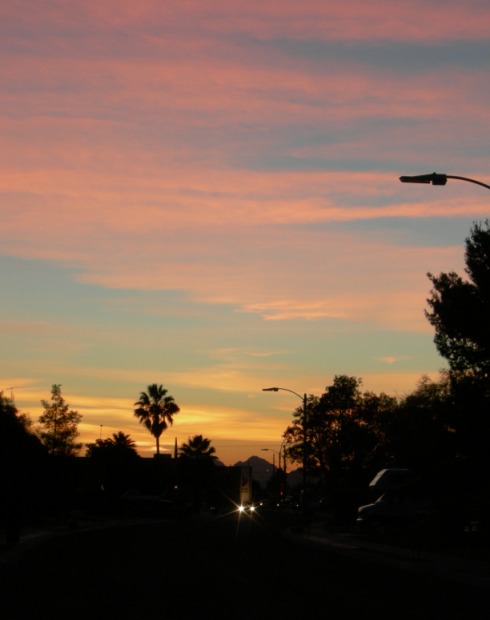
The little boy got it right. For example, here's a sunset picture from tonight, taken with one of the three "sunset" settings on my new camera:


It's not just in vintage decor that different shades of pink and blue look great together. Reason #3:

The miracle of imagination,
The marvels of Earth, Sea and Sky.
These wonders untold are ours to behold,
In the wonderful world of color.
--
The Wonderful World of Color,
by Richard M Sherman and Robert B Sherman


Okay, okay. I will admit that I still have a slight preference for certain shades of blue and red. Here's my current jacket. No Spandex or studs, but it is red and black! And notice the turquoise /Leap Blue wall reflected behind it.


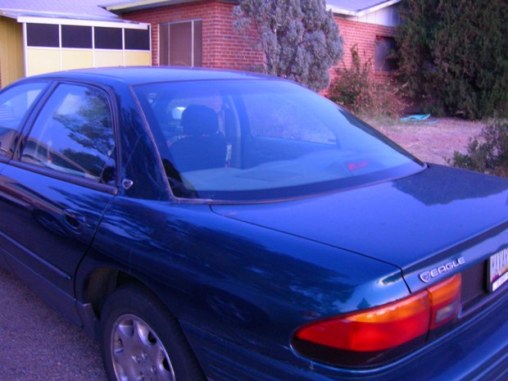
And here's my teal-colored car, photographed after sunset using the "dusk" setting on my camera. Note the red brick behind it. Those last two shots are for the extra credit.

If I apply the "at least three reasons" thing to blue, specifically the turquoise and teal part of the color range, I come up with this:

  1. It was my mom's favorite color, and the color of our unusual living room, which I once depicted in watercolor in a kindergarten art class.
  2. Turquoise is a very Arizona color, because the mineral is used extensively in native arts. And of course, the sky here is very blue, most of the time--unlike in Manlius!
  3. Sam Beckett's Imaging Chamber is primarily "leap blue," as is the show's main title.
  4. Several of Arizona's prettiest birds ae unusual shades of blue, most notably the indigo bunting.
  5. Blue represents both river and sky in the national symbol and royal seal of Mâvarin. (See the top of this blog.)
  6. It's calm and cheerful at the same time.

I'm not going to do a list of reasons for red, but I could if I had to.


Karen

Technorati Tags: , ,

Wednesday, March 22, 2006

Why I No Go Pro

Does this subject line qualify as pidgeon English? It's certainly "nonstandard" or incorrect English, but I can't resist the sound of it.

In his comment to last night's entry here at the Outpost, Paul latched onto a curious, almost shameful fact about my writing, quite aside from the typos I initially missed in the opening paragraph:


Also, she rejected one piece, and "that was that"? [insert incredulous smiley here] It seems to me that everything I've ever read about writing tells us to expect rejection, ignore rejection, and keep submitting. Of course, I'm one to talk. Never submitted anything anywhere. I think we're a lot alike.

Yes, it's true. The first time a review of mine was rejected by the editor to whom I'd previously sold several other music articles, I stopped writing them. If memory serves, Teresa and I did much the same thing again a decade later, quitting our collaboration on science fiction-related articles for Starlog the moment we ran out of easy pickings. And when a Dell puzzles editor bought my "Five Proud Mothers" submission and offered me a shot as a regular contributor of logic problems, I glanced over the writers' guidelines and never submitted another puzzle.

As a professional writer, I make a lousy role model. Perhaps that's because I'm not a professional writer. Call me, at best, a semi-pro.


Yes, I've sold bits of writing from time to time, and I've cashed the checks. That means I've been professionally published. But to really be a professional writer, I'd need to make a living at it, or close to it. Aside from a thick skin about rejection, being a professional writer would require much more of a commitment to the business of writing than I'm prepared to make.

People who make their living as writers, as for example John Scalzi does, tend to be writing something new all the time, often geared to specific markets, whether they are interested in the subject matter or not. (Yes, this is a gross over-generalization.) My personal history as a writer shows that I'm not at all good at that. The real reason I stopped writing the music articles wasn't so much the single rejection as the fact that I'd pretty much already said what I wanted to say on the subject. I'd written about the Beatles and the Clash, and said some long-overdue positive things about Yoko Ono. Anything beyond that would have just been reviews of Ohio rock concerts - and a New York-based rock magazine wasn't an ideal market for a review of Talking Heads at Blossom Music Center outside Akron. A professional writer would have either found a market for Ohio concert reviews or found something else to write about. Instead I stopped writing for about four years. Shame on me!


Then in 1985, I discovered the tv series Route 66 on Nick at Nite. I taped all the episodes, and got interested in writing a book about the show, or at least a TV Guide article. When John and I got to drive around the country for several months in 1986, with Jenny Dog on a mattress in the back of the van, part of the purpose of the trip was to research Route 66 the road, which didn't officially exist any more. We bought a Route 66 sign in Oklahoma, followed a bit of frontage road until in dead-ended in a cemetery full of browsing cows, fell in love with Gallup and an obscure county park north of Winslow, and took lots of notes. We even interviewed the stars and producers of Route 66, the series.


Then Nick at Nite stopped running the show, and it became obvious that at least two other people were writing books about the road. So all the material for the book, some of it in these red folders, the rest on Commodore 64 floppies, was essentially abandoned.

It appears that I'm a dilettante when it comes to writing. I write in spurts, and then quit as soon as I hit an obstacle. Yeah, it seems like that. But really, except for a few brief periods, I've been writing all along. I just haven't always been writing professionally.

Take that fallow period in the early 1980s, for example. I'm sure I pulled out The Tengrim Sword a few times, and at least tried to write it. Then there was the Route 66 project, and the Critters book, another abandoned project. In 1989 I co-wrote the Christmas Trivia book with John, and finally finished the novel, by then called Lost Heirs of Mâvarin.


In the 1990s, aside from the Starlog articles, I was in fanzine mode. For a while I was editing about eight magazines a year, writing about a third to half of the material myself. Later on, we cut back drastically on that schedule, but that was also the period during which I wrote several series of Doctor Who trading cards, revised the first novel, and started the second one. Eventually I gave up editing the two fanzines, but I continued to write for The Observer, and designed the covers - for a while. But I was terribly bored with the fan stuff by then. It had become a chore instead of a pleasure. So I stopped--mostly.

Even then, I was still writing. I was on to the second novel, which kept getting longer and longer as the plot turned in unexpected directions. And as that draft wound down, I got sidetracked by school, and wrote a bunch of papers and group projects. And two years ago today, I started blogging, in Musings from Mâvarin.

Yes, I'm terrible at the business end of writing. I don't write a variety of stuff for paying markets, I hardly ever submit anything anywhere, and I tend not to write anything that isn't fun or interesting to me.

Am I doing it wrong?

Karen


Technorati Tag:

For the Credit, not the Cash

I've posted this picture before:

I wrote the cover story for this.

It's funny how key moments in your life can happen largely by accident. The cover story in this issue of Relix Magazine was my first professional sale as a writer, and I didn't even need a query letter. Les and Toni of Relix were wholesalers of some of the buttons and stickers we used to sell at Rockarama, as well as publishers of the magazine. I was on the phone with them about once a week, placing orders. We carried the magazine as well. Sometime in mid-December, 1980, right after John Lennon's death, Toni happen to mention that she was having trouble getting an article on Lennon by the time she needed to go to press. I offered to write it overnight, and she gratefully agreed. I sent it off the next day.

If you look closely at the [photocopy of the] check, you'll see it's for $35. That wasn't exactly a princely sum, even in 1981, but I didn't care. I was a professionally published writer! Yay, me! I even got to autograph a copy of the magazine later, at a Beatles memorabilia show in Akron. Or was it the one at the Cleveland Agora? I forget.

I went on to write a two-part article on Beatles memorabilia for Toni, and a review of The Clash at Bond's, and I think a review of Yoko Ono's Season of Glass video. Then Toni rejected some other concert review, and that was pretty much the end of that. I'd come to the end of what I had both the interest and the opportunity to write about on the subject of rock and roll, at least while living in Columbus, Ohio. It was nice while it lasted, though.

Fast forward about ten years. Rockarama was long gone. We were in Tucson by then. I was editing TARDIS Time Lore for United Whovians of Tucson. We were also launching Project Quantum Leap and its fanzine, The Observer. Teresa Murray and I started interviewing actors and writers from both Doctor Who and Quantum Leap, ostensibly for the two zines. This was easy to do at the time. For a few years in the early 1990s, Gallifrey One and the Quantum Leap conventions took place the same weekend. Most of the guests at both cons were happy to be interviewed. Teresa's twin, the late Tracy Ann Murray, helped us with the taping, not only of the interviews, but also of some of the Q&A panels at the cons themselves. She also asked the occasional question.


This two-part profile of John Nathan-Turner
(half for past, half for future) came from a Q&A.

Somewhere in there, a guy from an obscure publishing concern called me at a Burbank hotel, offering to have us write a Quantum Leap book. That's another long story for another time, but it got us interested in doing something more with our interviews, something professional. So we approached editor David McDonnell of Starlog about doing some articles, based on the interviews and Q&As we'd captured on tape and transcribed. He agreed--but only for Doctor Who articles. He already had assignments out to other writers for Quantum Leap.


The beginning of the John Levene article


Writing to Starlog's guidelines turned out to be much harder than putting together an interview for the two zines. The TARDIS Time Lore pieces were straight Q&A format. From memory:

TERESA: Would you take on the role of the Sixth Doctor again, under the right conditions?
COLIN BAKER: Never say never!


But if you look at an interview in Starlog, you'll see it's not like that. Starlog publishes "profiles," not raw interviews. What the actor, writer or producer said needs to be woven into essay form, with each paragraph setting up the quote being used, and then sequeing gracefully into the subject of the next quote. The interviewer shouldn't be quoted at all.


The second half of the JN-T piece. We had nothing to do with
the art direction or photo selection. Nice layout, though, isn't it?


That's not all. We had to negotiate over the fact that we'd already used some of the raw quotes in the fanzines. Fortunately, he let us get away with that one. Years later, I obtained similar permission to use some of the quotes again, this time in the Doctor Who trading cards.

There were also style and formatting rules. I learned not to start two concecutive paragraphs with the same word, and when to use a number and when to spell it out. Proofreaders' marks had to be hand-entered on the manuscripts. We even had a minor virus problem on one of the floppies--a Mac virus, yet. And we had to work to a deadline. Overall, it was so stressful that Teresa made an ER visit at the end of one night-long writing and editing session.

It was worth it. I don't even remember how much we were paid for each of the four articles, but I'm sure it was more than the Relix ones brought in. Far more important to us were the writing credits, the names Karen Funk Blocher and Teresa Murray printed on glossy paper. After all, Starlog is a science fiction media magazine. This was the next best thing to having professional fiction credits of our own. It was also a potential stepping stone to the book about Doctor Who that we wanted to write. (That we never actually wrote the book is irrelevant.)

And frankly, fifteen years later I treasure the learning experience even more than the writing credits or the money. I still keep in mind some of the principles Dave McDonnell taught us, whether I'm writing fiction, a cover letter for my first novel...or a blog entry, like this one. Thanks, Dave! You've probably forgotten us by now, but thanks.

Karen

Technorati Tags: , ,

Monday, March 20, 2006

It Might As Well [Not] Be Spring

Your Monday Photo Shoot: Snap a shot of something that lets you know Spring has come around.


Spring? What's that? Tucson doesn't really have a spring. Does this look like spring to you?


Or this? Today's weather was a carryover from the winter conditions we had this weekend and last, but not in between. After three months of mild, seriously dry weather, instead of the winter rains needed to produce seasonal wildflowers and prevent wildfires, we've suddenly had two weekends of cold, wet weather. There's been snow in the mountains, rain down below. (No snow here in town. Drat!)

Has the late rain done anything to bring about spring? Not really. It's too little, too late. There won't be a bumper crop of flowers this year. The ones that are around, were equally around in January.

We don't really get the traditional signs of spring around here anyway. It just goes from pleasant and cool to pleasant and warmer, with a quick seque to too darn hot! Oh, some stuff will probably happen, but it hasn't happened yet. The ocotillo aren't leafing out, as they do during the monsoon...


...and the palo verdes and mesquites aren't particularly in bloom, or even looking as though they're gearing up for it. On the other hand, my allergies are up, so something somewhere is growing!


The only bits I saw today that looked like buds were on this bush near Unnamed Largish Company. For all I know, it may look like this all year long.

*****
I did some experimenting with Technorati tags tonight, but so far it's not working out. Technorati is still claiming that this blog hasn't been updated since the first week in December, no matter how many times I "ping" it. And when I pull up a Technorati list of entries tagged as doctor+who or "writing" or even "mavarin," neither this blog nor Messages appears in the results. I've tried reading the help screens about pinging, and turned the ping for this blog off and on, with no result. Unless someone can help me fix the problem, my only hope is that maybe the rest of you will get different results from mine. Shelly? Julie? Carly? When you pull up Technorati, does it say that Outpost was last updated 105 or 106 days ago, or does a more current dating appear? If you look for one of the tagged categories I've added, does Outpost come up? Please let me know. Thanks!

Karen

Technorati Tags: , , ,