Showing posts with label Route 66. Show all posts

Saturday, December 18, 2010

Round Robin Challenge: Signs and Symbols

For this week's Round Robin Photo Challenge, Symbols, as suggested by Ruth of  Scrabblequeen, I initially thought of religious symbolism. Here's just one example:

Deacon Michael Meyers lights the Advent Wreath

In the Roman Catholic and Episcopal churches (at least), the four week "season" leading up to Christmas is known as Advent, symbolized by the Advent wreath. Unlike the wreath on your door (or my alcove wall) at Christmas, it hangs horizontally. On Sundays it is lowered so that a priest, deacon or subdeacon can light one or more of the four candles on top of the wreath, one for each week. (One candle is lit the first week, two the second, and so on.) Three of the candles are purple, but one is rose colored.

Each part of the Advent wreath has its own symbolic meaning. The wreath itself, like most Christmas wreaths, is made of evergreen branches, symbolizing eternal life, since evergreen needles don't die with the autumn leaves. An advent wreath, again like many Christmas wreaths, may have red holly berries, symbolizing the blood of Christ. The candles represent the four weeks of Advent, a time to repent (literally to "think again") in preparation for Christmas. As more candles are lit, the Light of the World draws closer. The violet color of the three candles is the color of penitence. The rose candle, lit on the third Sunday (Gaudete Sunday, "Gaudete" being the Latin word for "rejoice"), symbolizes an element of rejoicing in the midst of our preparation.

And now you know more than you ever wanted to know about Advent wreaths, right?

The other symbols I thought of were the pictographic and color-based symbols of traffic signs - the red that means stop and green that means go (Starman thought that yellow meant "go very fast"), and most especially the shapes we recognize as meaning "Walk"...


...and "Don't Walk"...


...and similar symbols meaning "Pedestrian Crossing" and so on. Such symbols are a big factor in making the streets safer, because we can read the symbols faster than the words they represent. But photographically, they're kind of boring, aren't they? Let's move on to a street sign that symbolizes much more than is printed on it. Here it is:


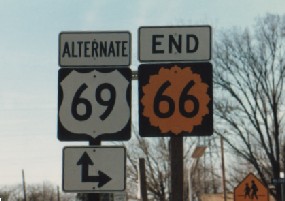
John bought this retired road sign from US Route 66 in Oklahoma, as I recall, on our big trip up and down the country (plus a bit of Canada) in 1986. We had been watching the 1960-1964 tv series Route 66 on Nick at Nite, and I was going to write a book about both the tv show and the road that inspired it. But U.S. 66 had been decommissioned by the Federal government, on the theory that it had been superseded by the Interstate Highway System and was consequently no longer needed. Towns and cities unlucky enough to be on Route 66 but without an exit off I-10, I-40 or any other Interstate, were bypassed and struggled to survive. A truck stop owner in New Mexico told me that each year, more towns fell off the Rand McNally road maps as their populations fell below the threshold for inclusion.

(Okay, so I only took two or three of these photos. But I did the editing!)

So what does a Route 66 sign symbolize? It's a symbol of the Open Road, the two-lane blacktop that could take you "more than two thousand miles all the way," or to the next adventure, like the adventures of Tod and Buz, on some obscure piece of classic American real estate. It symbolizes Roadside Americana, like the Buffalo Ranch and motels made from metal teepees. It symbolizes the call of the West, the Mother Road that the Joad family followed from the Dust Bowl to California. It represents that trip we took in 1986, the only time in our adult lives when we had no obligation to hold down a job and pay the rent or the mortgage.

End of the Road: the unedited version from 1986.

Most of all, it represents a time gone by, a time that was already starting to fade away as writer Stirling Silliphant drove around the country and wrote about the adventures of two guys and a car, and Martin Milner, George Maharis and (later) Glenn Corbett filmed those adventures on location. When we drove the old route in 1986, it was a patchwork of state routes called 66, which had a tendency to dead-end with little or no warning. The most memorable case was when it petered out at a cemetery, at which a cow was grazing. We thought that was a perfect symbol of Route 66 as it existed by then: quirky, picturesque, and dead, but with life still hanging on where it had been.

Added:
More on Route 66: there is an Historic Route 66 designation now, but back when we were driving it there wasn't. The signs for it are sporadic, and it's basically a collection of state routes where the original highway was. The highway itself did not have a completely stable route over its long history, and is not only about 85% drivable. The good news is that interest in Route 66, with an historic preservation society, travel guides and so on, have saved some businesses from the brink of extinction. More info here:

National Historic Route 66 Federation
Wikipedia entry


Now let's see what other symbols the Robins have found to show us!

Linking List
as of Saturday, December 18th at 8:35 PM

Ruth - Posted!
The Scrabblequeen Knits, Too
http://scrabblequeen.wordpress.com

Karen - Posted!
Outpost Mâvarin
http://outmavarin.blogspot.com

Jama - Posted!
Sweet Memories
http://mummyjam.blogspot.com

Monica - Posted!
Shutterly Happy
http://monica-frameofmind.blogspot.com/

Linda - Posted!
Mommy's Treasures
http://mommystreasures.blogspot.com

gMarie - **Welcome, new participant!**
gMarie
http://gmariesews.blogspot.com

Halie - **Welcome, new participant!**
My Memoirs
http://lifemomentsmemories.blogspot.com

Krista - Posted!
Through the Eye of my Camera
http://ourhomeschoolinthewoods.blogspot.com

Gattina - Posted!
Keyhole Pictures
http://gattina-keyholepictures.blogspot.com/

Manang Kim - Posted!
My Photography in Focus
http://mgahulagwayko.blogspot.com
Karen

Sunday, November 07, 2010

Fairness to George, Part Three

George Maharis and me in a Denny's parking lot, 1986.
I received an email today from Rick Dailey of Cuyahoga Falls, Ohio, who is building an online location guide to the 1960-1964 television series Route 66. Recently he and another fan have been researching the circumstances of George Maharis's controversial departure from that show, looking into actual documentation from the time. Rick got in touch with me because I wrote a couple of posts on the subject several years ago, based on my 1986 interviews with Maharis and others. I still occasionally get feedback from people about the two "Fairness to George" posts, so apparently there is still interest in this 48-year-old controversy. I recently found a dot matrix printout of the Maharis transcript, from our 1986 interview at a Denny's in Las Vegas, so this seems like a good time to post a few excerpts.

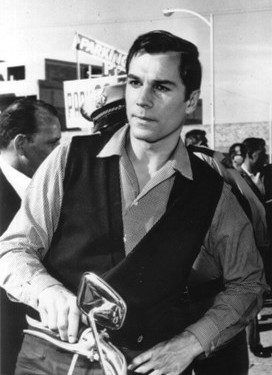
First, here's the gist of the story. Route 66 was a television series about two guys (originally Martin Milner as Tod Stiles and George Maharis as Buz Murdock) driving around the country in the late-model Corvette Tod inherited from his father, taking odd jobs, meeting people and having adventures. Three things made it an amazing and groundbreaking series. First, it was filmed on location all over the country, from Oregon to Grand Isle, Louisiana. Second, it was primarilly written by one of the show's producers, Stirling Silliphant, who drove around the country ahead of the production crew, and wrote stories based in the places he visited. Silliphant had a unique, lyrical style that was unlike anything else on tv. Third, the two stars, aside from being young and hunky, were interesting and contrasting characters, well-played by Milner and Maharis. Tod was the largely soft-spoken, well-educated but now penniless son of a failed businessman, with a strong ethical sense. Buz was working class, a bit of a rebel, self-educated, passionate and articulate.

And then George Maharis got sick with hepatitis, and ended up leaving the show under a cloud. There were accusations that he was trying to break his contract to go make movies, just another big-headed star behaving badly. The unreported (at the time) undercurrent of the rift between the star and producer Herbert B Leonard was Leonard's belated discovery that Maharis was gay, with the potential scandal that such a fact might cause the show if it ever came out in the press. This was 1962 after all, decades before Ellen. He was replaced by Glenn Corbett as Linc Case in 1963, but ratings soon declined and the show was canceled in 1964.

Found! The Maharis transcript.

Now let's have a look at a few bits of the transcript, which I typed up tonight for Rick Dailey:
Maharis: Well, they made a mistake with Glenn. It was very funny, because I had never seen the shows that he was in. I was ill. And I don't know what they told you about that, but that was a lot of stupidity and miscommunication. Nobody talked to me about it. And I was the object of all this garbage.

We had been working in cold water. It was winter, and we were working out here in California. We went out to do a show at the Veteran's Hospital, and there was a shot with Steve Hill, and I had to go down to the bottom of a pool and get him. Well, the inside pool that they used there was ninety degrees. The pool that they actually shot was an outdoor pool, and it was forty degrees. And the stuntman, who was my double, couldn't get in the water. It was too cold. So I did it.
He goes on to say that he also worked in a river with Barbara Barrie, at night in 17 degree weather, and she had a wetsuit and he didn't. He got a cold, and they gave him a B12 shot, and he got hepatitis from the needle. Then he worked in the water off Catalina Island, and felt very ill. At that point he ended up in the hospital for a month. After that he says he returned to work too soon, working long hours for the next four months.
Maharis: ...and I was in really bad shape in St. Louis. And the doctor in St. Louis , who they had sent me to, said, "Get home. Now." And for some reason or other, they thought it was something to do with contracts. And the doctor said to me, in St. Louis--and it was their doctor--he said, "If you don't leave now, you're in serious trouble." And I left.

And by that time, it was ugliness. It didn't have to occur. It didn't have to happen. But for some reason or other, the people who were next to the people who were next to the people, talk to each other, and they don't know what the hell is going on. And nobody ever called me about it, and said, "Are you ill?" All of a sudden I started reading this shit in the paper [which said] I was trying to get out of my contract. Trying to get out of my contract? I was in New York; I thought I was dying.

And here is the last page of the 53-page transcript.
Karen: He [Milner] said that he felt that Tod was not anything like himself.

Maharis: He's wrong. From my perspective, he's wrong. Very much of Tod in him.

Marty's not as gregarious as [I am]. He's not as trusting. He's more suspicious. I'm suspicious, but I'm more vocal about it. He's suspicious, but he's hesitant about it. I don't know why. He's been successful in his career, and he...you would think that he'd say what he wanted. See, I don't give a damn. I say what I want anyway. I figure, if they don't like it, too bad. Money doesn't make the difference of whether you can say it or not say it. I think everybody's got that right. The only thing is, you have to stand by it.

That's the best of it. here's also a rather good 2007 interview I found online tonight. Check it out here.

Update: I've had another email on the subject, and without going into specifics, I should state here that Maharis seems to have been more at fault in the circumstances of his departure than I ever suspected. The evidence would appear to indicate that (as usual) the truth is somewhere in between the claims made on each side, and possibly closer to the producer's side of the story than George's. For example, as producer Herbert B Leonard pointed out to us all those years ago, during the "three years" Maharis says it took him to recover from the hepatitis, he made at least three films, as well as recording sessions and singing appearances on tv. My guess, such as it is, is that Maharis felt he was well enough for these activities, but not for the more physically demanding work of an action-adventure tv series shot entirely on the road. What a shame; regardless of who was right and wrong and to what degree, the falling out between George Maharis and the makers of Route 66 cut short an astonishing run of literate, groundbreaking television, and left Maharis with a somewhat tarnished legacy.

Karen

See also:
Fairness to George, Part One

Fairness to George, Part Two

Thursday, April 19, 2007

Six Weeks in 1977, Double That in 1986

Weekend Assignment #161: What's the longest amount of time you've been away from home on a trip? By "trip" I mean things like a journey taken for pleasure (a vacation, cruise) or for business (business training, conventions, workshops, facilities tours) and things of that nature. Things that I would not classify as a "trip" for this assignment would be something like a military assignment or a long-term work posting, or going away for college. All of those will certainly keep you from home for a while, but they're of a different nature than when you're living out of a suitcase (or backpack, or whatever).

Here I am in July, 1977, at the Clarion Writer's Workshop, Michigan State University. My six weeks in East Lansing, Michigan are, I figure, right on the edge of qualifying as a long trip by Scalzi's definition, as opposed to going off to college. This was half a summer between my sophomore and junior years at Syracuse University. I spend part of May and all of June as an enumerator, asking questions door to door for R.L. Polk. (I pretty much hated that job, except for all the weight I lost walking around.) Then I was off by bus and by train to East Lansing, there to study with some of the best science fiction and fantasy writers of the era - Algis J. Budrys, Damon Knight, Kate Wilhelm, Peter S. Beagle - and of course, Harlan Ellison. Before the six weeks were over, I was at least half in love with one of my fellow Clarionites, a fellow named John Blocher. I've told that story, though, so here' are the links, and then we'll move on.

Clarion Auction - and a Hint of My Clarion Courtship
Harlan Ellison, Matchmaker
Surviving the "Failed" Clarion

If that doesn't count as a trip, then we...oh, wait a minute. I forgot THE trip. I must have had workshops and writerly trips on the brain not to think of the 1986 trip before the 1977 one. Heck, six weeks in a dorm is nothing compared to over three months in a van.

Jenny Dog in the van, 1986

John drove us around from the end of January through the beginning of May, 1986 in a 1984 Dodge van, with fake milk crates in the back, a mattress on the crates and Jenny Dog on the mattress. We went as far north and east as Montreal, as far south as Key West, Florida, as far west as Los Angeles and I think San Diego. And in between all those places, we spent a lot of time on Route 66, which didn't officially exist at the time. Part of the purpose of the trip was writing; I was working on a Route 66 book, which never saw the light of day.

Right in the middle of it all, in mid-March, I saw Tucson for the first time. There was a freak hail storm as we walked around the Arizona Sonora Desert Museum, but it didn't faze us. A week later, John was negotiating the purchase of our first house over the pay phone at Gilbert Ray campground, near ASDM, on the other side of Gates Pass from Tucson itself.

Yes, of course I've written about the 1986 trip as well:

Had Dog, Did Travel
Route 66 in 1986
Winter Wonderlands, 1966, 1976, 1986
Martin Milner and Other M Words

Extra Credit: What's the furthest you've been away from home?

Which is further: Tucson to Oahu, or Tucson to London? Probably the Hawaii trip. It was only three nights, at a grass-roofed hotel that was in decline and no longer exists: the Waikikian. We spent almost as much time getting there and back as we did on the ground, and while we were there we did everything but stay put. We drove all around the island, to a waterfall and other beauty spots, an art gallery that was all about the whales and the Dole Plantation with its garden of world pineapple species, to Sea Life Park, Hanuama Bay and the Polynesian Cultural Center. We never got to Pearl Harbor or up Diamond Head, and never got to any of the other islands. Shame, that, but the airfare was free and the trip was very much on the cheap. Someday we'll go back to Hawaii - the Big Island and Maui and probably Kauai. But for a three-day whirlwind tour, I think we did pretty well. No pictures of that trip tonight, but if they ever turn up I'll post a few.

Karen

Friday, September 01, 2006

Fairness to George, Part Two

A caveat before we get too far into this entry and I say something that might offend somebody somewhere. (Yeah, that about covers it.) To an extent I'm going to be speaking from ignorance - and that's kind of the point of the entry.

Back in July I promised to write more about George Maharis, the Route 66 star whose departure from the show remains somewhat controversial, some 43 years later. My original entry gives the background about our research for a Route 66 book (which I never wrote), the interviews we did, what I think really happened in 1963 and why I didn't write about it back in 1986. The short version: Maharis insists that he left the show for his health after being hospitalized twice with hepatitis. Executive producer Herbert B Leonard insisted it was a ploy to break his contract and go make movies, and furthermore brought up Maharis's homosexuality and alleged indiscretions, apparently to show that the actor couldn't be trusted. I shied away from the whole issue, and didn't even ask Maharis's co-star, Martin Milner, for his opinion until later.

Personally, I think George Maharis was legitimately concerned that his health was suffering, due to the punishing working conditions he was expected to put up with when he returned to work. He was very angry about it, and did not handle the situation with tact or discretion. The producers were ticked off: he was badmouthing the show and costing them money, just another star behaving badly. I doubt that they ever seriously considered the possibility that George was telling the truth, and that 15 hour days and shooting for hours in winter-cold water really was too much to ask of a guy with hepatitis. Actors who gripe in public are typically assumed to be spoiled and greedy, and Leonard didn't trust Maharis anyway after learning that the handsome young star was not the All-American heterosexual hearthrob the producer thought he'd hired. Aside from offering more money, which they assumed was the real issue behind the histrionics, the producers made no attempt to address Maharis's concerns, so he left the show. It's a tragedy in the classical sense, with hubris and a fatal flaw leading to the star's downfall. Maharis never regained the popularity he had for the first year and a half of his Route 66 tenure.

So George Maharis left Route 66 under a cloud, and with a bad boy image that did not yet have a sexuality component to it. Back in 1963, nobody was talking about which stars were gay, much less attaching a mystique to them as tragic heroes. But Maharis was reportedly arrested in 1967 and 1974 for "lewd conduct" involving men, and in 1973 he posed for Playgirl Magazine. As the LGBT subculture became less underground, these incidents gave the actor a cachet that presumably made him a more interesting and sympathetic figure for some people. He was no longer merely an actor who behaved badly and was struck down. Now he was a tragic, misunderstood artist, a bad boy who came into conflict with straight culture and suffered because of it.

Here we are, then, with multiple versions of the George Maharis story, and multiple perceptions of who he was and is, depending on who is telling the story. Frankly, none of these renditions, including mine, do the man justice. He's not merely an actor who misbehaved, nor the victim of circumstance, nor a gay icon. Well, okay, yeah, he's all of the above, but none of those descriptions provide a complete or accurate picture of him.

So when I first saw the George Maharis article on Wikipedia, I was less than pleased. From an old version of the article:

...the show's appeal declined when Maharis departed after his third year on the series, reportedly due to conflicts between him and Milner over acting styles. Glenn Corbett stepped in as Milner's new sidekick on the road, but a mere year later, in September 1964, Route 66 was cancelled.
For Maharis, a string of film failures followed, including "Quick Before It Melts" (1964), "Sylvia" (1965), "A Covenant with Death" (1967), "The Happening" (1967) and "The Desperados" (1969). To complicate matters, Maharis was arrested....

The two arrests were recounted in detail, but there was no mention of his Emmy nomination, his involvement in the unsuccessful-but-respected film The Satan Bug, the 1970 TV series he starred in, The Most Deadly Game, or his Las Vegas dinner theater gigs in the 1980s. No, the Wikipedia version was, he came from a large family, appeared in early dramas, starred in Route 66 alongside Martin Milner and a bunch of important guest stars, had a brief recording career, left Route 66 for no good reason, made some bad movies, was arrested a couple of times, sang in nightclubs, and does some impressionist painting.

Phooey on that. That narrative may be the one the first people who wrote the article wanted to tell, but it's not very accurate, and it wasn't very fair. So I added more of his tv, movie and Las Vegas credits plus his Emmy nomination, details on his recording career, and a photo that wasn't out of Playgirl. I also brought up the hepatitis, and both sides' claims about why he left the show. Better.

Then one day, as part of a general effort to bring Wikipedia biographies up to a required standard, the following notice appeared on the article's Talk page:

This article must adhere to the biographies of living persons policy as it directly concerns one or more living people. Unsourced or poorly sourced, and especially potentially libellous, material must be removed immediately.

That's when I deleted the references to the two arrests from the article.

Do I think those arrests ever happened? Oh, probably. But the only evidence I found online was an eBay listing for an obscure magazine, which had an article about one of the arrests. That's not exactly an unimpeachable source. To meet the Wikipedia standard, it needs to be better than that.

And frankly, I'm in no hurry to find a reliable source and put that stuff back in the article. The man is a (retired) actor, a singer and a painter. His profession should be his claim to fame, not a few incidents for which he was fined a few bucks. There was a time when George Maharis was a very successful actor in a very good tv show. That should be what's celebrated about him, not what happened in a men's room in 1974.

It's funny how the Internet works sometimes. Earlier this evening, I Googled "Mavarin map," hoping to find the entry in which I posted the map of Mâvarin that turned up recently in one of my old printouts. I wanted to use it in a pirate map generator. Instead I found a Route 66 blog, which did a whole entry about my earlier "Fairness to George" post, called Why did George Maharis leave “Route 66″? (Oddly, Google refused to turn up my entry itself.) After a semi-accurate recap of what I wrote about Maharis, Ron concludes:

I find it a little ironic that a socially progressive show like “Route 66,” which dealt with race and labor issues, didn’t take the high road with one of its co-stars. Then again, this was before the Stonewall uprising that sparked the gay-rights movement.

Yup. I agree. I hesitate to say outright that Herbert B. Leonard was homophobic, and that this was a contributing factor to the misunderstadings surrounding Maharis's departure from Route 66. But based on what we were told in those 1986 interviews, it's a little hard to draw any other conclusion. It really is rather sad. Here was a rising young actor in the role of his life, and it all came crashing down for reasons that had very little to do with the reported ones. Yes, Maharis and Milner had very different personalities and acting styles,but that wasn't the problem. Yes, Maharis probably did get the idea that he was largely carrying the show, and deserved better treatment. But if that's what he thought, there was plenty of justification for it. Maharis was so successful on the show that St. Louis Dispatch TV Magazine called Milner ""The 'Other Star' of Route 66". And Maharis certainly deserved to be treated with as much consideration for his medical situation as possible. Unfortuately, that didn't happen.

Blocher promises to write more about this subject, as she closes her post with “To be continued.” So stay tuned.
 
Done.

Karen

Update: Fairness to George, Part Three

Monday, July 10, 2006

Fairness to George, Part One

I've told parts of this story before, but bear with me.

Back in 1985 and 1986, Nickelodeon's new adult programming block, Nick at Nite, primarily aired black and white television shows from 20 to 25 years earlier. I still remember most of the lyrics they came up with for the My Three Sons theme on one of the promos:

They've got a dad
His name is Steve
He's got a job
He's really tall

And then there's Bud
He makes some food
They've got a dog
They're My Three Sons (on Nick at Nite!)

One of the shows Nick at Nite aired during that era was Route 66, a 1960-1964 series about two guys and a car, wandering the country together. John and I were much impressed with the writing on the show, so much so that we started taping it.

In early 1986, when John came into some money, we put our stuff in storage, bought a van, put a bed in the back of it, and started driving around the country ourselves. Partly we were looking "for someplace it isn't winter," but one of the goals was for me to write a book about Route 66, both the road and the tv series. Before the year was out, we drove on or near much of the decommissioned "Mother Road," talked to people from small towns and roadside businesses, and interviewed all three actors and both executive producers from the show. At least two other people were writing books about the road and the time, but we thought we had the angle to make ours unique, namely the tv show.

Then Route 66 was taken off Nick at Night, we switched from a Commodore 64 (whose oversized floppies have the only copies of most of my notes, even today) to a Mac SE, and I went out and got a job renting out videos. I abandoned the project.

One of the reasons I didn't try to finish the book was that I was having a moral quandary over it. When we interviewed George Maharis at a Denny's in Las Vegas, he spent much of the interview explaining vehemently that he left Route 66 for health reasons. In 1962 he came down with infectious hepatitis and was hospitalized. On this everyone agrees, but what happened next remains in dispute. According to Maharis, he came back to work, expecting a lighter shooting schedule because of his health. What he got was a relapse due to 15-hour days in often grueling conditions, including hours spent shooting a rescue scene in an unheated pool in winter, and another winter episode in which he spent many hours standing in cold water off Catalina Island. Finally his doctor told him to get out of there, or risk ruining his health for life. Convinced that the producers were never going to give him what he needed, George quit.

That's the Maharis version. The Herbert B Leonard version of the story was very different, but just as bitter and just as vehement. Leonard was the show's executive producer. He thought he'd hired a young hunk for the show, a hip, sexy man and good actor that all the girls would go for. This was all true of Maharis, but not the whole story, as Leonard discovered to his anger and dismay. George was gay, it turned out. Leonard told us that they sometimes had trouble keeping Maharis's sexual activities from the press. Meanwhile, according to Leonard, Maharis decided he was too big a star for tv, and to use illness as a pretext to break his contract and go make movies. Writer-producer Stirling Silliphant pretty much agreed with this assessment, as did the show's other star, Martin Milner, when I finally asked him about it in a follow-up letter. (Milner actually said very little in his low-key response. I think it was about one sentence in his one-page letter back to me.)

Myself, I believed George, at least 90%. I still do. Oh, he may well have gotten in trouble at times over his sexual orientation, in an era when practically all gay actors were very much in the closet. He probably also had some star moments in which he behaved badly. I've read some of the harsh things he said at the time. But I've also seen the old articles about what happened. He was hospitalized at least once, and had at least one relapse, and reportedly did work long hours in punishing conditions. I specifically remember the "trapped in the water off Catalina" episode and the "rescue a wheelchair-bound vet from a swimming pool" episode. The facts seem to be on George's side.

Here's what I think happened. The producers felt betrayed and duped when they learned of Maharis's sexual orientation, and never trusted him again. Maharis, for his part, started to feel that he was carrying the show and going unappreciated. So when he got sick, and came back, and started griping about the working conditions, the producers assumed it was all a ploy to either get more money or else get out of his contract and go make movies. In a less homophobic era, they might have communicated better, and worked things out instead of letting each other down.

But in 1986, I didn't want to write about controversy, or to "out" George Maharis, not that it was much of a secret by then. (During his dinner theater performance of a bedroom farce in 1986, we kept hearing a little old lady heckling him about this.) I just wanted to write a nice book about a great show and the road that inspired it.

Fast forward 20 years. George Maharis gets a Wikipedia entry. The initial version is three paragraphs long. The gist of it: George Maharis came from a big family, appeared on important early anthology shows, appeared on Route 66 alongside legendary actors, left the show for no good reason, was arrested a couple of times on indecency charges, and is also an impressionist painter. The next person to edit it added a picture of Maharis from Playgirl magazine. Yup, his bad boy image had entered a new century. This time it was a gay bad boy image, but it was no more fair or complete a picture of George Maharis than reports from 1963 or 1986.

But this time, I was determined to rectify the problem - within the bounds of NPOV, of course.

To be continued.


Continued here: Fairness to George, Part Two