Showing posts with label Thurber. Show all posts

Sunday, September 07, 2008

Dogs on the Bed, Look Out!

"Pigeons on the Grass, alas." -- Gertrude Stein


"It is neither just nor accurate to connect the word alas with pigeons. Pigeons are definitely not alas. … With a horse or a cow or a dog it would be different. ... I should not have minded if Miss Stein had written: dogs on the grass, look out, dogs on the grass, look out, look out, dogs on the grass, look out Alice."
--James Thurber, from "There's an Owl in My Room"


Dogs on the grass would be fine, if I could get them there. For some reason, Cayenne doesn't want to go into the yard while I'm watching. But dogs on the bed, look out!


The dog training book I bought a few weeks ago says not to allow dogs onto couches or furniture, but John and I rebelled. "But I like having dogs on the bed," John said, and I agreed.

Still, there are consequences. Cayenne likes to take over the bed, roll around to get attention, show off, demand petting...

or try to get Pepper riled up. Pepper likes to lie on the bed and bite or scratch herself.

And both of them want to make nests out of bedclothes. We've caught Cayenne chewing on an old blanket, and Pepper ripped a hole in the newly-laundered bottom sheet. Sometimes, they're apparently trying to get safe or comfortable, but we suspect they're also looking for buried treasure in the form of rawhide or dog biscuits. Such behavior is destructive and not at all restful, but they look so cute doing it!


Still, I have to wonder sometimes why they do these things, and how to get them under control!

Karen

Sunday, March 02, 2008

Equal Opportunity Obsessive

I never know from one day to the next what's going to grab hold of my synapses and refuse to let go. If you think I'm in full-blown Doctor Who mode these days, consider this: I've written two entire Wikipedia articles this week, neither of which even mentions the Doctor. One is based on the writing of Madeleine L'Engle, and the other is A Thurber Carnival.

The book that started the trouble

It was probably in early February that I noticed the disappearance of the Echthroi article from Wikipedia. Digging around in the ex-article's history, I discovered that it was sitting in something called "TransWiki," waiting to be evaluated and cleaned up for possible use in Wiktionary. On the Wikipedia side it had turned into a "redirect." This means that clicking on a link for "Echthroi" took the reader to the article for A Wind in the Door, in which the Echthroi first appeared. This happened even if the link for Echthroi was in the article for A Wind in the Door itself!

What are Echthroi? They're the supernatural baddies in two of L'Engle's books, sort of demon agents of depersonalization and nihilism. A number of people have written about them in connection with L'Engle's work. I spent a couple evenings this week digging up those references and adding them to the article. Meanwhile, it turned out that the term also appears in books about the Bible and about Greek Tragedy. It's Greek for Enemies, you see, which is why L'Engle called her evil uncharacters by that name. Someone on Wikipedia felt the article would be one-sided if I didn't mention all that, so I did. Basically the Bible connection is about people parsing the original Greek text to determine what is meant each time the word or its singlular form (Echthros) appears. As for those ancient Greek thespians, they tended to see the non-protagonist characters in three categories: philioi (friends and loved ones), echthroi (enemies) and medetoeroi (neithers).


As of last night I had that article more or less under control, and was getting a little bored with it. So I did my blog entry on Gallifrey One (part Whatever) and went to bed. Ten hours of sleep later, I got up and checked my email, my Doctor Who Forum subscriptions and my Wikipedia watchlist. It happened that someone updated the Peggy Cass article a little, so I clicked on that to make sure it wasn't vandalism (e.g. "I like cheese."). That's when the article taunted me, with its picture of Cass with Thurber, and its redlink for the nonexistent article on A Thurber Carnival.

So I wrote it. Beginning to end. Took me about ten hours. It's not perfect, but it's pretty darn good for a single day's work, if I do say so myself.


Why did I do it? Why do I even care that much? Well, I suppose it's because I grew up with that play, and with Thurber's writing in general. My mom directed A Thurber Carnival in Syracuse circa 1967. There's a mildly amusing story connected with that, in a you-had-to-be-there sort of way; I commend to your attention my previous write-up of the subject. Somewhere around the time I came across my mom's copy of Thurber's Alarms & Diversions, and loved it. By high school I was collecting Thurber books, and reading them when I supposed to be doing something else. My friend Howard and I used to play word games based on Thurber's writing, and I've discussed Thurber with William Windom, whose career has included a lot of Thurber stuff - a tv series and a one man show. Attending A Thurber Carnival on Broadway is even on my list of things to do when I get my time machine, but only if Thurber is on stage that night, playin himself in one of my favorite Thurber pieces of all time, "File and Forget."

Does this mean I'll spend tomorrow rereading Thurber Country, which has some great pieces I lost track of yours ago? Or will I get on with reading my L'Engle-related non-fiction, as I've been threatening to do for years? Could be both or neither. Maybe I'll go back to mapping northeast Mâvarin and counting out the number of hours it takes Jamek to get to his next scene. Or I'll resume watching every Doctor Who story from Rose through Voyage of the Damned, with the commentaries turned on.

Or, considering how late it is right now, maybe I'll go back to bed as soon as I get home from church. Yes, that seems more likely.

Karen

Thursday, February 01, 2007

Thurber, Whatshername and My Annual Disappearing Act

After several days in which I barely touched Wikipedia, I did a little work on some L'Engle-related articles on Tuesday, and then spent much of tonight messing around with James Thurber‎. Someone had added tidbits to the article about 1) Thurber's supposedly final drawing, which appeared on the cover of Time in 1951, and 2) a Thurber story, "You Could Look It Up", and the question of whether it inspired one of baseball impresario Bill Veeck's most famous publicity stunts. In researching these, I read a highly entertaining excerpt from Veeck's autobiography, and an equally entertaining article from that 1951 issue of Time. My favorite sentence from the latter was this:

For some time now, a psychiatrist has been writing Thurber, offering to cure him of his drawing.

Other points of interest in the Time article:

1. It contained a lengthy discussion of an upcoming full-length animated feature from UPA, to be called Men, Women and Dogs. It was going to be a faithful adaptation of some of Thurber's works, and include a couple of humorous lectures from Thurber itself. It didn't happen, unfortunately, but UPA (whose claims to fame were Mister Magoo and Gerald McBoing Boing) did make a cartoon of Thurber's fable "The Unicorn in the Garden." In finding this out, I discovered that the UPA article had the title of that cartoon wrong, and that the article about the short story was a stub, and didn't even mention that it was one of Thurber's Fables for Our Time. I ended up adding publication data to the story article, as well as info on adaptations to film, stage, television, light opera, and audio cassette.

2. Thurber was a great believer in revising and polishing, something I've known about him since the 1977 Clarion workshop. One detail in the article makes this concrete:

Before his sight began to go, Thurber could punch a typewriter at a brisk pace. Never having learned the touch system, however, he is now forced to scrawl with soft pencils on sheets of bright yellow paper, getting about 20 words to a sheet, words which he cannot see, although he peers at them through a thick goggle. After he has finished the first draft of a piece, it is read back to him, and he makes oral revisions sentence by sentence. Thurber always was a relentless reviser (he rewrote The White Deer 25 times) so that his composition has become slow and painful. Nevertheless, in the past ten years he has written and published more than he did in the previous ten.

I guess that makes me feel a bit better about how many drafts Heirs of Mâvarin has gone through. I couldn't begin to tell you how many that is, though. I expect it's rather more than 25 drafts for parts of Chapter One, but well under 25 for the chapters at the end. This is because it took me years and years of rewriting to finally budge the narrative past page 70 or so.

Speaking of writing troubles, I have not made a decision about our otherworld princess. So far I have one vote each for the following:
  1. Cathma with a nickname Masha, given by her real father
  2. Princess Lora
  3. Princess Carma and Prince Cathli
  4. a new suggestion: Cari and Catha, or possibly Carmi and Cathla.
Ack! At some point I'll have to decide this myself, but you're all welcome to continue confusing me. In the end, if all goes well, the vote that will count the most will come from my editor.


I probably won't see many sunsets for a while.

I'm gearing up for the time of year when I say to John, in essence, "Bye, John! See you in March!" I just lost my temporary assistant who was helping me do year-end catch-up stuff. It's not his fault; the job was huge, and they didn't budget enough time for it. Now he's been pulled off to work on other urgent stuff, and I'm looking at nights and weekends at the office, entering December data and troubleshooting problems. Guess I'd better bring in some more Beatles to sing along with late at night! I also need to go to bed, and hope I can concentrate at work tomorrow.

Karen

Thursday, January 18, 2007

Who Knows Were the Time Goes?


That's the title of a Judy Collins song and album.

But really. How did it get to be 2 AM? Okay, so I worked a little late, and I didn't get home with the food from Boston Market until 8:20 or so. That time of night, it seems I always have to wait for more green beans. And yes, there was that brief stint in from of the tv with John, and a little time reading together in bed. And I admit I did flit around a few Madeleine L'Engle articles on Wikipedia, and tweak the sidebar of the Round Robin Photo Challenges blog. But that doesn't seem like enough to take me to 2 AM!

And all right, yes, I also researched James Thurber's brief, unlikely stage career. In 1960, when he was 65 years old, blind and not terribly well (he died a year later), he played himself in 88 performances of A Thurber Carnival. The sketch he did, "File and Forget", is one of my favorites. It consists of Thurber writing a series of letters to his publisher, trying to stop them from shipping him more copies of the books Thurber's Ark and Grandma Was a Nudist. The replies from the publisher, of course, invariably worsen the situation.

You see me rant about time and sleep deprivation almost daily, so let's go with this Thurber tangent instead. My copy of A Thurber Carnival, from Samuel French, Inc., is the copy my mom used to direct an amateur production of the revue in Syracuse circa 1967, maybe 1968. This was about the time of the riots in Detroit and elsewhere. Even Syracuse was feeling the unrest. Police cars drove around the inner city with masking tape on the windows, to protect the officers from shattered glass if someone came at them with a gun or a baseball bat. This was the backdrop for my mom's production of this funny, cerebral show that has more to do with the battle of the sexes than tensions between black and white. (The photo of my mom below is from 1979, over a decade later.)

A Thurber Carnival has a lot of props considering its minimal staging, and a surprising number of these are weapons. "Mr. Preble Gets Rid of His Wife" calls for a large, lethal monkey wrench (Mr. Preble, in the basement, with the wrench); my mom's hand-written note adds a shovel. "If Grant Had Been Drinking at Appomattox" requires a military sword and scabbard. Walter Mitty has a scalpel, a piece of pipe (another Clue weapon!) and a knitting needle. "The Little Girl and the Wolf" equips the girl with a 45 automatic "in basket with red ruffle." For one of the sketches, probably Grant or the Walter Mitty firing squad, my mom added white, non-working parade rifles, borrowed from The Manlius School, a military school that merged with Pebble Hill a year or two later.

The play was rehearsed somewhere downtown or around the University; it may have been at Reid Hall or Peck Hall, the two buildings of University College where my dad was assistant dean (or possibly dean by then). Wherever it was, my mom didn't leave the props there between rehearsals. She stored them in the back of her station wagon, which she also used to drive some of her actors home around midnight after rehearsals. At least one or two of them lived in the inner city.

Picture it: here is a professional psychologist and amateur playwright, age 40ish, driving through riot-torn city streets in her 1961 Rambler. In the back are a couple of rifles, swords, a heavy monkey wrench, a pistol, and a few less likely weapons. The streets are mostly deserted except for heavily-armed cops in taped-up cars. At any moment, my mom thought, she might get pulled over, and have to explain the arsenal in the back of the car.

Fortunately, the Syracuse police had little interest in the midnight movements of a middle-aged blonde woman from Manlius. They never did stop her. Good thing, too, except that it would have given me the punchline I so obviously lack for this blog entry.

Karen

Friday, January 05, 2007

That Other New York

Weekend Assignment #146: New York -- America's largest and most important city. What are your thoughts about it? We're not all from New York, of course, but the city looms large in our collective consciousness. It's that whole "if you can make it there" thing. So share some of your thoughts about New York, whether it's an opinion about the city, a memory of a visit there, a screed on why you hate it and everything it stands for (if you're a Red Sox fan) -- anything, as long as New York, New York is the subject.

Extra Credit:
New York Yankees: Love em or hate em?


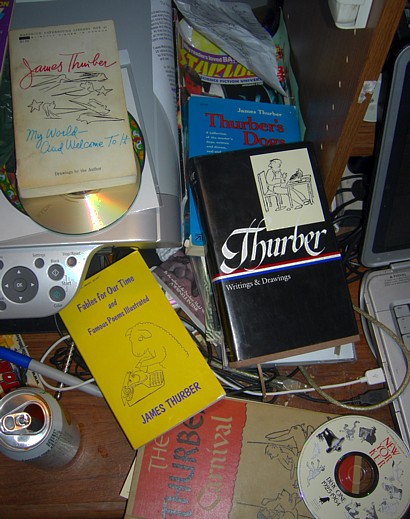
I don't have a single photo taken in New York City, but here are a couple of purchases I made there, over thirty years ago. Yes, of course there's a story behind them.

The blue trade paperback of Thurber's Dogs was one of two Thurber books I bought on my "senior trip" to New York City in 1973 or 1974. I was actually a high school junior at the time, but the school let a few juniors come along to fill out the roster. Good thing, too, because they didn't organize a senior trip to New York when I was actually a senior.

It was a great trip - not always pleasant or interesting, but perversely interesting even when things got a little boring or unpleasant. We stayed at a run down hotel somewhere near Lincoln Center; it hay have been called Hotel Lincoln Square or something like that. The image that sticks in my memory is that someone had painted the ceiling and fixtures white - including the bare lightbulb in the overhead light.

In case you're wondering, Manlius was about a five or six hour drive from New York, down the New York State Thruway. Or you could take the train from East Syracuse - which we did.

The trip's chaperons were members of the English and Music departments at Fayetteville-Manlius High School‎, so naturally there was a lot of culture on the itinerary. We saw The Tempest (one of my three favorite Shakespeare plays) at Lincoln Center, with young Carol Kane, fresh from her Dr. Pepper commercial, as Miranda. We visited the Metropolitan Museum of Art, and The Cloisters, the place with the Unicorn Tapestries. We visited Grand Central Station (the train from Syracuse went into Penn Station), went up the elevator in one of the towers of the World Trade Center, and walked through Central Park. We saw Carol Channing as Lorelei in Lorelei, a Broadway sequel to Gentlemen Prefer Blondes. We all agreed (including and especially the teachers) that it was terrible, Channing at her past-her-prime worst.

Back at Lincoln Center, we trooped up to the balcony, or possibly the mezzanine, to see Madame Butterfly. And here is where the books come in: Thurber's Dogs and the other book I bought that day, Thurber Country. Truth is, I hated Madame Butterfly. I didn't understand the language, didn't care for the music, and thought Butterfly was a pathetic victim who should have stood up for herself and gotten on with her life. Rather than pay full attention to something that bored and annoyed me so much, I sat in the balcony and squinted at Thurber's Dogs in the darkened Metropolitan Opera House. All these years later, that still amuses me. I don't regret it one bit.

That wasn't my first trip to New York City, or my last, but it was one of the most memorable. I'd previously been to the City a few times with my family when I was much younger, but all I remember from that was standing outside a hotel where my maternal grandmother was staying. My dad's family lived over in Little Ferry and Denville, New Jersey, but I think we pretty much bypassed Manhattan when we went to Jersey.

The other really memorable trip to NYC was in February, 1975, when several members of STAR Syracuse took the train down to the second-ever (or thereabouts) Star Trek Convention, held at the Commodore Hotel adjacent to Grand Central. For three days I practically lived on hot donuts I'd watched being fried, right around the corner from where the hotel emptied into the train station. (This was before my digestive system started punishing me for every donut I ate.) I met David Gerrold, who was one of my favorite writers at the time, and was kissed by Isaac Asimov, apparently one of his favorite activities at conventions at the time. I had chosen to praise his TV Guide articles to distinguish myself from the crowd. I think that amused him.

During that trip I made one solo journey away from the hotel and station to go see John Wood in William Gillette's play Sherlock Holmes. Foolishly, I carried my plastic bag from the Star Trek convention with faces of the cast on it, and I went alone: young, innocent and completely unarmed. I took a cab down, confidently asking the driver for "the Broadhurst Theater, please," only to be asked for the address. The play was a lot of fun, but I had a little trouble hearing the dialogue from the mezzanine. On the way back, I couldn't find a cab, because I needed to be one block over and didn't know it. So I took the subway back. The worst thing that happened was that a few people kindly berated me for taking chances, taking the subway alone like that. But it made me feel good, because people were actually looking out for me, a stranger, rather than trying to rip me off.

There was a moment, on that trip or the previous one, when someone tried to grab my purse in front of a store. They didn't get it. I held on too hard, and the guy kept going.

It was on this Star Trek trip that Chris D. and I saw the 59th Street Bridge, immortalized by Simon and Garfunkel, and that I bought The Wonderful O. On the train ride back, I amused Chris by reading passages from the Thurber fairy tale, so rich in wordplay:

"I don't like it, I don't like it," squawked the parrot, and Black squcked his thrug till all he could whipple was geep.

"Geep," whuppled the parrot.


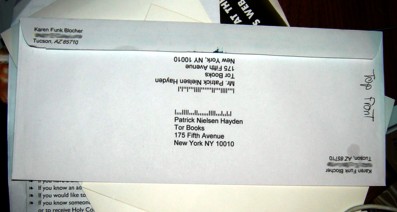
It's fitting that I should remember New York City fondly in connection with books and writers. New York is the center of the publishing world, at least in the United States. Most of the major publishing houses are based there, although some of them are owned by overseas conglomerates these days. James Thurber worked for The New Yorker for many years. Madeleine L'Engle was born in NYC and lived there at least part time as an adult. And of course John Scalzi is there now, conducting business with his editors and publishers. Someday I hope to do the same, perhaps in the very same building. To that end, I sent off my follow-up letter to Tor today, in preparation for which I wasted an envelope, sending it through my printer-scanner twice to determine the right way to insert it. Answer: face up, with the flap underneath to the left.

Come to think of it, I did once meet with my editor and publisher in New York City - somewhere in the vicinity, anyway. Les and Toni from Relix Magazine, which published my first professional articles, took John and me to lunch in Chinatown in 1981.

You may have noticed that I'm careful to always say New York City or NYC, never simply New York. Growing up in Manlius NY and later attending college in Syracuse, I was painfully aware that vast numbers of Americans, including people from New York City and environs, assume that "New York" consists of the five boroughs, or just Manhattan, or, at most, a metropolitan area that includes places like New Rochelle, but nothing much farther than that. Syracuse, located smack dab in the middle of the state of New York, at the crossroads of I-90 (the Thruway) and Interstate Route 81, is dismissively referred to as "Upstate." No, no, no. Upstate is Watertown. Syracuse and Manlius are in Central New York. I'll never win that battle, but I'll never stop trying, either.

Still, aside from the nomenclature problem, I quite like New York City, and would gladly go there again. And maybe I will.

As for the Yankees, I don't actually have strong feelings about them one way or another. I kinda lie Joe Torre, and the Yankees are certainly rich in baseball history. But I don't care. The Diamondbacks beat them that one glorious year. That's good enough for me.

Karen

Technorati Tags: , , , ,

Saturday, December 09, 2006

More Fun Than Anybody


  • It is better to ask some of the questions than to know all the answers.
    • "The Scotty Who Knew Too Much", The New Yorker (18 February 1939)
It's 4 AM already, and my brain, back, and eyes decided an hour ago that they shouldn't be expected to do any more work tonight. So I'm aiming for a short entry tonight, passed out with the stuff I'm writing about: quotations by James Thurber.
  • Don't get it right, just get it written.
    • "The Sheep in Wolf's Clothing", The New Yorker (29 April 1939); Fables for Our Time & Famous Poems Illustrated (1940). The moral is ironic.
I spent six hours tonight tracking down 17 quotations by James Thurber. Perhaps if I explain, you'll be able to decide whether this is a new obsession, a minor variant on the existing one, or an evening's aberration. It started a day or two ago, when someone added the following to the Wikipedia article on James Thurber, right at the beginning of the bio after a discussion of Thurber's mother:

Some relatives still living today include Mark M... of M..., New Jersey and his family. [Identifying details removed at person's request, May 2008]

I had a minor wrangle with someone over the fact that I took this out. Relative he might be, but Mr. M, whose sole claim to fame other than family connection is that he once sold a crossword puzzle for publication, is unlikely to be more notable that any other living Thurber relative. I pointed this out, and the person who griped at my edit added references to other Thurber relatives to balance things out. I'd not an ideal solution, but it will do for now.
  • "All right, have it your way - you heard a seal bark!"
    • "Women and Men", The New Yorker (30 January 1932);The Seal in the Bedroom and Other Predicaments (1932).
Anyway, today someone else made a minute edit, and it occurred to me that the bio section of the article wasn't very good and could use a rewrite. I pulled up the Thurber House page with the bio on it, and did a quick revision. Then I was going to go back and add citations, maybe even do a more thorough rewrite from other sources - but I never got there.
  • A pinch of probability is worth a pound of perhaps.
    • note for "a future fable", "Such a Phrase as Drifts Through Dreams", Holiday Magazine; reprinted in Lanterns & Lances (1961).
You see, there's a rather long list of quotations on the Thurber article, probably because he said quote a few interesting, funny, profound and/or memorable things, and people keep wanting to add their favorites. Like trivia, though, a long list of quotes is looked down upon at Wikipedia. I wondered, therefore, whether it might be worth moving some of them to Wikipedia's sister site on Wikimedia, Wikiquote. So I followed the link to Wikiquote, to see what was there already.
  • It is better to have loafed and lost, than never to have loafed at all.
    • "The Courtship of Arthur and Al", The New Yorker (26 August 1939); Fables for Our Time & Famous Poems Illustrated (1940). Parody of Alfred Lord Tennyson, Better to have loved and lost/than never to have loved at all.
Well. There are, by actual count, nearly 100 Thurber quotes there, over half of which weren't nailed down as to where they came from. You probably know by now how the Internet is: the various quotation sites copy from each other, until everyone has the same long list of assorted quotes, half properly quoted and attributed, half not-so-much.
  • In this light, let's not look back in anger, or forward in fear, but around in awareness.
    • "Foreword", Lanterns & Lances (1961)
Six hours later, I had organized the Wikiquote page into more sections, pulled half my Thurber books off their shelf, run a search for Thurber on a CD of New Yorker cartoons, tracked down the source for 17 quotes and entered them. While I was at it I was able to fix about five misquotes, read bits and pieces of a lot of diverse Thurber material,and generally had a great time.
  • The dog has got more fun out of Man than Man has got out of the dog, for the clearly demonstrable reason that Man is the more laughable of the two animals.
    • "An Introduction", The Fireside Book of Dog Stories (Simon and Schuster, 1943); reprinted in Thurber's Dogs (1955)
But now it's almost 5 AM, and I really, really, really need to go to bed. Good night!

Karen


Technorati Tags: , ,