Showing posts with label Ethics. Show all posts

Wednesday, August 16, 2017

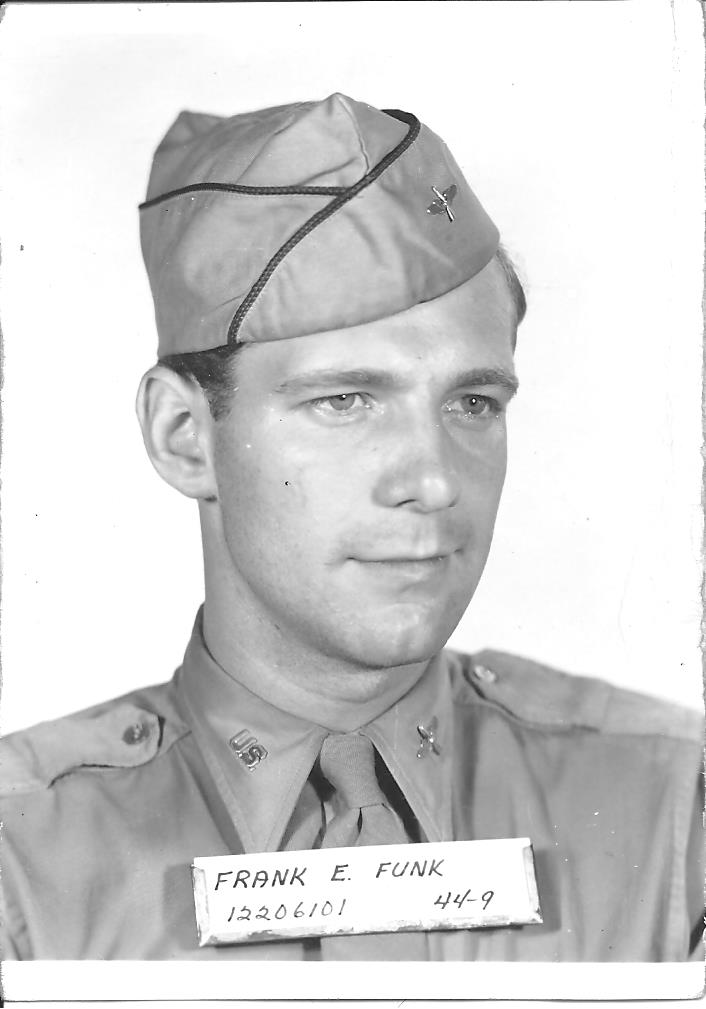
Frank Funk Vs. the Nazis

 A picture someone posted of Allies storming the beaches of Normandy tonight reminded me of my own dad's World War II experiences. He didn't talk about it much, but he spent time in a German POW camp, and saw the actual, historical Nazis close up.


(Any typos or mispelling are from the quoted source.)

Frank Funk: As a World War II combat vet, I decided I would go [to a class on World War II]. And what was interesting to me is that while I had experiences during World War II, but I had a narrow view of a war, because of my own experiences., flying out of Italy in a B17 bomber as a navigator. But Wilbur's course gave me more of a global sense of that total war, including the Pacific as well as European war and all that.

I flew out of Foggia, which is north of Naples, as I say, in a B17 bomber. After three missions, I think, our plane went down in Czechoslovakia. We were captured by the old guard and taken to prison.
They took us to an interrogation camp where they tried to squeeze what they can out of you. It was an interesting experience, because they understand, if you get isolated and nobody talks to you, then you can play the good cop, bad cop. Bad cop suggests you might leave feet first. And good cop says, "For you, da var is over. Ve is flyers together. Ve understand these things, und have a zigaretten." And I said, "No thank you." 

So an interrogation camp, and then to an officers' camp. See, under the Geneva Convention, officers were not supposed to have to work, whereas enlisted me had to be in work camps. And so I was in Stalag Luft I north, about 60 miles from Sweden, north of Berlin, for seven months I think, seven or eight month. We eventually were liberated by the Russians, believe it or not, and they were very unhappy with us, because our high command had decided that the would keep us locked in, because if they let us scurry around the countryside, people would get in trouble, easily. We were half starved, and if you overate, you could actually die from acute gastritis and stuff. 

Anyway, I'm coming up to my favorite World War II story. So we were finally, after drinking vodka with the Russian high command and radioing frantically to France, we were flown out from a nearby airport to Marseilles in France. So here we are, ex Krieg Gefangeners, was the German name. Krieg for war, war prisoners, on a chow line, watching German POWs go through the line with their trays piled high with food, and we'd eaten sawdust bread and scooped maggots of the top of stew and so on. So that was not a very good thing for us to see, but we had tried to understand. And there was a commotion at the end of the chow line. You could tell from retinue that somebody important was coming along. By gum, it was Ike Eisenhower.

Yeah, we were in Marseilles, on a chow line, ready to be shipped out. And usually, by boat, which gave them a chance to fatten us up on the way over to the States. Anyway, the story goes like this. We noticed this commotion, and here comes Ike Eisenhower and a whole retinue of people with him. And he stopped and it sounds like I'm making this up, but I swear, I'm not. He stopped the guy next to me and he said, "Where are you from, son?" 
And the guy said, "Kansas, sir." 

"Oh, the hell you are. You know, I'm from Kansas too," and they both laughed. And he says, "Got a question to ask you," says Ike. "Would you rather go home quickly, or in style?" 

And this kid, without missing a beat, said, "Both, sir." And he laughed and moved on. And that's a wonderful memory of a world renowned figure and humanizing. And he was that way with the troops, and it was genuine. You know, it wasn't phony. "Oh, the hell you are. I'm from Kansas." You know, it was like-- it made him very human and special. That's my World War II story.

We had a quick home visit and then went to a convalescent hospital in St. Petersburg, Florida. And they had ex prisoners of war go there. They thought that we might have post traumatic stress syndrome. And so they gave us what is called truth serum, to have us talk about horrible things that happened and so on. Well I read recently, that don't assume that everybody has automatically post traumatic syndrome. I don't think I had a lot of it. I saw a guy get shot through the window, because we weren't supposed to be near the windows during an air raid. And somebody was drawing his picture and wanted him near the window for light. I saw a guy get shot because he went after a ball, and he thought the guard had nodded to say, yes you can get it, and the guard didn't. So, you know, and we were starving and all kinds of things. And we were shot at, as we went over targets and saw planes go down and so on. But anyway, then we talked earlier. We came back and got the GI Bill. I'd gotten out of high school in 1940, and you could tell the war was coming. You know, the march into Poland and all kinds of things. And Britain was in it early and so on. So I was saving money to go to college. Nobody else in my family had gone to college. I have four sisters.

So I didn't go to college. I went to work for a valves company and did all kinds of other things. Eventually, after Pearl Harbor, all young men wanted to get into the service, and most of us wanted to be a hot pilot [makes engine noise]. I went to get a physical and was rejected because of a deviated septum. I went and got it operated on and went back the same day. And I remember the doctor looked at me and pulled the cotton out and said, "I can't even see, but I can tell you've had an operation done on your nose. Accepted." And then you went to basic training, Atlantic City, then to a classification center in Nashville, where you had all kinds of tests. Then you'd go to the bulletin board, and if your name was on it in the right way, you'd go to an officer's school. If it wasn't you'd go to a gunnery school and be a noncom, or an enlisted man, a gunner. I evidently made it to navigation school at Monroe, Louisiana, and the government spent about $87,000 on each of us and taught us to navigate by the stars, celestial navigation, and then they sent us to Europe. And my sextant to do the star sighting was in a polished wooden box at the corner of my muddy tent in Italy. But if they needed to, they could have sent me the Pacific, you see. So that's the way it was.

After the war, I used-- yeah, I went back to Syracuse. Oh, I forgot. When I first got in the service, as so many men were going in soon after Pearl Harbor that the classification center was jammed. So what they did was to send you to a campus in a college training detachment, and I went to Syracuse University. And so, I wanted to go, I knew it, and it was a beautiful city, and I wanted to go back to it, and I did. And eventually, you know, got my undergraduate degree there, on the GI bill. Went to Lehigh University in Bethlehem, Pennsylvania as an instructor, working on a master's. Finished my master's, went to Purdue University to get my doctorate in 1955.

End quote.

Yes, it was a different time, but the same Nazi regime that imprisoned my dad also killed millions of Jews, gays and others for the crime of merely existing. The Nazis of yesteryear are now being emulated by twenty-somethings and others who carried Nazi flags, torches and guns in Charlottesville last weekend. Anyone who marched and chanted with such people, some carrying Confederate battle flags, some not, is allying himself or herself with evil. Anyone who equates the counter-protesters (many of them clergy, many of them trying to help and protect others, very few of them violent in any way) with armed and violent neo-Nazis and their allies as "equally to blame" for what happened in Charlottesville is giving aid and comfort to the forces of hatred and oppression.

Karen

Sunday, November 07, 2010

Fairness to George, Part Three

George Maharis and me in a Denny's parking lot, 1986.
I received an email today from Rick Dailey of Cuyahoga Falls, Ohio, who is building an online location guide to the 1960-1964 television series Route 66. Recently he and another fan have been researching the circumstances of George Maharis's controversial departure from that show, looking into actual documentation from the time. Rick got in touch with me because I wrote a couple of posts on the subject several years ago, based on my 1986 interviews with Maharis and others. I still occasionally get feedback from people about the two "Fairness to George" posts, so apparently there is still interest in this 48-year-old controversy. I recently found a dot matrix printout of the Maharis transcript, from our 1986 interview at a Denny's in Las Vegas, so this seems like a good time to post a few excerpts.

First, here's the gist of the story. Route 66 was a television series about two guys (originally Martin Milner as Tod Stiles and George Maharis as Buz Murdock) driving around the country in the late-model Corvette Tod inherited from his father, taking odd jobs, meeting people and having adventures. Three things made it an amazing and groundbreaking series. First, it was filmed on location all over the country, from Oregon to Grand Isle, Louisiana. Second, it was primarilly written by one of the show's producers, Stirling Silliphant, who drove around the country ahead of the production crew, and wrote stories based in the places he visited. Silliphant had a unique, lyrical style that was unlike anything else on tv. Third, the two stars, aside from being young and hunky, were interesting and contrasting characters, well-played by Milner and Maharis. Tod was the largely soft-spoken, well-educated but now penniless son of a failed businessman, with a strong ethical sense. Buz was working class, a bit of a rebel, self-educated, passionate and articulate.

And then George Maharis got sick with hepatitis, and ended up leaving the show under a cloud. There were accusations that he was trying to break his contract to go make movies, just another big-headed star behaving badly. The unreported (at the time) undercurrent of the rift between the star and producer Herbert B Leonard was Leonard's belated discovery that Maharis was gay, with the potential scandal that such a fact might cause the show if it ever came out in the press. This was 1962 after all, decades before Ellen. He was replaced by Glenn Corbett as Linc Case in 1963, but ratings soon declined and the show was canceled in 1964.

Found! The Maharis transcript.

Now let's have a look at a few bits of the transcript, which I typed up tonight for Rick Dailey:
Maharis: Well, they made a mistake with Glenn. It was very funny, because I had never seen the shows that he was in. I was ill. And I don't know what they told you about that, but that was a lot of stupidity and miscommunication. Nobody talked to me about it. And I was the object of all this garbage.

We had been working in cold water. It was winter, and we were working out here in California. We went out to do a show at the Veteran's Hospital, and there was a shot with Steve Hill, and I had to go down to the bottom of a pool and get him. Well, the inside pool that they used there was ninety degrees. The pool that they actually shot was an outdoor pool, and it was forty degrees. And the stuntman, who was my double, couldn't get in the water. It was too cold. So I did it.
He goes on to say that he also worked in a river with Barbara Barrie, at night in 17 degree weather, and she had a wetsuit and he didn't. He got a cold, and they gave him a B12 shot, and he got hepatitis from the needle. Then he worked in the water off Catalina Island, and felt very ill. At that point he ended up in the hospital for a month. After that he says he returned to work too soon, working long hours for the next four months.
Maharis: ...and I was in really bad shape in St. Louis. And the doctor in St. Louis , who they had sent me to, said, "Get home. Now." And for some reason or other, they thought it was something to do with contracts. And the doctor said to me, in St. Louis--and it was their doctor--he said, "If you don't leave now, you're in serious trouble." And I left.

And by that time, it was ugliness. It didn't have to occur. It didn't have to happen. But for some reason or other, the people who were next to the people who were next to the people, talk to each other, and they don't know what the hell is going on. And nobody ever called me about it, and said, "Are you ill?" All of a sudden I started reading this shit in the paper [which said] I was trying to get out of my contract. Trying to get out of my contract? I was in New York; I thought I was dying.

And here is the last page of the 53-page transcript.
Karen: He [Milner] said that he felt that Tod was not anything like himself.

Maharis: He's wrong. From my perspective, he's wrong. Very much of Tod in him.

Marty's not as gregarious as [I am]. He's not as trusting. He's more suspicious. I'm suspicious, but I'm more vocal about it. He's suspicious, but he's hesitant about it. I don't know why. He's been successful in his career, and he...you would think that he'd say what he wanted. See, I don't give a damn. I say what I want anyway. I figure, if they don't like it, too bad. Money doesn't make the difference of whether you can say it or not say it. I think everybody's got that right. The only thing is, you have to stand by it.

That's the best of it. here's also a rather good 2007 interview I found online tonight. Check it out here.

Update: I've had another email on the subject, and without going into specifics, I should state here that Maharis seems to have been more at fault in the circumstances of his departure than I ever suspected. The evidence would appear to indicate that (as usual) the truth is somewhere in between the claims made on each side, and possibly closer to the producer's side of the story than George's. For example, as producer Herbert B Leonard pointed out to us all those years ago, during the "three years" Maharis says it took him to recover from the hepatitis, he made at least three films, as well as recording sessions and singing appearances on tv. My guess, such as it is, is that Maharis felt he was well enough for these activities, but not for the more physically demanding work of an action-adventure tv series shot entirely on the road. What a shame; regardless of who was right and wrong and to what degree, the falling out between George Maharis and the makers of Route 66 cut short an astonishing run of literate, groundbreaking television, and left Maharis with a somewhat tarnished legacy.

Karen

See also:
Fairness to George, Part One

Fairness to George, Part Two

Wednesday, September 01, 2010

Weekend Assignment #333: Discussion on a Bathroom Wall


Weekend Assignment #333: Writing on the Wall

Have you ever written on a bathroom wall, or left graffiti anywhere at all? Confess! I promise we'll go easy on you! How do you feel about the ethics of graffiti, and the level of discourse sometimes found in illicit art and messages in public places?

Extra Credit: If you were to leave a message to the world on a public wall, what would it be?


I went back and photographed the Safeway restroom walls all over again for you, because my original photos were on my phone and I can't find the adaptor for the memory card. Darn it.


"RU Born Again?" someone with a blue Sharpie asks, followed by the inevitable Bible citation. Someone with a pink marker adds a different Bible reference. "Born right the first time," someone cheekily replies.


Another exchange on the same wall runs along similar lines.

"Want change? Ask Jesus to come into your life."

"OR TAKE RESPONSIBILITY FOR YOUR LIFE AND MAKE THINGS HAPPEN YOURSELF!"

"love [something crossed out, possible "God"] MY LIFE"

"Don't depend on Obama or any other political personality!"

I was fascinated with these little handwritten religious and philosophical arguments among strangers that I encountered at my local Safeway a few weeks ago. I have to wonder what sort of person thinks a bathroom wall is an appropriate and effective medium for converting someone to Christianity, or who they expect to convince with a cliche phrase or two. The responses I find more understandable, as someone's attempt to disabuse the original writer of her naivety, or at least let loose with a bit of wit. It's interesting to see graffiti that points out the logical flaw in someone else's graffiti:


"I need some advice"

"So you ask for it on a bathroom wall?!"

"I needed an unbiased opinion"

Apparently the person no longer needs the advice. We don't get to find out what their dilemma was. Dump the boyfriend? Go back to school? We'll never know.

And then there is random paranoia on the opposite wall:


"The government is looking for you."

Heh.

It seems to me that I may have written on an already well-covered bathroom wall a few times in my life, most likely in Columbus Ohio when I was in my early 20s. I have no idea what I wrote, if anything. The one graffiti of mine that I remember almost-for-sure goes back even earlier. There was a tall silo or water tower at the edge of the farm adjacent to Fayetteville-Manlius High School when I was there from 1972 to 1975. (My junior high before that was in half of that same building.) The farm belonged to the man who moonlighted as the driver of my afternoon school bus. I've long since forgotten his name. The tower was, of course, covered with graffiti, mostly about how great the school and its sports teams were. For years I looked at that silo and had two conflicting impulses about it. On the one hand, I fundamentally didn't like the idea of defacing someone else's property. I considered it unethical. On the other hand, writing on that tower was clearly a school tradition, and one more note was not going to make much difference. In the end I decided to go up to that silo and write the word "HI" in the tiniest lettering I could manage. In pencil.

I don't remember whether I ever actually committed this crime, or merely thought about it for a year or longer.

But yes, I think graffiti can be really interesting, obviously. Sure, there's very little to be said for messages such as "JOHN + KAREN 4EVER!!!" or some bit of rudeness or crudeness. Not do I approve of "tagging," where the sole purpose is to leave your mark on someone else's property in six foot high letters and three colors of paint. But a discussion on a bathroom wall is a different story. That's pretty much a victimless crime,  a momentary amusement and food for thought for whoever comes along and reads it.

If I were to leave a message on a wall myself, maybe it would be the word "HI" in 1/4" tall letters. Or maybe it would be the aphorism version of my personal philosophy:

There is no Them. There is only Us.

But what the heck. I don't need to write on a wall. I have a blog!

Karen

Thursday, November 06, 2008

I Remember Ethel


Sometime in the last 24 hours, I dreamed about Ethel. It was just for a second, just long enough for me to realize who she was. Then she walked away, head held high.

I probably wouldn't have remembered that snippet of dream were it not for the fact that Merry Maids has a sign up announcing that they're hiring. I considered for a moment whether I'd be willing to wash windows and vacuum floors just to get employed again. Then I saw that the pay offered is hardly more than I'm getting in unemployment now.

Ethel was a maid - or, more accurately, a housekeeper. Within a year or two of our moving to Manlius, NY in 1961, my Mom hired her to come in twice a week and clean our house. She did laundry and vacuuming, dishes and dusting. And when I was little and not in school, she made me Campbell's soup and bologna sandwiches for lunch. I think that when she started, she was 28 years old. Her favorite tv show was The Edge of Night.

We didn't get along well, especially as I grew older. It wasn't because she was the only African American I knew back then (not that that term existed yet). It was because she found that the most efficient was to clean my room was to throw my stuff away. Once I wrote on an envelope, "Do not throw away." She threw it away. There was money in it. I got in the habit of going through the trash cans in the garage on Tuesdays and Fridays.

I should have been cleaning my own room, and I should have negotiated with her rather than resenting her. As it was, I probably wasn't very respectful. She called me a "b---h" when I was too young to know the word. When I was a little older, I tried to get her fired. Not good. My mom was never going to fire her in any case. Mom's health wasn't great - she had lingering effects from polio encephalitis - and she really needed the help.

And yet, even back then, with no experience of black people beyond this woman I didn't like very much, I saw that bigotry wasn't confined to the people on tv, the people down South who opposed "forced busing" and the man who killed Martin Luther King. I saw that even my mom, the Johnson Democrat from Stratford, Connecticut, had her lapses and her biases. It made me question my own attitudes, and fight to be fair-minded. And when we finally did terminate Ethel's employment, because my parents were divorcing and my mom was moving to Florida, I cried and wished her well.

And here is where I'm going with this seemingly pointless reminiscence. I would like to think that 45 years later, a young woman like Ethel would have a much broader track of opportunity than the woman I sort-of knew. Today's Ethel should have the same shot as anyone else of a decent education, and of a job that doesn't involve cleaning up after a suburban family of professionals. Given the same advantages I had, today's Ethel could probably be a suburban professional herself. And I hope that even the original Ethel's life improved considerably after the day we said goodbye.

Are we there yet? The election of Barack Obama as President of the United States points to the answer, that yes, she can. But as far as we've come, we still have some distance to go. Last night, NPR ran a memorable photo of a hotel ballroom in North Carolina, site of an abortive GOP victory party. The signs for Elizabeth Dole (shame on her!) were still up, but the Republicans had left. "But as Obama's speech came on the TV in the hotel ballroom, about a dozen hotel employees gathered to watch -- all of them African-American."

There will always be people cleaning rooms and vacuuming floors, and making considerably less money than other people with better jobs. But we should never have reason to assume that the people at the party are white, non-Hispanic and Protestant, and the people doing the cleaning are African American in some parts of the country, Hispanic in others. We really should be beyond that by now.

And it is getting better, much better. Last night's election proved that. The smart, thoughtful, even-tempered Harvard guy didn't fit the old profile for the job of President of the United States, but he was the better candidate and he won anyway. The old barriers are falling. And that's also why I'm sure that the passage of Proposition 8 in California, of Prop 102 in Arizona and whatever the equivalent measure was in Florida is only a temporary setback. The tide of history is pushing us forward, and a single wave of bigotry can't hold it back for long.

Karen

Sunday, June 15, 2008

Humans: Threat or Menace?

I think it was in ninth grade that my English class was not only assigned to read the novel Lord of the Flies by William Golding, but to watch the 1963 film based on the novel. I hated them both, passionately. In the years since then, I have occasionally remarked that it's the one book I would "unread" if I could, and one of only two or three films I would "unsee."

Then today I saw "Midnight," the newest episode of Doctor Who which just aired in the UK. I don't like to go on too much in this blog about the plots of episodes that have not yet aired in the U.S., but I must tell you that this particular story shook me. It was a psychological horror story about human beings at their worst, pretty much the opposite of the pro-humanity message usually put forth by Russell T Davies, the showrunner and author of this episode. While it's true that there are extenuating circumstances (including a particularly mysterious alien) that help to bring about the characters' paranoia and potentially murderous behavior, that doesn't make it any easier to watch or accept.

Yes, I know that people sometimes behave horribly in the real world, especially when stressed or frightened. On the trivial, relatively harmless end of the scale, I was ganged up on by a circle of kids on the school playground in fourth grade, and laughed at by the teacher who should have put a stop to such things. People have been killed for cutting someone off in traffic, or for money, or because people have convinced themselves and each other that another human being is one of Them, subhuman and evil.

If I need reminding of the failure of humans to behave humanely, I have only to listen to the news. The United States currently has a president who believes in denying habeas corpus and other protections to offshore prisoners for years on end, on the theory that they're "bad guys," and resists making any attempt to prove this assertion in civilian court. The Supreme Court finally made a stronger statement about this unconstitutional policy than in its previous decisions on the subject, and John McCain made some horrible, ridiculous statement about it being the worst decision in the history of the country. And in the same week, this paranoia about Them has led to erosion of similar principles in the U.K., and protections that go all the way back to the Magna Carta. Aside from being unethical, this Us and Them attitude backfires on the country that behaves this way, making Us seem ignorant and cruel and hypocritical.

That's all real stuff. I don't like it, but I accept that people behave that way. So why can't I handle seeing six fictional characters on a space bus, excluding the inciting alien, being mean to the Doctor? That's crazy, isn't it? Don't I know that people under duress can be horrifyingly evil? How else does one explain the Holocaust?

Okay, yeah. But.

By and large, I don't see people murdering each other over money, religion, political power, sexual orientation or any other motivating factor. Heck, I've never seen a murder at all, and hope I never shall. I think one reason I listen to NPR rather than watching tv news is so I won't see people suffering and dying in Iraq or Zimbabwe or Myanmar. And on NPR I also hear the voices of people trying to help, the Doctors Without Borders rep, the reporter who sneaks into a third world country at the risk of his own life, the Red Cross or UN spokesperson.

And I know that there are a lot of good people out there, and that people are mostly good most of the time. For every xenophobic jerk who thinks that a young Mexican man or woman sneaking across the border in search of a better life is a lawless, freeloading "invader," there's someone else who is trying to reduce the horrible death toll in the Arizona desert of "invaders" who didn't manage to survive the dangerous trek. I've seen many people behave with kindness and compassion - and that's what I prefer to see in people, not the awful flip side.

The question is, what can we do about human brutality, paranoia and mob behavior? Is it inherent? Can it be overcome? I'd like to believe that it can. What it would take, I think, is for people to be taught to reason and to understand, and to have compassion. Most of all, we need to know, finally know, that we're all human beings and there is no Them. If every person saw the value in every other person - the Muslim, the Jew, the undocumented alien, the opposition leader, the member of that other tribe or religion or nation or faction - it would be much harder to have wars and murders and other horrible things that we do to ourselves.

Unfortunately, I know of no way to accomplish this. All I can do in support of the cause, apparently, is rant in this blog.

Rant over, until next time.

Karen

Tuesday, December 04, 2007

The Comment Manifesto

I tend to get suspicious when an older entry from the Outpost gets a new comment. Sometimes it's because someone was Googling for pages on a specific subject (I get lots of hits on my George Maharis posts, for example), but more often it's comment spam.

But this one tonight was in a class of its own. It was posted to "The Curse and Promise of Change," an entry from November 16th that has recently aged off my blog's main page.
Let's start with a copy of my posted comment in reply, slightly edited for typos, and then I'll say something new. Here we go:

I am deleting a comment that begins,

rafael said...

AUTHENTIC RECORD AND GEOLOGY SCIENTIS CAN’T CALCULATE THE AGE OF THE EARTH.
The subject of evolution among those who understand it, they must be aware that there is the danger of excessive subjectivity concerning one owns knowledge. This is not healthy, is a means of cultivating the mind with vain thoughts, and be fill with self examination. Is better, to be objective.

...and goes on for a total of 20,661 words, most of it in one paragraph. The bulk of it is an attempt to use Biblical quotes to disprove evolution. It contains misspellings, poor grammar and punctuation, logical fallacies, and pure gobbledegook. My favorite (by default because I haven't the patience to read the entire screed), is the following:

Darwinism was accepted by eugenics which was Hitler idealism or dream, never accomplished in Germany but applied in North America, where is up to now working, nevertheless the biggest lied on humanity is ending microscopic world.

Looky there! A genuine Reductio ad Hitlerum!

I would leave this misguided comment up in the interest of fairness (and so Paul et al. can laugh at it), but the fact is that it fails my comment policy. There is no indication whatsoever that the person read my entry, which was mostly about my job changes and Tuffy's cancer, and secondarily about change itself. Evolution wasn't even mentioned. I'm assuming that the person Googled the buzzword "species" and pasted in comment spam everywhere the word turned up. Sorry, rafael. Your manifesto, pasted in as a response to a posting on an entirely different subject, does not constitute intelligent discourse. Bye-bye.

Anyone who knows me, or even reads this blog on a regular basis, can probably tell that I'm not the most confrontational of people. I hate, hate, hate interpersonal conflict, and do my best to avoid it. It makes me physically ill. And I really do believe strongly in tolerance for other points of view, and not dividing the world into Us and Them, and all that other ethical stuff I sometimes rant about here.

So believe me when I say that I don't really want to belittle or make fun of this "rafael" person. That's not my idea of a good time. The deficiencies in English may be an ESL issue, and if it's not, it mostly just makes me sad to see the language mangled. Nor am I going to refute this manifesto, which when I paste it into Word comes out as 32 pages. The final paragraph is over 28 pages long, and consists entirely of interpreting Bible quotes as "proof" that Darwin was wrong. At least, that's the impression I get from glancing at a few lines here and there.

And that's kind of my point. Even if I were to leave this ridiculously long comment visible, I doubt that anyone would read it through, least of all me. It's not necessary, when it's possible to get a sense of the thing from reading bits and pieces of it. I can overlook deficiencies in punctuation (well, let's pretend I can) if the words themselves make sense. But there seems to be precious little sense to be found in this one, even beyond my gut reaction of "I disagree with you, and therefore you're wrong," which is a fallacy in itself. If I were to read it through, it would probably be to play "count the fallacies."

But let's not, and I'll tell you why. First off, this was an anonymous comment, in the sense of having no contact link for the commenter. It is unlikely that any attempt on my part to educate this person about science or critical thinking or paragraph breaks would ever reach its target. Second, even if the person were to turn up again, and I somehow overcame my aversion to confrontation, I doubt I could make a dent in the person's illogic. Third, evolution has plenty of defenders online, with far more knowledge of the subject and far better arguments than I could manage. It doesn't need me to jump in there too. Fourth, at least one of my friends has issues with the subject, and I don't want to open that can of worms. Fifth, I really do respect the right of this person to disagree with me. And sixth, it would be too darn much trouble!

What annoys me about it, though, and the reason I clicked on the trash can icon, is that this person posted 20,661 words of comment to my 1,519-word entry, not one of which related directly to what I wrote about. That's rather rude, isn't it? Here I am, going on about jobs lost and a sick dog, and trying at the end to turn it into something philosophical and uplifting. And does rafael call me by name, sympathize about Tuffy, or indicate in any way whatsoever that he's read a single word that I wrote? He does not, unless that single word is "species." And what is my grandiose claim, requiring 32 pages' worth of passionate but clumsy refutation? As far as I can tell, it was simply this:

Species die out, the Earth gets warmer, and new superviruses arise.

Y'know, I wouldn't have thought there was anything terribly controversial about that sentence. The passenger pigeons unquestionably existed, and don't anymore. Icebergs are melting, and polar bears are having a difficult time as a result. And hospitals find themselves battling highly drug-resistant viruses that weren't around a decade ago. One can debate about dinosaurs, or whether humans have an effect on global warming, or why and how viruses seem to get more virulent over time. But the facts stated in my little sentence are pretty hard to refute at this point, short of some elaborate twisting of both facts and logic. Notice that I didn't say why or how any of that stuff happens. I never used the word evolution. I was merely listing three examples of change, which was after all the subject of the essay.

Still, I doubt rafael even knows this, or cares. And that, more than anything else, is why I deleted the comment.

Karen

Friday, June 01, 2007

Stop MDC

Kate and her pistol
Black Rose Kate has no problem dispatching history's villains

"Aye, I thought ye'd be at the computer," announced. I looked up, startled. There she was, standing in front of my L'Engle books, my semi-fictional pirate friend, looking down at me with her usual air of amused tolerance. It was Thursday night, ten minutes past one in the morning. "Ariel said that you wanted to see me," she explained.

"Hi, Kate," I said. "Yes, I did. But how did Ariel know that?" Our mutual friend Ariel travels in time and between universes, meanwhile attending Croatoan College, which is itself transdimensional.

Kate shrugged. "She reads your blog. You mentioned me in tomorrow's entry. And that black cloth rose of yours was in one of your photos this week, so we knew you were already thinking of me. So tell me. Am I here for a particular reason, or is this a social call only? Did you want my expert opinion on that Johnny Depp movie Ariel has spoken of for the better part of an hour tonight?"

"Oh, I didn't go on about it that long," Ariel said, coming into the room behind Kate. "Hi, Karen."

"Hi, Ariel. And no, it's not about Pirates of the Caribbean. I have a Weekend Assignment to do, and I thought Kate might be able to help. You too, Ariel."

"Oh, one of those," Kate said, looking none too pleased.

I pasted the relevant text into this entry, and let them read it over my shoulder:

Weekend Assignment #168: For reasons best left unexplained, you have been allowed to excise one and only one person from the course of history. Which person would you choose to remove from history and why? That's right: Any one person you think history would be better without, you can now expunge. So who would it be -- and how do you think history would be changed with their absence? See. Told you it was one that would make you think.

Extra Credit: Favorite historical-themed movie. Because why not?


"I see," Kate said as she finished reading. "Because I have dispatched my share of enemies on the high seas and elsewhere, it pleases you to seek my advice before murdering some historical villain before he is ever born. Is that it?"

"Pretty much, yes," I said. "And you're right. I do think that preventing Nero or someone like that from being born is a kind of murder."

"But you don't have a problem with--" Ariel began. I was starting to think she was a mind-reader.

"Shh," I interrupted. "I don't want to talk about that. The point is, I wouldn't have the right to stop someone from ever existing."

"And you think that I, the bloodthirsty pirate, would be more ruthless about such things, and thus could give Scalzi an answer in your stead," Kate said.

"Yes," I said. "And if not, you can at least discuss the idea with me, and I can report on that."

"As I notice ye be doing already," Kate observed.

"Your problem with this is that you lack perspective," Ariel said. "There are plenty of worlds in which there was no Hitler, or no John Wilkes Booth, or no Nero. On the multiverse level, it's not that big a deal."

"It is if you're in a world where he did exist, and now you decree that he doesn't," I insisted. "That creates a whole new universe, right? And that's on top of the loss suffered by family and friends."

"I have known several families," Kate said, "that benefited greatly from the death of a father or brother or son. A woman my own age once thanked me for killing her husband, who had chained her and beaten her. Pick someone sufficiently awful, and the world is certain to benefit."

"Well, I did think about choosing someone whose nonexistence would mean lives saved," I said. "I could go with Adolf Eichmann or Josef Mengele, but that violates the spirit of disallowing Hitler."

"Who were these people?" Kate asked.

"Eichmann helped Adolf Hitler, the ruler of Germany, organize the murder of millions of Jews and Romany and other people," Ariel said. "Mengele conducted horrific medical experiments on some of their victims before killing them."

"Right," I said. "But it's all part of the same horror. And I don't think there is an equivalent person in more recent examples of genocide. Usually it's groups of people killing other groups for the crime of being a 'them'. So I was thinking along the lines of a Richard Speck, or Timothy McVeigh - you know, someone who personally killed a lot of people."

"Aye, that makes sense," Kate said. "But ye didn't need me to figure that out."

"I still don't like it, though," I said. "I still wouldn't do it. Would you?"

"Aye, with hardly a moment's thought, nor any regrets," Kate said. "Oliver Cromwell is another one I would not mind seeing gone from the world."

Ariel was rereading the text of Scalzi's assignment. "You know, I don't think you read this very carefully," she said. "It doesn't specify that one person was never born. It only says excised from history. There might be other ways to do that."

That got me thinking. "Such as?" I prompted. I was starting to have a few ideas, but wondered what Ariel had in mind.

"Lock the person up so he or she can do no harm," she suggested. "Send the person back in time, or forward, or to another universe."

"Where the person can do even more harm in unknown ways," I said. "That's no good. But if we can stop the person from becoming crazy or evil or both, that would take him out of the history we know."

"Mark David Chapman," Ariel suggested.

I nodded. "I suppose I should go with McVeigh or someone like that anyway," I said, "or the older of the two DC snipers, or one of the serial killers up in Phoenix last year. But Chapman...I don't know. If you could catch him young, get him the right treatment, keep him on the right medication and away from the Dakota, that still only saves one man's life, technically."

"Yes, but what a life you'd be saving," Ariel said.

"Whose?" Kate asked.

"John Lennon," Ariel and I said together. "Of the Beatles," I added.

Before I could explain further, Kate pointed at me, a look of triumph on her face. "Aye, that's the one!" she said. "I like the Beatles. Ariel even took me to the Cavern once."

This made me angry. "Why didn't you take me with you? You know how much I want to go."

Ariel shook her head. "We bend the rules quite a bit even just coming to see you, even for a quick conversation. Your version of the world isn't meant to have time travel, and I can't let you go wandering the multiverse with me. We're pushing the fiction boundary as it is."

"Fiction boundary? What's that?"

"It's a way of gauging relationships between realities, and the relative safety of certain kinds of interactions," Ariel explained. "As my supposed creator in the context of this reality, you can receive my visits, as long as they can be passed off as fiction. But the moment you actually go into the past with me, or off into a world in which the Beatles have been reunited for the past twenty years and are currently in the studio, you damage every timeline you touch. Sorry."

"Whereas I have no such restriction," Kate said. "Say the word and I will take this Chapman person from history, my way."

"You know I won't condone that," I said. "Much as I'd like to."

"And anyway, you can't do that either," Ariel told Kate. "John Lennon wrote a song about you. That makes you fictional to him, too."

"He did? When was that?" I asked.

"1982."

"But he died in 1980," I said.

Ariel looked thoughtful. "Maybe I'm wrong. Maybe Kate does go after Chapman," she said.

"Then that's my choice, if I have to choose someone," I said. "Just don't actually kill him if you can help it."

For a moment Ariel looked tempted. Then she shook her head. "No, sorry," she said. "His death is too well established in your world. But we might be able to do it in another world, a few universes over. Are you game for it, Kate?"

"Aye, always. Let's go, then."

"Bring me back a CD," I said.

Ariel laughed. "Can't do that, either," she said. "but if you're very good, I'll find a way for you to at least hear a later album, at least once."

They left, then, and I was alone again, finishing up this entry. I don't know how serious Ariel was. She could easily have been making up all those rules as she went along. And I'm still a little worried that Black Rose Kate will kill Chapman rather than try to get him into treatment, or at least locked up.

Imagine there's no murder.

But oh, wouldn't it be something, having another 26 1/2 years and counting of new music by John Lennon?

Oh, drat, I didn't ask my guests about the Extra Credit. I'm not big on historical movies, unless you count Back to the Future or Camelot. Lawrence of Arabia was kind of amazing, although the long version really is too long. Oh, I know. My Favorite Year. That's based on a very specific history period: the days of early television, and the live comedy variety show.

Karen

Friday, September 01, 2006

Fairness to George, Part Two

A caveat before we get too far into this entry and I say something that might offend somebody somewhere. (Yeah, that about covers it.) To an extent I'm going to be speaking from ignorance - and that's kind of the point of the entry.

Back in July I promised to write more about George Maharis, the Route 66 star whose departure from the show remains somewhat controversial, some 43 years later. My original entry gives the background about our research for a Route 66 book (which I never wrote), the interviews we did, what I think really happened in 1963 and why I didn't write about it back in 1986. The short version: Maharis insists that he left the show for his health after being hospitalized twice with hepatitis. Executive producer Herbert B Leonard insisted it was a ploy to break his contract and go make movies, and furthermore brought up Maharis's homosexuality and alleged indiscretions, apparently to show that the actor couldn't be trusted. I shied away from the whole issue, and didn't even ask Maharis's co-star, Martin Milner, for his opinion until later.

Personally, I think George Maharis was legitimately concerned that his health was suffering, due to the punishing working conditions he was expected to put up with when he returned to work. He was very angry about it, and did not handle the situation with tact or discretion. The producers were ticked off: he was badmouthing the show and costing them money, just another star behaving badly. I doubt that they ever seriously considered the possibility that George was telling the truth, and that 15 hour days and shooting for hours in winter-cold water really was too much to ask of a guy with hepatitis. Actors who gripe in public are typically assumed to be spoiled and greedy, and Leonard didn't trust Maharis anyway after learning that the handsome young star was not the All-American heterosexual hearthrob the producer thought he'd hired. Aside from offering more money, which they assumed was the real issue behind the histrionics, the producers made no attempt to address Maharis's concerns, so he left the show. It's a tragedy in the classical sense, with hubris and a fatal flaw leading to the star's downfall. Maharis never regained the popularity he had for the first year and a half of his Route 66 tenure.

So George Maharis left Route 66 under a cloud, and with a bad boy image that did not yet have a sexuality component to it. Back in 1963, nobody was talking about which stars were gay, much less attaching a mystique to them as tragic heroes. But Maharis was reportedly arrested in 1967 and 1974 for "lewd conduct" involving men, and in 1973 he posed for Playgirl Magazine. As the LGBT subculture became less underground, these incidents gave the actor a cachet that presumably made him a more interesting and sympathetic figure for some people. He was no longer merely an actor who behaved badly and was struck down. Now he was a tragic, misunderstood artist, a bad boy who came into conflict with straight culture and suffered because of it.

Here we are, then, with multiple versions of the George Maharis story, and multiple perceptions of who he was and is, depending on who is telling the story. Frankly, none of these renditions, including mine, do the man justice. He's not merely an actor who misbehaved, nor the victim of circumstance, nor a gay icon. Well, okay, yeah, he's all of the above, but none of those descriptions provide a complete or accurate picture of him.

So when I first saw the George Maharis article on Wikipedia, I was less than pleased. From an old version of the article:

...the show's appeal declined when Maharis departed after his third year on the series, reportedly due to conflicts between him and Milner over acting styles. Glenn Corbett stepped in as Milner's new sidekick on the road, but a mere year later, in September 1964, Route 66 was cancelled.
For Maharis, a string of film failures followed, including "Quick Before It Melts" (1964), "Sylvia" (1965), "A Covenant with Death" (1967), "The Happening" (1967) and "The Desperados" (1969). To complicate matters, Maharis was arrested....

The two arrests were recounted in detail, but there was no mention of his Emmy nomination, his involvement in the unsuccessful-but-respected film The Satan Bug, the 1970 TV series he starred in, The Most Deadly Game, or his Las Vegas dinner theater gigs in the 1980s. No, the Wikipedia version was, he came from a large family, appeared in early dramas, starred in Route 66 alongside Martin Milner and a bunch of important guest stars, had a brief recording career, left Route 66 for no good reason, made some bad movies, was arrested a couple of times, sang in nightclubs, and does some impressionist painting.

Phooey on that. That narrative may be the one the first people who wrote the article wanted to tell, but it's not very accurate, and it wasn't very fair. So I added more of his tv, movie and Las Vegas credits plus his Emmy nomination, details on his recording career, and a photo that wasn't out of Playgirl. I also brought up the hepatitis, and both sides' claims about why he left the show. Better.

Then one day, as part of a general effort to bring Wikipedia biographies up to a required standard, the following notice appeared on the article's Talk page:

This article must adhere to the biographies of living persons policy as it directly concerns one or more living people. Unsourced or poorly sourced, and especially potentially libellous, material must be removed immediately.

That's when I deleted the references to the two arrests from the article.

Do I think those arrests ever happened? Oh, probably. But the only evidence I found online was an eBay listing for an obscure magazine, which had an article about one of the arrests. That's not exactly an unimpeachable source. To meet the Wikipedia standard, it needs to be better than that.

And frankly, I'm in no hurry to find a reliable source and put that stuff back in the article. The man is a (retired) actor, a singer and a painter. His profession should be his claim to fame, not a few incidents for which he was fined a few bucks. There was a time when George Maharis was a very successful actor in a very good tv show. That should be what's celebrated about him, not what happened in a men's room in 1974.

It's funny how the Internet works sometimes. Earlier this evening, I Googled "Mavarin map," hoping to find the entry in which I posted the map of Mâvarin that turned up recently in one of my old printouts. I wanted to use it in a pirate map generator. Instead I found a Route 66 blog, which did a whole entry about my earlier "Fairness to George" post, called Why did George Maharis leave “Route 66″? (Oddly, Google refused to turn up my entry itself.) After a semi-accurate recap of what I wrote about Maharis, Ron concludes:

I find it a little ironic that a socially progressive show like “Route 66,” which dealt with race and labor issues, didn’t take the high road with one of its co-stars. Then again, this was before the Stonewall uprising that sparked the gay-rights movement.

Yup. I agree. I hesitate to say outright that Herbert B. Leonard was homophobic, and that this was a contributing factor to the misunderstadings surrounding Maharis's departure from Route 66. But based on what we were told in those 1986 interviews, it's a little hard to draw any other conclusion. It really is rather sad. Here was a rising young actor in the role of his life, and it all came crashing down for reasons that had very little to do with the reported ones. Yes, Maharis and Milner had very different personalities and acting styles,but that wasn't the problem. Yes, Maharis probably did get the idea that he was largely carrying the show, and deserved better treatment. But if that's what he thought, there was plenty of justification for it. Maharis was so successful on the show that St. Louis Dispatch TV Magazine called Milner ""The 'Other Star' of Route 66". And Maharis certainly deserved to be treated with as much consideration for his medical situation as possible. Unfortuately, that didn't happen.

Blocher promises to write more about this subject, as she closes her post with “To be continued.” So stay tuned.
 
Done.

Karen

Update: Fairness to George, Part Three

Monday, July 10, 2006

Fairness to George, Part One

I've told parts of this story before, but bear with me.

Back in 1985 and 1986, Nickelodeon's new adult programming block, Nick at Nite, primarily aired black and white television shows from 20 to 25 years earlier. I still remember most of the lyrics they came up with for the My Three Sons theme on one of the promos:

They've got a dad
His name is Steve
He's got a job
He's really tall

And then there's Bud
He makes some food
They've got a dog
They're My Three Sons (on Nick at Nite!)

One of the shows Nick at Nite aired during that era was Route 66, a 1960-1964 series about two guys and a car, wandering the country together. John and I were much impressed with the writing on the show, so much so that we started taping it.

In early 1986, when John came into some money, we put our stuff in storage, bought a van, put a bed in the back of it, and started driving around the country ourselves. Partly we were looking "for someplace it isn't winter," but one of the goals was for me to write a book about Route 66, both the road and the tv series. Before the year was out, we drove on or near much of the decommissioned "Mother Road," talked to people from small towns and roadside businesses, and interviewed all three actors and both executive producers from the show. At least two other people were writing books about the road and the time, but we thought we had the angle to make ours unique, namely the tv show.

Then Route 66 was taken off Nick at Night, we switched from a Commodore 64 (whose oversized floppies have the only copies of most of my notes, even today) to a Mac SE, and I went out and got a job renting out videos. I abandoned the project.

One of the reasons I didn't try to finish the book was that I was having a moral quandary over it. When we interviewed George Maharis at a Denny's in Las Vegas, he spent much of the interview explaining vehemently that he left Route 66 for health reasons. In 1962 he came down with infectious hepatitis and was hospitalized. On this everyone agrees, but what happened next remains in dispute. According to Maharis, he came back to work, expecting a lighter shooting schedule because of his health. What he got was a relapse due to 15-hour days in often grueling conditions, including hours spent shooting a rescue scene in an unheated pool in winter, and another winter episode in which he spent many hours standing in cold water off Catalina Island. Finally his doctor told him to get out of there, or risk ruining his health for life. Convinced that the producers were never going to give him what he needed, George quit.

That's the Maharis version. The Herbert B Leonard version of the story was very different, but just as bitter and just as vehement. Leonard was the show's executive producer. He thought he'd hired a young hunk for the show, a hip, sexy man and good actor that all the girls would go for. This was all true of Maharis, but not the whole story, as Leonard discovered to his anger and dismay. George was gay, it turned out. Leonard told us that they sometimes had trouble keeping Maharis's sexual activities from the press. Meanwhile, according to Leonard, Maharis decided he was too big a star for tv, and to use illness as a pretext to break his contract and go make movies. Writer-producer Stirling Silliphant pretty much agreed with this assessment, as did the show's other star, Martin Milner, when I finally asked him about it in a follow-up letter. (Milner actually said very little in his low-key response. I think it was about one sentence in his one-page letter back to me.)

Myself, I believed George, at least 90%. I still do. Oh, he may well have gotten in trouble at times over his sexual orientation, in an era when practically all gay actors were very much in the closet. He probably also had some star moments in which he behaved badly. I've read some of the harsh things he said at the time. But I've also seen the old articles about what happened. He was hospitalized at least once, and had at least one relapse, and reportedly did work long hours in punishing conditions. I specifically remember the "trapped in the water off Catalina" episode and the "rescue a wheelchair-bound vet from a swimming pool" episode. The facts seem to be on George's side.

Here's what I think happened. The producers felt betrayed and duped when they learned of Maharis's sexual orientation, and never trusted him again. Maharis, for his part, started to feel that he was carrying the show and going unappreciated. So when he got sick, and came back, and started griping about the working conditions, the producers assumed it was all a ploy to either get more money or else get out of his contract and go make movies. In a less homophobic era, they might have communicated better, and worked things out instead of letting each other down.

But in 1986, I didn't want to write about controversy, or to "out" George Maharis, not that it was much of a secret by then. (During his dinner theater performance of a bedroom farce in 1986, we kept hearing a little old lady heckling him about this.) I just wanted to write a nice book about a great show and the road that inspired it.

Fast forward 20 years. George Maharis gets a Wikipedia entry. The initial version is three paragraphs long. The gist of it: George Maharis came from a big family, appeared on important early anthology shows, appeared on Route 66 alongside legendary actors, left the show for no good reason, was arrested a couple of times on indecency charges, and is also an impressionist painter. The next person to edit it added a picture of Maharis from Playgirl magazine. Yup, his bad boy image had entered a new century. This time it was a gay bad boy image, but it was no more fair or complete a picture of George Maharis than reports from 1963 or 1986.

But this time, I was determined to rectify the problem - within the bounds of NPOV, of course.

To be continued.


Continued here: Fairness to George, Part Two