Sunday, March 12, 2006

More Ranting About Writing


This image has nothing to do with tonight's entry. I just like it. It's the view in my side mirror on my way home from church this afternoon. This shows the first and only major snow on Mount Lemmon this winter, courtesy of yesterday's storm. Down here in the valley, we only got wind and rain.

***

Pat (DesLily) did a follow-up entry today about writers versus "career writers" versus authors, and you know I just can't shut up about a subject I care about it until I've pretty much covered it to death. So here we go again! She seizes on some comments I made about the quality of written work and asks,

I just wonder how one knows it's of a quality likely to attract readers? I think we can all agree that, similar to a movie or a painting, the attractiveness is in the eye of the beholder. So.. just because "I" like it doesn't really mean it is a quality others will be attracted to. So how does one know?

I replied in comments:

Yes, it's all subjective, up to a point. Nevertheless, there are minimum standards that any literate person will notice if they are not met. I've read passages by writer wannabes that are chock full of bad grammar, bad punctuation, atrocious spelling (not typos, but the sort where you can tell the person doesn't know what the right spelling is, or that they should have looked it up), wrong words, run-on sentences, and so on. Sometimes you can't even tell what the person meant to say. Their stories often wander and make no sense, with no plot structure to speak of, no conflict and bad continuity. Often they're Mary Sues, in which the impossibly perfect, idealized version of the author saves the day. Yet such people often believe that their every word is golden, and that if no major publisher wants them it must be discrimination, or lack of the right connections. So they pay to have their books published, and call themselves authors.

But if you have a good grasp of such fundamentals, you can probably tell that your work isn't total dreck. The next step is to farm it out to beta readers, people you can trust to say, "This bit doesn't make sense," or "Your dialogue doesn't ring true," or "You need to work in more description," as well as all the positive things. Consider each suggestion carefully, and decide whether changes really need to be made or whether it's a personal taste issue. Polish. If the beta readers say it's great, and problem-free, then you can subject your word-child to the ultimate test: submission somewhere. A rejection doesn't mean it's bad, but a acceptance goes a long way toward validating it as having met professional standards.


Pat goes on to tell about a self-anointed "career writer" whose only writing included the unpaid publication of a story she sent to an actor in her teens, followed by years and years of writing in private journals. Pat asks, "Did she really have claim to the title of career writer?"

My reply:

As for your "career writer," this is clearly a case of inflated ego, not a writerly attitude. Career implies making a living as a writer, which this person did not remotely approach doing.

Was this person a writer? Certainly. She did a lot of writing. Was the work up to professional standards? Probably not. The story appeared in an unpaid market, probably as fan fiction, I'm guessing. The rest was not subjected to outside scrutiny at all. It may have been good stuff, but it certainly was not professional work, and the person did not make writing her career. She made it her hobby, nothing more. And that's fine, as long as you don't claim a level of professionalism that this person claimed--and did not earn.

Pat writes,

I was never deterred from writing.. but from seeking an agent or publication. Probably because good is not good enough, neither is very good.. only excellence is accepted. (well, ya ain't gonna get it from someone who only got thru high school lol) Add to the fact that at my age I've had my fill of "not being good enough".. so the thought of the rejection letters sits a might uneasy.

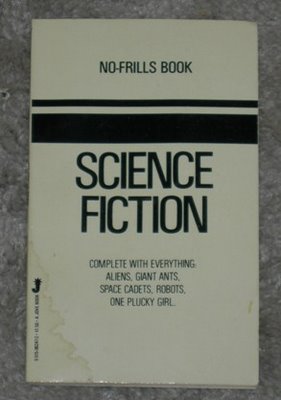
The idea that "only excellence is accepted" is debatable. How many of us have tried to read a book, only to discover that it's poorly written? I've done that as recently as last week, when I read that No Frills Book: Science Fiction travesty. The fact that it was meant to be a parody of pulp / space opera cliches did not excuse the book's many shortcomings. It met whatever standard its publisher required, but no one, probably not even the story's author, would claim that the standard it met was one of excellence.

That said, it is true that a writer with no name recognition or track record needs to be at least as good as established writers to get professionally published, if not more so. A well-known name on a book will guarantee more copies sold than an unknown one, so the work needs to have other qualities to compensate. But that doesn't mean you have to outwrite a J. K. Rowling, a Robert Jordan or a Stephen King to get a shot.

On the rejection front, I admitted in comments that I know the emotional toll of this very well:

Yes, rejection letters hurt, especially if you're not thick-skinned about such things - and I'm not. It's hard not to take it personally, but you shouldn't.

A rejection slip means simply that on that particular day, the editor or publisher decided not to buy that particular work. Most of the time, you'll never know why this is the case. The budget and publishing schedule may mean that the editor can only buy six titles this year that aren't already contracted for - and yours would be the seventh. Or maybe the editor just bought a book about a pair or royal twins, and doesn't want to publish another one at this time. Or the first reader didn't care for the cover letter and first two pages, and didn't read any further. Or the book's tone is too serious or too silly for the editor's taste. Or the market is currently glutted with poorly-selling books in your particular book's subgenre. Or...well, you get the idea. Maybe the book really wasn't "good enough" by that particular publisher's standards, but that's not the only possible reason for the rejection.

Even if it is the reason, that doesn't necessarily mean that no other publisher would ever want it, or that you can't make the book better before sending it out again, or that you should give up writing for publication. The book has been rejected, by one publisher (or two, or five, or ten). That doesn't mean you personally have been rejected, or that you can never write anything worthwhile. One thing that everyone agrees about is that virtually all professional and semi-professional writers get work rejected. A Wrinkle in Time, the multi award-winning classic children's book by Madeleine L'Engle, was rejected by virtually every major publisher in existence at that time. It eventually sold because L'Engle met a publisher at a party, who loved the book so much in its uniqueness and challenging material that he bought it, even though he was sure it wouldn't sell. Fortunately for us all, he was wrong about that.

So I, for one, am willing to submit my book to publishers as often if I have to, despite a number of past rejections. I know the book is better than it was when it was rejected before, because I made it better. And if Tor doesn't think it's "good enough," I'll find someone who does. I hope!

Finally, Pat asks,

And if lightening only strikes once? And what is More? Is is writing in journals? Is it writing many letters? What if it's YEARS between writings because... maybe life has to bring the wisdom or the will or whatever it took to come out and write the first time??

and I reply:

More writing is more writing - and yes, blogging counts. I'm a better writer now that I was the day I started Musings. And I'm a MUCH better writer than I was the day I started work on the first book. There is no reason to think that you only had one story in you, and it's over, and every reason to think that more experience writing makes one a better writer.

Just consider what I've been doing for the last several years. I had the first draft of Mages 98% done - and then virtually abandoned it for over two years because I went back to school. During that time, my writing was almost entirely confined to formal essays for school, supplemented toward the end by blogging. Mages languished, but I got pretty good at the essays, which probably contributed to the quality of my online writing. I even learned some things in my schoolwork that I could apply to the prose in my fiction.

Research material

Back in the early 1990s, when Teresa Murray and I sold those articles to Starlog, most of my writing was for fanzines, primarily nonfiction. I eventually got bored with that, until writing about Quantum Leap became an excruciating chore. So what have I been doing most of today? Writing an article about the music of Quantum Leap, because I promised that I would. And you know what? It's not too bad - except that I've spent seven hours doing the research for three quarters of a page of prose.

Four or five hours of watching Quantum Leap yielded only three identifiable songs.

I feel a little guilty that I haven't done as much fiction writing recently as I'd like, but I know that I will get Mages under control, and I will write the sequel and prequel. I know because I've already written a book, and an incredibly long draft of a second one. There's no reason to think that I can't write more books, and do a slightly better job each time I do so.

What I don't believe for a moment is that someone who wrote one book, or a trilogy, is incapable of writing another one. The only exception would be if the person's one book is an autobiography, or if everything the person ever wanted to say is in that one volume. Even then, chances are excellent that someone who stops after one book has chosen to do so. Whatever ability got the person through the first book is still there - if the person cares to use it.

(Actually, reading Shelly's comment below, I must agree that I overstated this last point a bit. There could be a writer's block issue, emotional problems, physical health problems, and other legitimate reasons why someone stops writing after one book. My point, however, is that by and large, if someone stops after one book, it's because the person already said what he or she wanted to say. It's not because the person's talent or skill suddenly dissippated the moment the first book hit the stores.)

Karen

Saturday, March 11, 2006

A Six-Pack of Blogs for Writers

Editor Joe has asked for blog entries directing readers to a "six-pack" of blogs, preferably centered on some sort of theme. Joe did "B" blogs, and Scalzi did sf writers' blogs. Other people have covered other themes. I'm going to do blogs about writing, because that's where my head is at the moment, and I should be able to put together such an entry quickly, before I turn into a pumpkin.

The Write Stuff is our friend Shelly's writing blog, over on LiveJournal. Shelly is best known to J-Bloggers for Presto Speaks!, with all its helpful stuff about blogging, but I've been reading The Write Stuff ever since it was also called Presto Speaks! (Don't ask). Sometimes she just does entries listing named used by spammers, because they are often amusing, and can be used as character names. Other times she'll tell us about what's happening with her own writing, or write an in-depth essay about the writing process, or bad advice given to writers.


Making Light used to be entirely written (aside from comments) by Teresa Nielsen Hayden, an editor with Tor Books. These days there are also entries by her husband, editor Patrick Nielsen Hayden, in whose hands the fate of Heirs of Mâvarin currently lies. Jim Macdonald also contributes. The entries are not always about writing, editing and publishing, but many of them are. Currently on the front page you'll find entries about hamsters, amusing Dublin nicknames, prescription and non-prescription drugs, an attack on food warning labels, the use of uniformed military for partisan purposes (which is illegal), a question about vegans and chalk (this may be an open thread entry), FEMA, why perpetual copyright is a Bad Idea, a boneheaded attempt in Arizona to let students opt out of assignments they find "offensive," lyrics that can be sung to different tunes, the Hugo Awards, snow in Brooklyn, a predatory agency for screenwriters, and truthfulness in non-fiction. The discussion threads are long and lively and literary, with lots of writers hanging out there. Good stuff, and a certified time-sucker.

Writer's Edge, by Georganna Hancock, is about "English words, books and writing." Every day she has something interesting or helpful to writers, whether it's about e-books, press releases, the em-dash, the future of libraries, or weird new ways to do a book signing. In other words, it's chock full of tools for writers and bloggers, and a fun read as well.

A Stop at Willoughby is the prolific Patick's blog about writing--mostly. He recently wrote a series of posts there about racism and publishing, and related issues. The blog name, by the way, comes from an episode of the original version of The Twilight Zone.

CIW: The Other Invisible is the home of Jess's Writer's Weekly Question, in which writers and others are invited to blog about the writing process. Jess doesn't always keep up with the weekly schedule, but the questions are thought-provoking when she does them, and sometimes she does a two-fer. Jess is in academia, which is also interesting to read about. She's about to give an interview to CNN, and the play-by-play on that is an education in itself.

I'm not sure whether to mention Julie's Oh My! She's At It Again! or Julie's Web Journal at Stately Barrett Manor, so I'll mention them both. She writes about her writing in both places, and other stuff. She does a lot of web-related work, but she's also written at least one radio play and other fiction, including but not limited to fan fiction. She has a good, solid take on the business end of writing, but also writes about times when a draft of something is being difficult, and why. When it's done, there is much rejoicing. (Yes, she's a Python fan.)


Honorable mentions: DesLily is currently writing a series about writing, Sara occasionally comes up for air long enough to tell us how her novel is going, and Bea writes about the journaling process, and how the online and offline versions differ. We know that John Scalzi has another blog, Whatever, that deals with his writing a bit more than By the Way does. And Maryanne sometimes gives us tantalizing details about the book she decided not to publish. Last but not least, Mike Porcello, an NYU college student and nephew of my long-dead high school best friend/boyfriend, writes about his writing, among other things. Strong language and mature themes warning on that one, but it's clear the kid can write. Dan would have been proud, I think.

Oh, and I write about writing, too, mostly on my LJ. Hi.

Karen

Tiers and Tyrannies of Writing


Pat, a.k.a. DesLily, wrote an entry on her blog today (AOL version here, BlogSpot version here) about a discussion we had in IM last night about who is a writer and who is not. Like many people who are interested in writing, she seems to have accepted the popular idea that writers are a breed apart, driven by their talent to write, to be "authors." She writes:

I was told once, by a friend who is a published author a few times over, that if you don't burn to write, don't even bother to try to get something published. I pretty much took this to heart, as it wasn't the first time I heard it. But I sometimes wonder how true it is.

Now, there are several messages imbedded in this interpretation of the words of a well-meaning friend, and not one of them is good for the writing. The first is that only a person who writes obsessively, compulsively, is capable of getting work published. The second is that only someone who is both a ) a compusive writer and b) published deserves the title of "writer" or "author" at all. The third is that this is a closed club of writers who are born, not made. No others need apply.

And yet DesLily has written books herself, a whole fantasy trilogy. Encouraged by friends, she wrote and expanded it and finished it, tinkered and polished - and put it away, because she wasn't really a writer.

Balderdash.

On the AOL version of her blog, I commented,

Pretty much the only definition of writing that counts with me is basically the first one there. A writer is one who writes. Period. That means that someone who wrote a trilogy, for Pete's sake, is or at least was a writer, even if she never sent out so much as a query letter. Conversely, a person who has lots of story ideas, hangs out with writers, and has nothing to show for it but a 10 page partial outline written in 1975 and a map her neighbor drew for her, is NOT a writer.

There are higher bars to hurdle, of course. The "published writer" is the next step up, but the easy availability of self-publishing venues, including blogs, has muddied the waters quite a bit on exactly what this means. YOU are a published writer, because you're a blogger.

One more step up: a professionally published writer. To get that one, you have to actually submit something somewhere. Chances are you have to do it a lot, and try to shrug off the inevitable rejection.

Next step, and this is the one you're confused about: "professional writer." Not many writers make their living at it, and some of those who do, including our beloved Scalzi, do commerical writing - PR, technical writing, etc. - rather than relying on storytelling alone to pay the bills. Many well-known writers never gave up their day jobs.

The top rung is "bestselling author" - and that's a function of talent, skill, relentless self-promotion, and a whole lot of luck.

Okay, so I changed metaphors there, from high bar to a ladder analogy, and the subject line of this post has yet another image. But you get the idea. There are different levels of success as a writer, but even at the lowest one, you're still a writer. The other levels are something to work for, if you care to do so, and are legitimate measurements of success in the business of writing. But you have to start with the basic requirement of level one: writing. and you have to keep that part going if you're going to make your way up from there.

The real test of writing is whether complete works are actually being produced, at a level of quality likely to attract readers. The degree to which the writer is inspired, driven, or even previously published is irrelevant. A would-be writer who waits for inspiration will probably produce very little of value. A writer who writes compulsively suffers from a mental disorder called hypergraphia, and may or may not produce anything good. And someone who is deterred from writing by the belief that she doesn't have the right stuff is throwing away the chance to be proven wrong.

What counts, at least in the writing part of being a writer, is the writing itself. You've got to write, and you've got to keep writing until the book, poem, play, magazine article, tv script, whatever - is done. And then you probably need to revise and edit and polish. After that, unless you really only have one story you want to tell (and probably even then), you need to write something else, or at least something more. Your exact schedule, motivations, working method, are all unimportant compared to this one basic requirement.

The great thing that happens as you write is that you get better at it, assuming you have at least a modicum of literacy and good judgment. And maybe you find out you have more stories to tell after all. You may also learn more about the original story you wrote, enough to go back later and make it better. But it all starts with writing, and not believing that you can't do it, and therefore shouldn't even try. That negative stuff is your Inner Weasel talking, and it almost never has anything good to say. Maybe your story will never be optioned in Hollywood, or even sold to a major publisher. But you'll never get there, for sure, if you don't write it, or don't finish it, or don't try to sell it.

Selling the writing is, of course, as big a challenge as the writing itself, and requires different skills. Rejection is an inevitable part of the business end of writing, and that can be very hard on a writer's self-confidence. I speak from experience here. But if you want more than five friends to read it, it's got to be done. If you don't care whether more than five people ever read it, well, then, suit yourself. Getting something professionally published does four things:


  1. It tells you that on a given day, a person whose job it is to select works for publication honestly believed that your work was good enough, and marketable enough, to attract readers who are willing to pay to read your words.
  2. It actually gets your words out to those readers.
  3. It builds name recognition, so that readers and editors will be more disposed to give your words a chance the next time.
  4. It puts a check in your mailbox - usually a small one.
But that's all. It doesn't confer a mystical mantle of authorhood. It doesn't mean your writing is the best it will ever be. And it doesn't get you off the hook from writing something else.


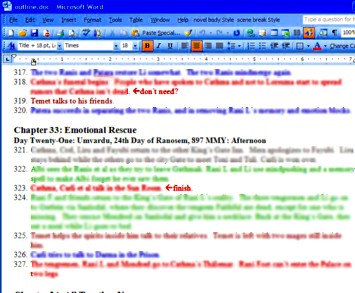
(This is meant to be blurry.)


Yes, this is me ponitificating again, when the fact remains that Mages from Mâvarin is still waiting for me to type up a few missing scenes, and then take on the huge task of making this ridiculously large manuscript consistent and complete and, I hope, a bit shorter, when my history with such things is that they usually get longer. I also need to get on with either the sequel or the prequel, as soon as I possibly can.

See, I can't let myself off the hook, either. I write every single night, albeit mostly just in blogs these days. But for me to be the kind of writer I want to be, and know I can be, I have to continue to get my stories written, revised and edited - and sell the dang things, too.

"I can think of one, maybe two, writers who rely heavily on inspiration. Everybody else I know works like a dog." - Patricia C. Wrede

Karen

P.S. Oh. You may be wondering about the birthday. I had one. Here's photographic evidence. True to my long history of crying on my birthday, I cried on my birthday, and not with joy. But it was nothing important, and it's over, and it's fine. It started well, with cards and presents in my purse from John, and ended well, with lots of nice cards and emails (including gifts from Amazon!) from friends and family, a nice dinner with John at Peking Palace, and unsatisfactory season-ending cliffhangers on Sci-Fi. That'll do nicely - very nicely indeed. Thanks, folks!

Thursday, March 09, 2006

The Math of Life in the Universe; and Happy Birthday to Me

Okay, first of all, I was born something like 12:23 AM on March 10th, 1957, so I declare a free pass for tonight in my getting this blog entry in. It's my birthday, and I'll write if I want to.

Now, on to the Weekend Assignment:

Weekend Assignment #102: Do you honestly think there is life out there in the universe? And if so, what kind of life do you think it is?

Extra Credit: Name your favorite (fictional) alien creature.

Yes, of course. By the numbers, there pretty much has to be life elsewhere in the Universe - but that doesn't mean we'll ever actually meet anyone.

This comes down to a couple of factors, in a concept I first ran across in some non-fiction book about Star Trek many years ago. Was it the Whitfield, or the Gerrold? I don't remember, but the logic of it goes something like this:

1. The Universe, as Douglas Adams famously observed, is an unsettlingly big place. I have a particular Adams quote about this hovering just beyond the edge of my conscious mind, but trust me, he said something really good about it. More famously, he wrote the following, which is quoted all over the Internet, and rightly so:

Space is big. Really big. You just won't believe how vastly hugely mindbogglingly big it is. I mean you may think it's a long way down the road to the chemist, but that's just peanuts to space. Listen...


NASA: http://hubblesite.org/

By the way, in looking for my quote among the many copies of this other quote, I came across a fun parody of Wikipedia. Take a look at its Space page. Neat, huh?

2. In such a big Universe, there's bound to be a lot of worlds. Even though Space is mostly empty, its immense size guarantees that you can still fit Carl Sagan's "billions and billions" of stars in there without making much of a dent in it. I can't be bothered to look up any real numbers, but I figure there's got to be about a quilliard* stars in the galaxy, and there are lots of galaxies. We know that at least some of those stars have planets. We even know for a fact now that at least some of them are what Star Trek called "Class M" planets - planets with the oxygen, nitrogen, carbon, water, temperatures, etc. needed to support life as we know it. A few such places have already been found by astronomers - and the odds are excellent that there are billions more, most of them beyond the reach of our current telescopes.

If just one planet in a thousand can support carbon-based life, and only one planet in a thousand that can support life actually goes ahead and does so, that still makes for lots and lots of planets with life on them. And as evolution takes place on all those planets with life, certain traits are likely to be advantageous on more than a few of them. One of these traits is intelligence. And if you believe, as I do, that one of the reasons God started all this stuff in the first place was to eventually have someone to interact with, it seems likely that that same general evolutionary path will crop up all over. Even without God in the equation, the result is probably the same. I don't mean that every planet will have six-foot tall people with two legs, two eyes and hair on top, but there may well be "people," regardless of what they actually look like. As Adams put it, "The things are also people."

http://hubblesite.org/newscenter/newsdesk/archive/releases/2005/12/image/a


NASA link
Adams has this to say about the math of people in the Universe:

POPULATION OF UNIVERSE : None.
It is known that there are an infinite number of worlds, simply because there is an infinite amount of space for them to be in it. However, not every one of them is inhabited. Therefore, there must be a finite number of inhabited worlds. Any finite number divided by infinity is as near to nothing as makes no odds, so the average population of all the planets in the Universe can be said to be zero. From this it follows that the population of the whole Universe is also zero, and that any people you may meet from time to time are merely the products of a deranged imagination.


On the other hand, some astronomers are now saying that space itself is finite**, although they all agree that it is, in fact, vastly, mindbogglingly big. (Really. They quote that a lot online.)

Therefore, there are a lot of people (and "also people") out there. However, the Universe being the unsettlingly big place it is, you're not likely to meet any of the "also people." Ray Bradbury's Martians and Doctor Who's Ice Warriors aren't going to turn up on the Mars of our version of reality, no matter what may be found by way of water, ice, and ancient microbes. And anything outside our solar system is too far away to get to conveniently, unless we find a useful loophole in the laws of physics as we know them.

186,000 miles per second. It's not just a good idea - it's the law.
- button sold at science fiction conventions

(Hubble image PR99-30B 9/16/99)

Science fiction writers get around this with wormholes and warp drives and hyperspace, tesseracts and Infinite Improbability Drives, Stargates and transmats and other fun stuff. But alas, so far there's little evidence we'll be able to make wormholes do what we want, or build FTL or space-warping devices in Real Life anytime soon.

And any "also people" who might want to "say a big hello to other intelligent life forms" (that's Adams again) run into the same inconvenience. Earth is just too far away to hitchhike to from Damogran, if there is a Damogran. And why would they bother, anyway?

Therefore - any "also people" you might meet are almost certainly the products of a deranged imagination.

Drat.

My answer on the extra credit is the "also people," those fascinating aliens who are close enough to humans to be intelligent and semi-comprehensible, but different enough to be disconcertingly alien and interesting. My favorite of these is probably a particular Gallifreyan, the one with the Type 40 time capsule. I'm also very fond of a couple of guys from somewhere in the vicinity of Betelgeuse***.

Runner-up, a non-humanoid intelligent species: McCaffrey's bioengineered dragons.

Karen

* "A quilliard is a whole page full of noughts with a one at the beginning." - Ford Prefect, the Hitch-Hiker's Guide to the Galaxy (tv series)
**at least, according to Woody Allen
***Ford Prefect, formerly known as Ix, and Zaphod Beeblebrox the Nothingth. But only the book, radio, LP, audiotape and tv versions, not the film ones. The Gallifreyan is, of course, the Doctor.

Wednesday, March 08, 2006

Sign Up and Sign In

I've run late the last two nights, and my cardiac stress test is in the morning, and it's 11:22 PM already; so I'm going to rush this entry a bit. In theory, IE and Blogger are uploading my pictures now. I'll believe it when I see it. It didn't work on Netscape the last several times I tried to upload photos onto Blogger. I had to host them elsewhere, and crib the HTML to display them the way I wanted.

Hey, it worked! That's one less problem to deal with tonight.

All right. Next Wednesday, March 15th, is the posting date for the next Round Robin Challenge. The topic, as chosen by Kimberleigh of "I Shaved My Legs For This?" is "Signs." That should be fun! Signs are all around us - vintage signs, temporary signs, signs of the times, signs we should have read but didn't, warning signs, funny signs, colorful signs, plain signs, even signs you can generate online. What signs have the most meaning or beauty or amusement value for you? Here's one that means a lot to me:

I've shown you this sign before, but the picture is new, taken today with the new Nikon camera. The poor, dilapidated sign promises "31 Merchants to Serve You." I'm sure the 31 merchants existed, decades ago; but the shopping center has changed greatly since then, with one wing added and another, longer one bulldozed into a long-lost past. But the sign is still there. I feel sorry for it somehow.

As the song says, I've "made my own little sign." It's Round Robin time, folks! Well, not yet, but it will be, on Wednesday the 15th. That gives you nearly a week to find some signs that amuse, inspire, affront or intrigue you, and take a picture or two (or five, or ten). Everyone's welcome to join in! All we ask is that you read the simple rules in the Round Robin blog, and RSVP in the "Signs" blog entry so that we can link to you. Okay? Okay!

Speaking up the new camera, I decided to mess around with that time traveling car some more. Here it is in Leap Blue:


And one other bit of news tonight. I'll skip over the health update, and whine about something else. John Scalzi linked to a LiveJournal entry by a Tor submissions editor, giving guidelines that go beyond what's in the official posted ones. I did not conform to them all, I'm chagrined to say. For example, she wants the three chapters submitted to total sixty pages or less. Heck, my first two chapters exceed that. In fact, my submission package is longer than this whole book:


Then again, it's an extraordinarily short book.

Stress? Yep, I've got stress - even before I jump on a treadmill in the morning at TMC.

Karen

*******

Update: The submissions editor replied to my comment, promising that no one would reject my book on the basis of my minor faux pas. And the stress test went fine. There's nothing at all wrong with my heart. (I did get a minor asthma attack from the exertion, but I daresay they didn't even notice this.) So the next question is, is the leg thing all due to my weight, my allergies and my falling in the street a couple of weeks ago? Or is there something else involved? Will I ever know? Does it even matter? All things considered, I may be one of the healthiest people I know, even with the itchy leg and swollen ankle. - K.

I mean it must be high or low

Click the entry title above for a web page with a nice Strawberry Fields Forever midi.

I'm sitting here with my new Nikon Coolpix P1 on the laptop in front of me, waiting for something called PictureProject to finish importing all the pictures in My Pictures so that the computer software and hardware can get around to noticing that the camera is plugged into the computer via USB. In theory, I should be able to transfer my first handful of pictures from the Nikon in this way. But first I have to wait. 6251 pictures imported and counting...!

So that's the big news of the day. John stopped at Costco after work and got the camera, the new Harry Potter DVD and the My Neighbor Totoro DVD. (Thank you, thank you, thank you, John!) Then I went to Best Buy to get an SD memory card. Since then I've been following the "Quick Start" instructions, taking a few pictures, and installing software. It's great, it's wonderful, I'm very happy - but it's time intensive. So now it's 10:30 PM,and I need to rush to write this entry and get the photos transfered and uploaded by midnight. (Didn't make it! Drat!)

7293 and counting.

The other news of the day is that the infamous postcard arrived from the doctor's office. The remarkable thing about it is not that my HDL was 71, my LDL was 112 and my triglycerides were 118. No, the remarkable part is that other than a squiggle next to the printed words "Your laboratory tests were all normal (meaning that they were), there is no further indication that they tested for anything else at all. Was my blood sugar high or low? Did they check? What about the mild anemia that made the Red Cross turn me away twice so far this year? Do I have hypothyroidism, even mildly? I think that under the circumstances these are reasonable questions to ask. I mean, as long as they're going to struggle mightily to get blood out of my half-hidden, undersized, rolling veins, shouldn't they be testing for something that might explain why my legs and ankles are still swollen with fluid, and red and itchy and awful? Wasn't that kind of the point of the exercise?

Last week, when they told me they mailed a postcard instead of bothering to call, I thought it at least meant that certain possible conditions had been eliminated, such as diabetes. Now I realize it doesn't rule out anything except atherosclerosis - maybe.

9746 pictures imported. Total. That doesn't count the many pictures in my two web folders, or the Sherlock art in my "mavarin" folder, or stuff I moved off the computer onto CD. Now Nikon is downloading an update to some software or other.

Blogger said it imported five photos, but they did not appear in this edit posts window. But I'm going to introduce them anyway, and then try to get them in here somehow.


The obligatory stuff-that-came-with-the-camera photo, picture number one.


More books I missed last night: the bookshelves at my elbow, beneath the printer...


...and the stack o' books to be put away.


And of course I had to photograph Tuffy. This one is a little unusual because she's looking at John instead of me and the camera. No doggie-flash-eye!


and finally...


Now it can be told: my car is a time machine. You didn't think I actually made up that stuff about Future Karen and the picnic with presidents Jefferson and Madison, did you?

Next time: Signs - a Round Robin Reminder! (tm)

Karen

Monday, March 06, 2006

Which Bookshelf?

Your Monday Photo Assignment: Show us what's in your bookshelf right now. That's right, right this very second!

Oh, the things I do for you guys! Or, more likely, to satisfy my obsessions and feed my ego. You've seen pictures of bookcases at Casa Blocher before. More than likely, you've seen most of these very same books in those pictures. Nevertheless, despite the fact that most of these new photos are almost identical to the old ones in content, despite the fact that I'm woefully out of practice using the old Mavica, I took the pictures anyway. Here's what I had to do to get these lousy, blurry, repetitive photos to you:

  1. Find a floppy that was neither completely full nor unreadable.
  2. Put it in the Mavica.
  3. Light up each bookcase as best I could.
  4. Take flash pictures.
  5. Find another working floppy, because the first one was full now.
  6. Take the last two photos.
  7. Put the floppies in my purse, and hope I didn't wreck 'em.
  8. Drive to work, park, get in with my security pass, go upstairs.
  9. Transfer files from 2002 through 2006 from floppies into a folder on my desktop at work.
  10. Sign into AOL.
  11. Use the AOL Web mail client to email the files home, eight files at a time in six emails.
  12. Drive home.
  13. Download the files from email and organize them into folders - old school stuff, old web stuff, 2002 pictures, 2006 pictures.
  14. Edit the 2006 photo files, while getting bummed out at their poor quality.
  15. Start writing the blog entry in Composer, because Blogger is apparently down again.
  16. Upload the photos to mavarin.com, because I don't trust Blogger right now.
  17. Force quit Netscape, which froze up, and hope to heck I could "recover post" from I.E. Yay! It worked! Oh, foo. Half of it's missing.
Now my question is, what bookshelf do you have in mind? There's the built-in bookcase in my office, the one with the L'Engle books, the rare T.H. White books and the neglected accounting review books:


And there are two bookcases in the den, one of which is currently buried behind boxes of stuff that came out of storage while John does some wallpapering. The one on the right is currently visible, though:


From our "Museum of the Weird" file, I'd like to point out the Better Homes and Gardens barbecue and decorating books from circa 1960 (middle shelf on the left), birding books, some rare Ellisons (Harlan, not Ralph, top shelf), and retro books with titles like Atomic Home and Tiki Road Trip (middle shelf, middle).

There's more cool stuff in the living room and bedroom bookcases, but it's almost midnight, and the computer ate my descriptions.


Bedroom: mostly Tolkien and other fantasy.


Living room: Doctor Who and Quantum Leap.


living room #2
Living room, second bookcase: Tiki mugs, Chevron cars, Piers Anthony, Peanuts & Babylon 5 books, and Ranma 1/2 videos. Ranma is about a boy who turns into a girl when he gets wet. (And his father turns into a panda, one of his fiancees becomes a cat, and his rival turns into a little black pig!)

Not shown here are the bookshelves in my office closet, where the McCaffrey books are; the room divider in the living room, where most of the Thurber and Disney books are; John's bookcases in his office and the bedroom; my two bookcases full of tv scripts and magazines and oversided Doctor Who books; innumerable books in boxes, even after several major purges; a couple stacks of unshelved books in my office; and the No Frills Book: Science Fiction paperback in the bathroom.

And for all that, I haven't satisfied John Scalzi's original question, which is, "So, what are you reading? I want the visual evidence." If it's on a bookshelf, I'm not currently reading it. The two Meg Cabot books I just read or reread are floating around the house, waiting to be put away. The Grand Tour: Being a Revelation of Matters of High Confidentiality and Greatest Importance, Including Extracts from the Intimate Diary of a Noblewoman and the Sworn Testimony of a Lady of Quality by Patricia C. Wrede and Caroline Stevermer, which I started reading the night the latest Harry Potter came out, but didn't actually buy until months later, is, well, um...I think it's probably under these church bulletins and other papers on my desk. And I'm halfway through the so-called "generic" sf parody book.


The book I'm actively reading right now is The House Teridel (working title) by Sara G. I'm beta reading it, demanding more scenes as fast as Sara can turn them out. Although she had the basic idea for the story years ago, she just started actually writing it in novel form this past fall, and just passed 100,000 words of manuscript. And I tell you honestly, if The Tengrim Sword was as good in its first full draft as this is turning out to be, it would have been published years ago. Brava, Sara!

Karen